USTR Retains India on Priority Watch List in IP Report
Source:The Hindu ↗
ఇది ఎందుకు ముఖ్యం
The issue of Intellectual Property Rights (IPR) is a core component of the GS3 syllabus. The persistent inclusion of India on the US 'Priority Watch List' highlights the friction between developed nations demanding strict IP protection and developing nations prioritizing public welfare and affordable access to essentials like medicines. Understanding these competing interests, the nuances of the TRIPS agreement, and the geopolitical implications of trade disputes is essential for Mains answers on economy, trade, and international relations.
సారాంశం
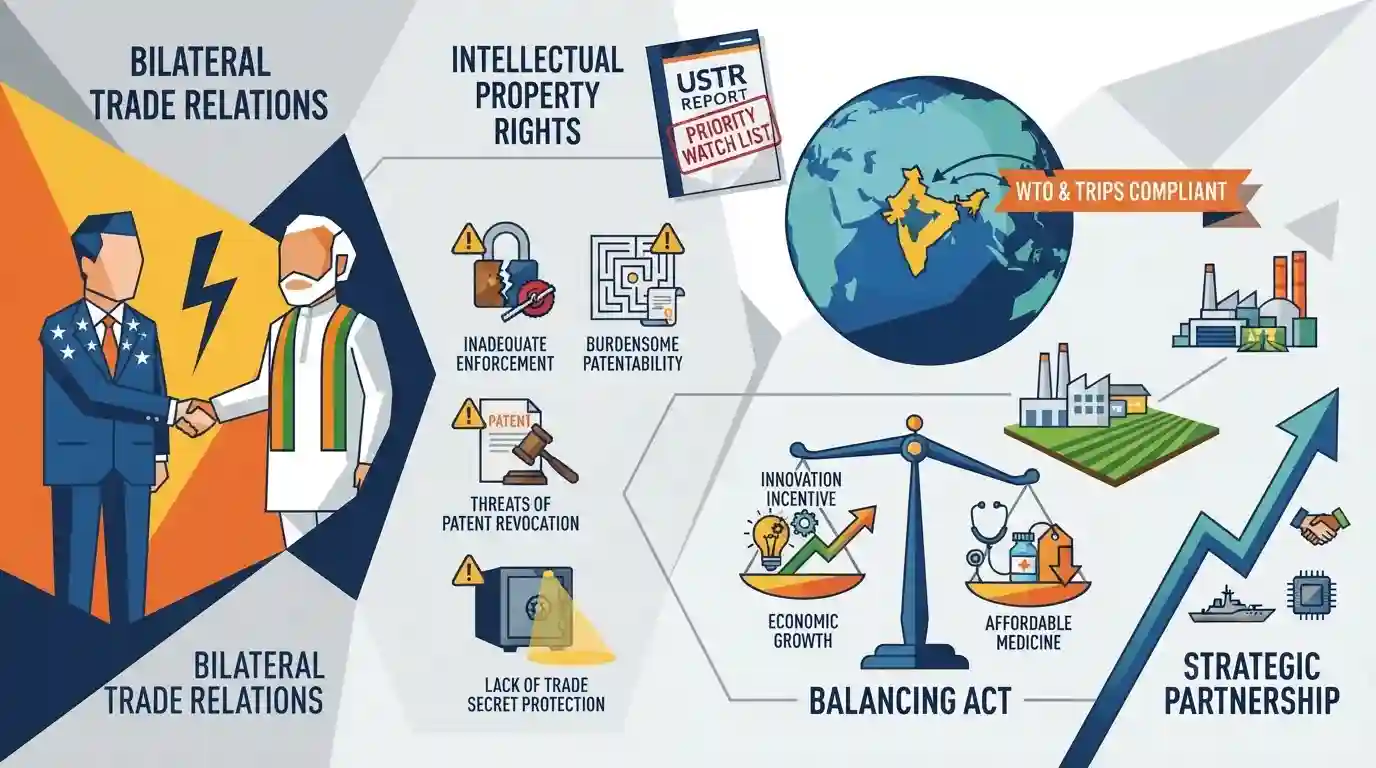
The United States Trade Representative (USTR) has once again placed India on its 'Priority Watch List' in the 2024 Special 301 Report, citing ongoing concerns about India's intellectual property (IP) regime. The US allegations focus on inadequate IP enforcement, burdensome patentability criteria, threats of patent revocation, and the lack of a comprehensive legal framework for protecting trade secrets. India has consistently rejected these unilateral assessments, maintaining that its intellectual property laws are fully compliant with the World Trade Organization's (WTO) Trade-Related Aspects of Intellectual Property Rights (TRIPS) agreement. India argues that its IP framework carefully balances the need to incentivize innovation with broader public interest objectives, particularly in ensuring access to affordable healthcare and protecting agricultural livelihoods. The persistent disagreement over IP rights remains a notable irritant in bilateral trade relations, even as the broader India-US strategic partnership continues to deepen.
ముఖ్య అంశాలు
- The US Trade Representative (USTR) has retained India on its 'Priority Watch List' for Intellectual Property (IP) protection and enforcement in its 2024 Special 301 Report.
- The USTR cites issues like inadequate IP enforcement, patent revocation threats, high customs duties on IP-intensive products, and lack of trade secret protection.
- India maintains its IP regime complies with WTO's TRIPS agreement and balances IP protection with public interest, especially in pharmaceuticals and agriculture.
- India objects to being placed on the Priority Watch List, arguing the Special 301 Report is a unilateral US mechanism not recognized by the WTO.
- The ongoing friction over IP rights highlights broader trade tensions between India and the US, despite growing strategic and economic ties.
ముఖ్యమైన పదాలు
Special 301 Report

An annual U.S. report identifying trade partners whose intellectual property regimes are deemed inadequate by American standards. It classifies countries on a "Watch List" or "Priority Watch List" for targeted bilateral engagement.
UPSC context
GS Paper 2 (IR) / GS Paper 3 (Economy). Tests knowledge of Indo-US trade disputes over intellectual property rights.
TRIPS Agreement
A foundational World Trade Organization agreement that establishes minimum global standards for protecting and regulating intellectual property forms, such as patents, copyrights, and trademarks, among all member nations.
UPSC context
GS Paper 3 (Intellectual Property). Tests awareness of WTO obligations, patent laws, and public health flexibilities like compulsory licensing.
Protection of Trade Secrets Bill, 2024
Draft legislation proposed by India's 22nd Law Commission to create a dedicated civil framework protecting confidential business information against misappropriation, while maintaining exceptions for public interest and compulsory licensing.
UPSC context
GS Paper 3 (Economy/IPR). Tests understanding of India's evolving IP framework and legal responses to international concerns regarding trade secrets.
United States Trade Representative (USTR)
The U.S. government agency within the Executive Office of the President responsible for developing international trade policy, negotiating trade agreements, and resolving trade disputes with foreign partners.
UPSC context
GS Paper 2 (International Relations). Tests knowledge of key institutional actors shaping US-India bilateral trade relations and negotiations.
ప్రిలిమ్స్ ఉచ్చు
The Special 301 Report is a WTO-mandated annual multilateral audit of global intellectual property compliance.
The Special 301 Report is a unilateral US domestic legal mechanism under its Trade Act of 1974. It has absolutely no standing, mandate, or endorsement under the WTO framework.
అనుసంధానమైన స్థిర భావనలు
What is Section 3(d) of the Indian Patents Act, 1970?
- Anti-Evergreening: Prevents 'evergreening' by barring patents on minor modifications of known substances unless they show significantly enhanced efficacy.
- Therapeutic Efficacy: The Supreme Court interpreted 'efficacy' strictly as 'therapeutic efficacy' for pharmaceuticals in the landmark Novartis Glivec case (2013).
- TRIPS Flexibility: Maintains compatibility with TRIPS flexibilities, allowing India to protect public health while recognizing genuine innovation.
What is Compulsory Licensing (CL) under international and Indian law?
- Definition: A mechanism allowing governments to license generic production of a patented drug without the patent owner's consent under specific conditions.
- Doha Declaration: Reaffirmed by the 2001 Doha Declaration as a valid public health tool that WTO members are free to determine the grounds for.
- Indian Provision: Governed by Section 84; India has issued it only once (in 2012 to Natco Pharma for Bayer's cancer drug Nexvar).
అంతర-అంశ నమూనాలు
IPR vs. Right to Health
Balances India's constitutional Right to Health (Article 21) and generic medicine access with international TRIPS commitments, shaping global South pharma policy.
Unilateralism vs. WTO Multilateralism
US domestic tools like Special 301 bypass the WTO multilateral dispute settlement system, highlighting the tension between bilateral trade pressure and multilateralism.

Expect questions linking Section 3(d) of Patents Act, Compulsory Licensing, and TRIPS flexibilities to generic pharmaceutical dominance.
అనుసంధాన PYQలు · 3
అనుసంధాన PYQలు · 3
- 2014MainsGS3
In a globalized world, Intellectual Property Rights assume significance and are a source of litigation. Broadly distinguish between the terms-Copyrights, Patents and Trade Secrets.
- 2023MainsGS3
What are the direct and indirect subsidies provided to farm sector in India? Discuss the issues raised by the World Trade Organization (WTO) in relation to agricultural subsidies.
- 2023PrelimsGS1
Consider the investments in the following assets: 1. Brand recognition 2. Inventory 3. Intellectual property 4. Mailing list of clients How many of the above are considered intangible investments?
