Disappearing Lakes in India and Public Trust Doctrine Implications
Source:Indian Express ↗
Why It Matters
Disappearing urban and rural lakes directly affect water security and urban flood resilience, recurring themes in UPSC Mains (e.g., GS1 water bodies reclamation, GS3 urban flooding). The 2025 Supreme Court ruling on the Public Trust Doctrine provides a highly relevant constitutional argument for GS2 governance and GS3 environmental conservation answers.
Summary
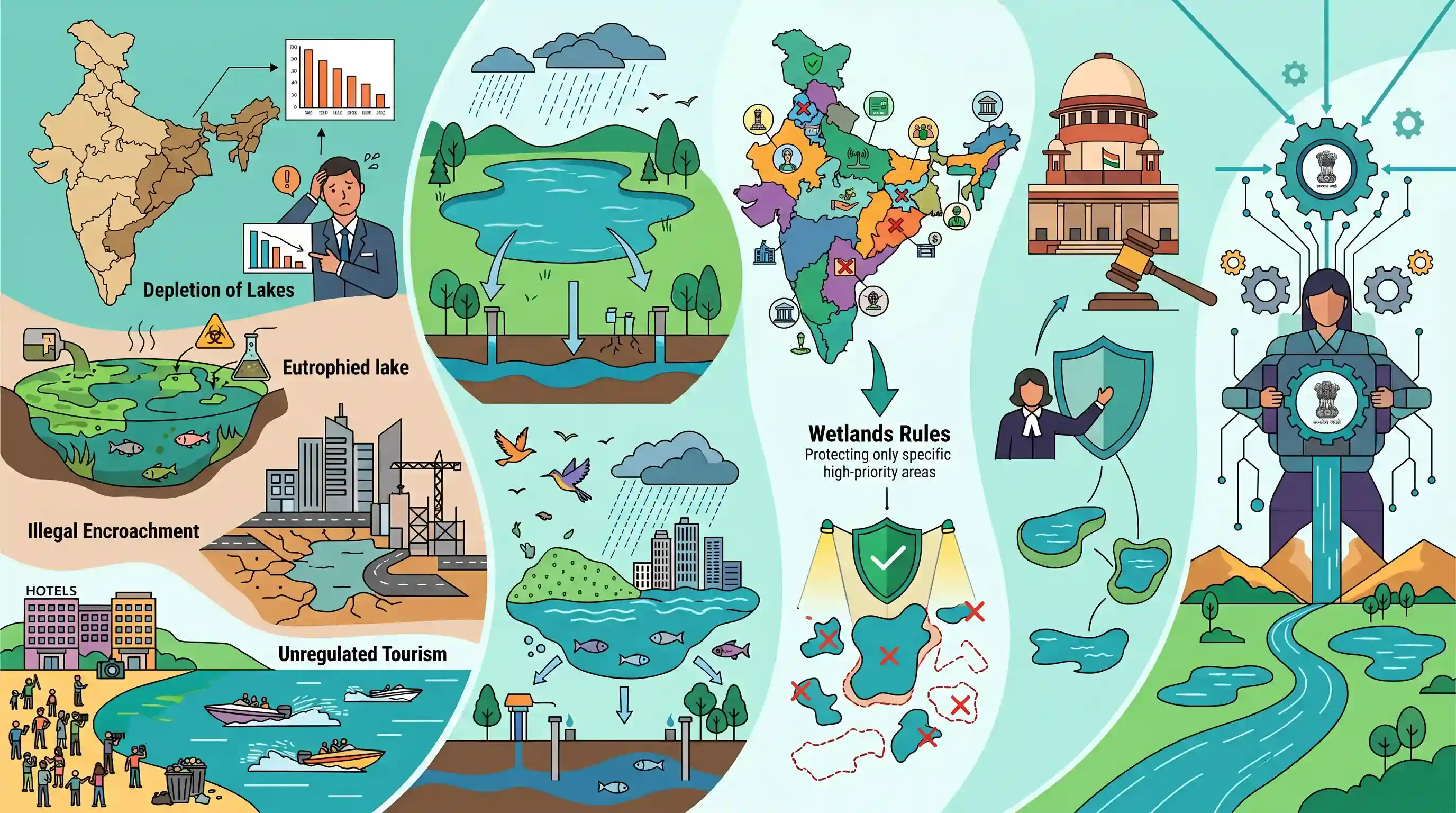
The article analyzes the rapid depletion of lakes in India due to human interference, highlighting their socio-ecological importance for groundwater recharge, flood regulation, and biodiversity. Citing a CAG report that found hundreds of lakes vanished in Jammu & Kashmir alone, it points to eutrophication, illegal encroachment, and unregulated tourism as primary threats. The piece emphasizes significant governance challenges, noting that water is a State subject and the Wetlands Rules 2017 mainly protect Ramsar sites, leaving many urban water bodies vulnerable. It underscores the Supreme Court's recent 2025 ruling that expands the Public Trust Doctrine to artificial lakes, calling for a dedicated national legal framework and statutory nodal authority to prevent further ecological loss.
Key Points
- Lakes provide 90% of Earth's surface freshwater and serve critical functions such as groundwater recharge, flood buffering, and biodiversity conservation.
- A CAG report reveals widespread lake disappearance, with 315 out of 697 lakes in Jammu & Kashmir vanishing since 1967.
- Major threats include eutrophication from urban sewage and agricultural runoff, illegal sand mining, and the conversion of lakebeds for real estate.
- The 2025 Supreme Court ruling in 'Swachh Association vs State of Maharashtra' expanded the Public Trust Doctrine, making the state responsible for protecting both natural and artificially created lakes.
- Current governance is fragmented because water is a State subject, and the Wetlands (Conservation and Management) Rules, 2017 primarily cover designated Ramsar sites.
- A dedicated central legislation, rigorous scientific mapping, and the strengthening of the National Programme for Conservation of Aquatic Eco-systems (NPCA) are essential for holistic lake conservation.
Important Terms
Public Trust Doctrine

A legal principle holding the State as a trustee for natural resources like rivers and lakes, ensuring they are preserved for public use rather than private ownership.
UPSC context
GS Paper 2 (Judiciary) and Paper 3 (Environment); tests understanding of evolving environmental jurisprudence and the 2025 expansion to artificial lakes.
Wetlands (Conservation and Management) Rules, 2017
A regulatory framework under the Environment Protection Act 1986 that decentralizes wetland management to State Wetland Authorities and emphasizes the 'wise use' of notified water bodies.
UPSC context
GS Paper 3 (Environment); tests knowledge of domestic environmental legislation and its limitations in protecting non-notified urban water bodies.
National Programme for Conservation of Aquatic Eco-systems (NPCA)
A centrally sponsored scheme formed by merging the National Lake Conservation Plan and National Wetlands Conservation Programme for the holistic restoration of aquatic ecosystems.
UPSC context
GS Paper 3 (Water Management); crucial for questions on government interventions and funding for ecosystem restoration.
Comptroller and Auditor General of India (CAG)
A constitutional authority that audits government expenditure; its 2024/2025 reports highlighted the disappearance of 74% of lakes in Jammu & Kashmir due to governance failure.
UPSC context
GS Paper 2 (Constitutional Bodies); tests the role of oversight institutions in ensuring environmental accountability.
Ramsar Convention
An intergovernmental treaty providing the framework for national action and international cooperation for the conservation and wise use of wetlands of international importance.
UPSC context
GS Paper 3 (Conservation); high-frequency topic for Prelims and Mains regarding international environmental agreements and protected sites.
Environment Protection Act, 1986
Umbrella legislation enacted to provide for the protection and improvement of environment; it serves as the parent act for the Wetlands Rules, 2017.
UPSC context
GS Paper 3 (Environmental Laws); fundamental for understanding the statutory powers of the Central Government in environmental regulation.
Prelims Trap
"The Public Trust Doctrine under Indian environmental jurisprudence applies exclusively to naturally occurring water bodies and ecosystems."
The 2025 Supreme Court ruling explicitly expanded the Public Trust Doctrine to include artificial/man-made lakes, making the state a trustee for their protection too.
Static Concepts Connected
What is the Public Trust Doctrine in Indian environmental law?
- Origin: Introduced into Indian jurisprudence via the M.C. Mehta v. Kamal Nath (1997) case, originally rooted in Roman law.
- Core Principle: The state acts as a trustee of natural resources (air, water, forests) for public use, rather than an absolute owner.
- Restriction on State: It restricts the state from transferring ecologically significant resources to private ownership if it deprives the public of their use or harms the environment.
What are the key exclusions under the Wetlands (Conservation and Management) Rules, 2017?
- Rivers & Agriculture: River channels and paddy fields are explicitly excluded from the definition of wetlands under these rules.
- Man-made structures: Water bodies specifically constructed for drinking water, aquaculture, salt production, recreation, and irrigation are excluded.
- Coastal Zones: Wetlands falling within the Coastal Regulation Zone (CRZ) are excluded, as they are governed by separate CRZ notifications.
Cross-Topic Patterns
Urban Flooding & Disappearing Sinks
The loss of urban lakes directly connects to GS3 Disaster Management questions on recurrent urban flooding (e.g., Chennai, Bengaluru), as the destruction of natural drainage sponges exacerbates climate-induced rainfall events.
Federalism in Water Governance
Since 'Water' is a State List subject (Entry 17), the implementation of central conservation schemes like NPCA often reveals friction between state priorities (real estate) and central environmental guidelines.

Expect a Prelims statement testing if the Public Trust Doctrine covers artificial lakes, combined with Wetlands Rules 2017 exclusions.
Linked PYQs · 4
Linked PYQs · 4
- 2021MainsGS1
What are the environmental implications of the reclamation of water bodies into urban land use ? Explain with examples.
- 2024MainsGS3
Flooding in urban areas is an emerging climate-induced disaster. Discuss the causes of this disaster. Mention the features of two such major floods in the last two decades in India. Describe the policies and frameworks in India that aim at tackling such floods.
- 2018MainsGS1
The ideal solution of depleting ground water resources in India is water harvesting system." How can it be made effective in urban areas?
- 2019PrelimsGS1
Consider the following statements: 1. Under Ramsar Convention, it is mandatory on the part of the Government of India to protect and conserve all the wetlands in the territory of India. 2. The Wetlands (Conservation and Management) Rules, 2010 were framed by the Government of India based on the recommendations of Ramsar Convention. 3. The Wetlands (Conservation and Management) Rules, 2010 also encompass the drainage area or catchment regions of the wetlands as determined by the authority. Which of the statements given above is/are correct?
