National Family Health Survey Omissions and Policy Governance
Source:Indian Express ↗
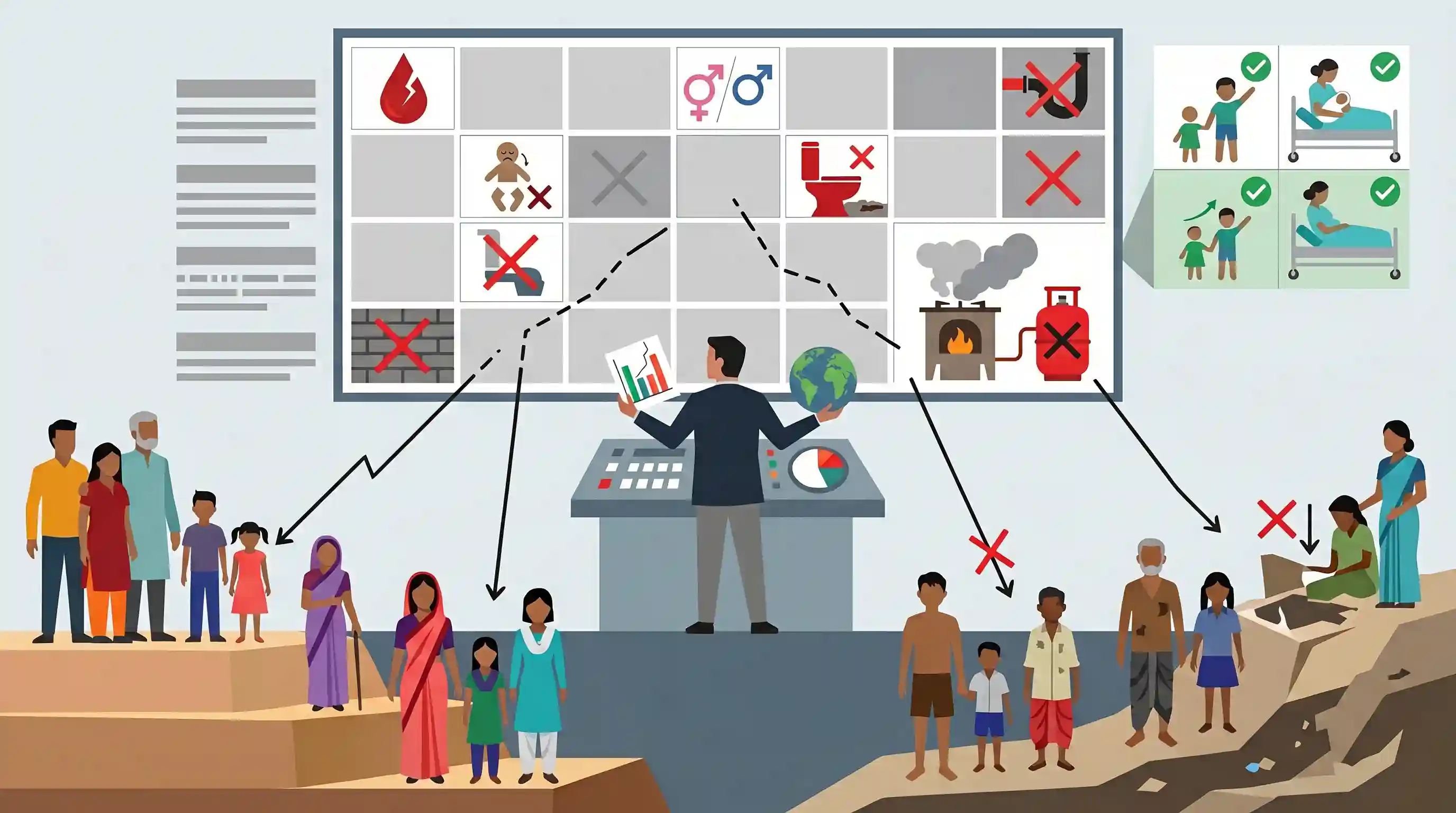
Why It Matters
The article raises fundamental questions about data integrity, governance, and structural challenges in policy monitoring. Understanding how missing public health indicators affect welfare interventions like POSHAN Abhiyaan and Anaemia Mukt Bharat is essential for addressing GS Paper 2 questions on health, governance, and human capital.
Summary
The National Family Health Survey-6 (NFHS-6) has omitted 43 critical public health, demographic, and sanitation indicators—including anaemia, child mortality, sex ratio at birth, improved sanitation, and clean cooking fuel access. While NFHS-6 highlights notable achievements such as a reduction in stunting (to 29.3%) and a rise in institutional deliveries (to 90.6%), the exclusion of key metrics severely constrains data-driven governance. These omissions restrict the ability of policymakers to evaluate public health schemes, track social disparities, and formulate targeted interventions for vulnerable populations, especially given that nutritional and sanitary outcomes are deeply gendered and socio-economically stratified.
Key Points
- The National Family Health Survey (NFHS), launched in 1992-93, is conducted under the Ministry of Health and Family Welfare with the IIPS as the nodal agency, funded as part of USAID\'s global DHS programme.
- NFHS-6 data shows overall progress: India\'s Total Fertility Rate (TFR) has stabilised at 2.0 (below the replacement level of 2.1); stunting has declined from 35.5% to 29.3%; institutional births have increased to 90.6%; and child immunisation has risen to 87.1%.
- A total of 43 vital indicators present in previous rounds have been omitted from NFHS-6, including all 7 indicators measuring anaemia, sanitation, child mortality, sex ratio at birth, and clean cooking fuel access.
- The exclusion of anaemia metrics is particularly alarming since NFHS-5 showed that 67% of children and 57% of women of reproductive age were anaemic, representing a severe public health crisis.
- Omiting clean cooking fuel and improved sanitation indicators limits the ability of policy makers to track progress under schemes like PM Ujjwala Yojana and the Swachh Bharat Mission.
- The omission coincides with structural changes, such as the Ministry of Consumer Affairs discontinuing iron fortification of rice in February 2026, amid debate over its scientific validity.
- The lack of granular, caste-class-segregated social data on health hampers targeted social welfare interventions, since health, nutrition, and sanitation outcomes are highly gendered and socially stratified.
Important Terms
National Family Health Survey (NFHS)

A large-scale, multi-round survey conducted across India providing high-quality, district-level data on population, health, nutrition, and family welfare to guide evidence-based policy.
UPSC context
GS Paper II (Governance/Health) & GS Paper III (Poverty); tests data-driven policy evaluation and developmental indicators.
International Institute for Population Sciences (IIPS)
A premier Mumbai-based academic and research institute under the Ministry of Health and Family Welfare, serving as the nodal agency for conducting the National Family Health Survey.
UPSC context
GS Paper II (Institutions/Governance); tests understanding of organizations producing vital demographic and national health statistics.
Anaemia Mukt Bharat
A flagship health initiative launched in 2018 under POSHAN Abhiyaan, aiming to reduce anaemia among vulnerable groups—including children, adolescents, and women—using a target-based "6x6x6" strategy.
UPSC context
GS Paper II (Welfare Schemes/Health); tests awareness of national programs targeting micro-nutritional deficiencies and maternal health.
POSHAN Abhiyaan (National Nutrition Mission)
India's flagship multi-ministerial convergence mission launched in 2018 to improve nutritional outcomes for children, pregnant women, and lactating mothers by reducing stunting, wasting, and underweight.
UPSC context
GS Paper II (Social Sector-Hunger/Health); tests understanding of multi-sectoral strategies to combat chronic malnutrition.
Swachh Bharat Mission
A nationwide campaign launched in 2014 to eliminate open defecation, improve solid waste management, and establish "Open Defecation Free" (ODF) status across Indian rural and urban areas.
UPSC context
GS Paper II (Governance/Schemes); tests awareness of hygiene, public sanitation policies, and rural-urban developmental interventions.
Pradhan Mantri Ujjwala Yojana (PMUY)
A welfare scheme launched in 2016 to provide deposit-free LPG connections to women from below-poverty-line households, promoting clean cooking fuel and reducing indoor air pollution.
UPSC context
GS Paper II (Welfare Schemes) & GS Paper III; tests energy access policies and women’s health-centered development.
Prelims Trap
The National Family Health Survey is conducted by MoSPI and funded entirely through domestic budgetary resources.
NFHS is conducted under the Ministry of Health and Family Welfare (MoHFW) with IIPS as the nodal agency, and is partially funded by USAID's DHS program.
Static Concepts Connected
What is Total Fertility Rate (TFR) and Replacement Level Fertility?
- TFR Definition: The average number of children a woman would have during her reproductive years under current age-specific fertility rates.
- Replacement Level: The rate (typically 2.1) at which a population replaces itself from one generation to the next without migration.
- India's Status: NFHS-6 shows India's TFR has declined to 2.0, below the replacement rate, signaling long-term population stabilization.
What is the status and role of the International Institute for Population Sciences (IIPS)?
- Establishment: Established in Mumbai in 1956, it operates under the administrative control of the Ministry of Health and Family Welfare.
- Academic Status: It was declared as a 'Deemed to be University' in 1985 under Section 3 of the UGC Act, 1956.
- Core Mandate: Serves as the premier hub for population studies and is the designated nodal agency for conducting surveys like NFHS.
Cross-Topic Patterns
Data deletion vs. SDG monitoring
Dropping anaemia and sanitation metrics limits India's ability to empirically self-report progress under UN Sustainable Development Goals, specifically SDG 3 (Good Health) and SDG 6 (Clean Water and Sanitation).
Nutritional interventions and scientific dissent
The convergence of halting iron-fortified rice distribution and dropping anaemia tracking highlights deep inter-departmental policy conflicts regarding scientific evidence and administrative intervention.

GS-2 questions in 2026 may ask how the dilution of empirical health surveys impacts targeted welfare funding under cooperative federalism.
Linked PYQs · 3
Linked PYQs · 3
- 2023PrelimsGS1
Consider the following statements in the context of interventions being undertaken under Anaemia Mukt Bharat Strategy: 1. It provides prophylactic calcium supplementation for pre-school children, adolescents and pregnant women. 2. It runs a campaign for delayed cord clamping at the time of child-birth. 3. It provides for periodic deworming to children and adolescents. 4. It addresses non-nutritional causes of anaemia in endemic pockets with special focus on malaria, hemoglobinopathies and fluorosis. How many of the statements given above are correct?
- 2017PrelimsGS1
Which of the following are the objectives of 'National Nutrition Mission'? 1. To create awareness relating to malnutrition among pregnant women and lactating mothers. 2. To reduce the incidence of anaemia among young children, adolescent girls and women. 3. To promote the consumption of millets, coarse cereals and unpolished rice. 4. To promote the consumption of poultry eggs. Select the correct answer using the code given below:
- 2024MainsGS2
Poverty and malnutrition create a vicious cycle, adversely affecting human capital formation. What steps can be taken to break the cycle ?
