Constitutional and Statutory Challenges Facing the New Waqf Law
Source:Indian Express ↗
Why It Matters
The administration of religious endowments is a critical intersection of fundamental rights, minority protections, and state regulation. The ongoing legal debate over the Waqf law is highly relevant for GS Paper 2 (Polity and Governance), touching on the autonomy of statutory bodies, secularism, and constitutional guarantees for religious denominations to manage their properties.
Summary
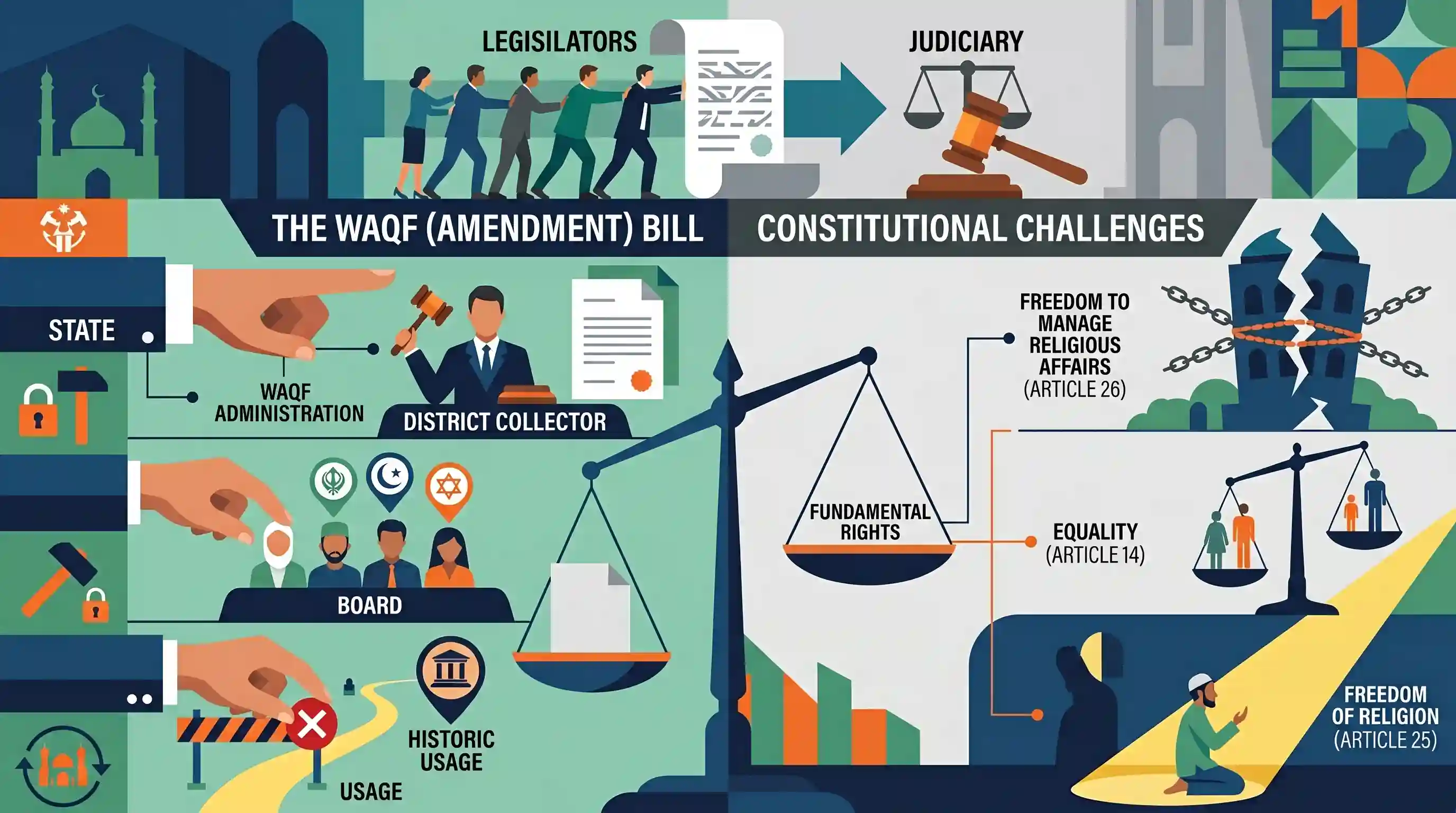
The article examines the legal and constitutional challenges surrounding the new Waqf (Amendment) Bill. Key issues raised include potential violations of Articles 14, 25, and 26 of the Constitution due to excessive state interference in the administration of Islamic religious endowments. Provisions such as granting District Collectors the authority to resolve property disputes, eliminating the concept of 'Waqf by user', and mandating non-Muslim representation on Waqf boards are heavily contested. The overarching concern is that these amendments infringe upon the right of a religious minority to manage its own religious affairs and properties.
Key Points
- The Waqf (Amendment) Bill has faced legal challenges primarily revolving around alleged violations of constitutional rights, including freedom of religion (Articles 25 and 26) and the right to equality (Article 14).
- A major point of contention is the proposed shift of power to District Collectors to adjudicate whether a property is Waqf or government land, which critics argue undermines the autonomy of Waqf Tribunals.
- The elimination of "Waqf by user" (where property is recognized as Waqf based on long-term usage without formal documentation) poses a threat to historic religious properties and burial grounds.
- Mandating the inclusion of non-Muslim members in Waqf Boards is seen by petitioners as unwarranted state interference in the management of religious endowments.
- The debate highlights the delicate balance between the state's intent to bring transparency and accountability to charitable trusts/endowments and the protection of minority religious property rights under Article 300A and Article 26.
Important Terms
Waqf (Amendment) Bill, 2024

A 2024 legislative proposal seeking to overhaul the 1995 Act by enhancing government oversight, mandating property registration, and introducing non-Muslim representation in Waqf governance.
UPSC context
GS Paper II: Government policies, interventions, and issues arising out of their design and implementation. Relevant for secularism and minority rights debates.
Waqf Act, 1995
The primary legislation governing Islamic religious endowments (Auqaf) in India, providing for the establishment of State Waqf Boards and the Central Waqf Council.
UPSC context
GS Paper II: Statutory and regulatory bodies. Tests understanding of the legal framework for managing religious properties.
Waqf by user
A legal doctrine where property is recognized as Waqf based on its long-standing, continuous public use for religious or charitable purposes, even without a formal deed.
UPSC context
GS Paper II: Minority Rights and Freedom of Religion. A central point of legal contention in the 2024 Bill.
Waqf Board
A statutory body at the state level responsible for the administration, protection, and recovery of properties dedicated to religious or charitable purposes under Islamic law.
UPSC context
GS Paper II: Governance and Quasi-judicial bodies. Concerns autonomy vs. state regulation in religious administration.
Article 26
A Fundamental Right guaranteeing every religious denomination the freedom to establish institutions, manage religious affairs, and own/administer property subject to public order, morality, and health.
UPSC context
GS Paper II: Indian Constitution—Fundamental Rights. Frequently tested in the context of state interference in religious institutions.
District Collector (Waqf Role)
In the 2024 Bill, this official is empowered to determine if a property is Waqf or government land, shifting authority away from specialized Waqf Tribunals.
UPSC context
GS Paper II: Separation of powers and dispute redressal mechanisms. Important for discussing executive overreach concerns.
Prelims Trap
Waqf Boards are constitutional bodies established to protect minority rights under Article 26.
Waqf Boards are strictly statutory bodies created under the Waqf Act, 1995. The Constitution guarantees religious denomination rights but does not explicitly mandate Waqf Boards.
Static Concepts Connected
What is the scope of Article 26 for religious denominations?
- Collective Right: Unlike Article 25 which protects individual rights, Article 26 guarantees collective rights to religious denominations or sections thereof.
- Property Administration: It grants the right to own, acquire, and administer movable and immovable property strictly in accordance with law.
- Constitutional Limitations: The rights are explicitly subject to public order, morality, and health, giving the state grounds for regulatory intervention.
How does shifting dispute resolution to District Collectors impact administrative law?
- Executive Adjudication: Shifting property dispute resolution from specialized Waqf Tribunals to District Collectors merges executive and quasi-judicial functions.
- Article 50 Conflict: This conflicts with the Directive Principle (Article 50) advocating the separation of the judiciary from the executive in public services.
- Natural Justice: If the state itself claims the disputed land, an executive officer ruling on it raises concerns of bias and violates principles of natural justice.
Cross-Topic Patterns
Waqf vs Hindu Religious Endowment Acts
The debate mirrors historical state control over Hindu temples under state HRCE Acts, highlighting the broader Indian model of secularism where the state actively regulates religious administration and properties.
Executive encroachment on Tribunal powers
Replacing Waqf Tribunal authority with District Collectors reflects a wider legislative trend of empowering executive bureaucracy at the expense of specialized judicial tribunals, raising Article 50 concerns.

Expect a comparative Mains question on state regulation of Hindu Endowments vs Waqf properties, testing Article 26 and Indian secularism.
Linked PYQs · 3
Linked PYQs · 3
- 2021PrelimsGS1
What is the position of the Right to Property in India?
- 2024MainsGS2
Public charitable trusts have the potential to make India's development more inclusive as they relate to certain vital public issues. Comment.
- 2018MainsGS2
Whether National Commission for Scheduled Castes (NCSC) can enforce the implementation of constitutional reservation for the Scheduled Castes in the religious minority institutions? Examine.
