डिजिटल व्यक्तिगत डेटा संरक्षण नियम ढांचा
स्रोत:द हिंदू ↗
क्यों मायने रखता है
DPDP Act और इसके संबंधित नियम भारत के पहले व्यापक, वैधानिक डेटा संरक्षण ढांचे (data protection framework) का प्रतिनिधित्व करते हैं। यह सुप्रीम कोर्ट के 2017 के के.एस. पुट्टास्वामी निर्णय के प्रति एक सीधी विधायी प्रतिक्रिया है, जिसने निजता के अधिकार (Right to Privacy) को अनुच्छेद 21 के तहत एक मौलिक अधिकार के रूप में मान्यता दी थी। यह प्रारंभिक और मुख्य परीक्षा (GS2 और GS3) दोनों में बार-बार पूछा जाने वाला एक महत्वपूर्ण विषय है।
सारांश
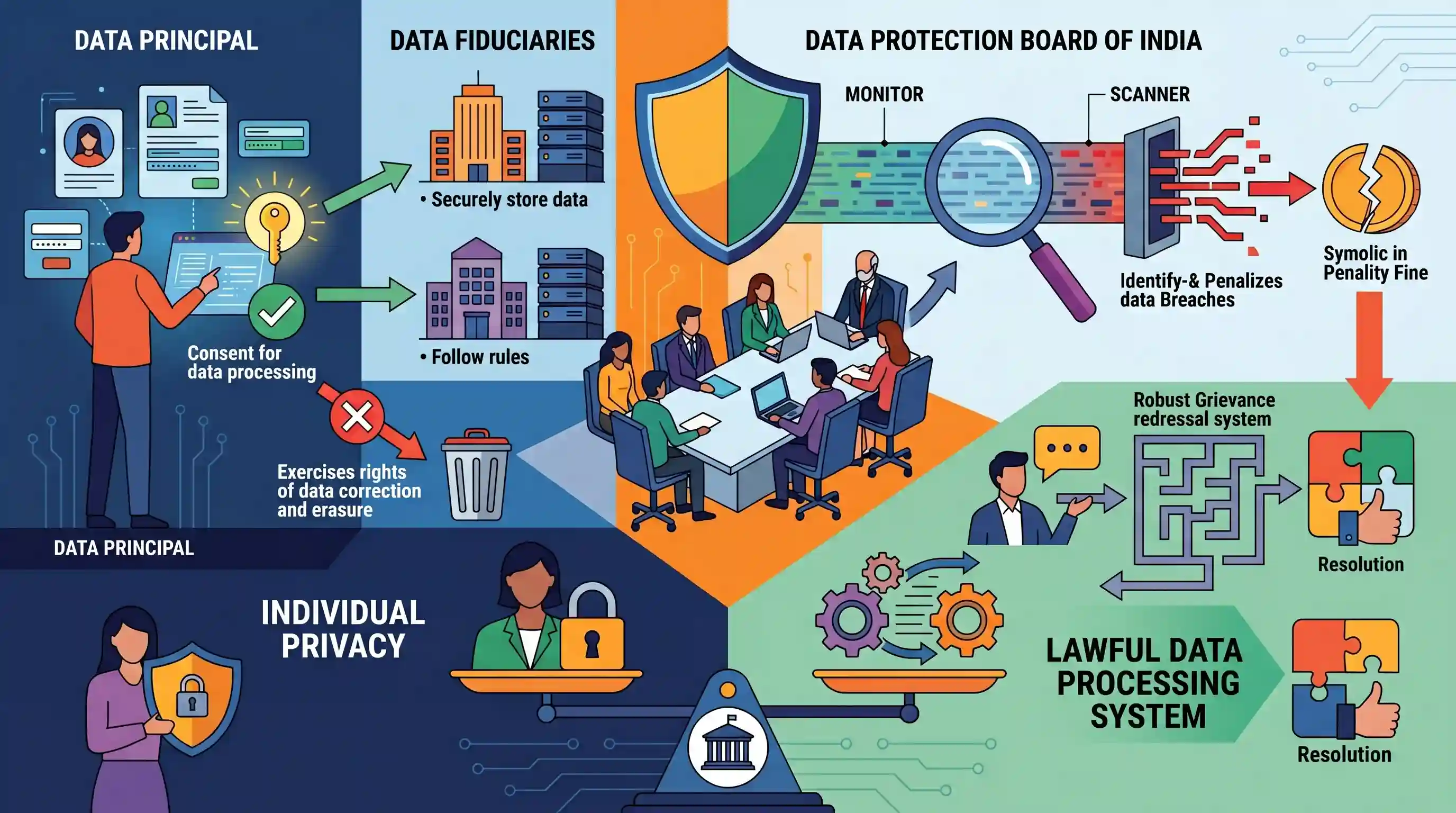
The article details the Digital Personal Data Protection (DPDP) Rules framed under the DPDP Act, 2023, by the Ministry of Electronics and Information Technology. The rules establish a comprehensive framework for the processing of digital personal data, prioritizing individual consent and clearly outlining the obligations of 'Data Fiduciaries' (entities collecting data) and the rights of 'Data Principals' (individuals). Key provisions include mechanisms for giving and withdrawing consent, the right to data correction and erasure, robust grievance redressal systems, and the establishment of the Data Protection Board of India to monitor compliance and penalize data breaches. The Act seeks to balance individuals' fundamental right to privacy with the necessity of processing personal data for lawful purposes.
मुख्य बिंदु
- इलेक्ट्रॉनिक्स और सूचना प्रौद्योगिकी मंत्रालय (MeitY) ने व्यक्तिगत डेटा को प्रोसेस करने के तरीके को विनियमित करने के लिए डिजिटल व्यक्तिगत डेटा संरक्षण (DPDP) अधिनियम, 2023 के तहत नियमों को अंतिम रूप दे दिया है।
- The rules emphasize affirmative consent, requiring Data Fiduciaries to explicitly inform Data Principals about what data is collected and its intended purpose.
- Data Principals (citizens) are granted rights to access, correct, update, and erase their personal data, alongside a mechanism to withdraw consent.
- यह ढांचा अनुपालन की निगरानी करने, विवादों का निपटारा करने और डेटा उल्लंघन (data breaches) के लिए दंड लगाने हेतु नियामक निकाय के रूप में भारतीय डेटा संरक्षण बोर्ड (Data Protection Board of India) की स्थापना करता है।
- The rules provide specific exemptions for data processing by state agencies in the interest of national security, sovereignty, and public order.
महत्वपूर्ण शब्द
Digital Personal Data Protection (DPDP) Act, 2023

India’s first comprehensive law regulating digital personal data processing, balancing privacy rights with the necessity of lawful data processing.
UPSC context
GS II (Policies) & GS III (Cyber Security). Landmark legislation establishing India's data governance and digital privacy regime.
Data Protection Board of India (DPBI)
A quasi-judicial body established to adjudicate data breaches, handle individual complaints, and impose financial penalties for non-compliance under the Act.
UPSC context
GS II (Quasi-judicial Bodies). Important for understanding the institutional oversight and enforcement mechanism of privacy rights.
Data Fiduciary
Any person or entity (e.g., companies, government) that determines the purpose and means of processing personal data, bearing primary accountability for compliance.
UPSC context
GS II/III. Key stakeholder role defining legal accountability and liability for organizations handling personal information.
Data Principal
The individual whose personal data is being processed; the legal subject who grants consent and holds rights to correction or erasure.
UPSC context
GS II (Fundamental Rights). Focuses on individual agency and the protection of citizen data in the digital economy.
Consent Manager
A registered third-party intermediary enabling individuals to give, review, and withdraw data consents through a transparent, interoperable digital platform.
UPSC context
GS III (IT/Economy). Represents India’s unique technological innovation (DEPA) for user-centric data management and portability.
Digital Personal Data Protection Rules
The procedural framework detailing compliance timelines, grievance redressal mechanisms, and registration requirements for intermediaries like Consent Managers.
UPSC context
GS II (Governance). Essential for understanding the executive's implementation of legislative mandates in digital spaces.
Ministry of Electronics and Information Technology (MeitY)
The nodal ministry responsible for drafting and implementing digital policies, including the DPDP framework and electronic governance initiatives.
UPSC context
GS II (शासन)। IT-संबंधित हस्तक्षेपों और डिजिटल इंडिया मिशन के लिए नोडल मंत्रालय।
Right to Privacy
Declared a fundamental right under Article 21 by the Supreme Court in the 2017 Puttaswamy judgment, forming the constitutional basis for DPDP.
UPSC context
GS II (Indian Polity). Foundational constitutional concept tested in the context of individual liberty and digital surveillance.
प्रारंभिक ट्रैप
The DPDP Act, 2023 regulates both digital and offline non-digital personal data of Indian citizens.
The DPDP Act specifically applies only to digital personal data, or data collected offline but digitized later. Purely offline personal data is excluded.
संबंधित अवधारणाएँ
How did the K.S. Puttaswamy Judgment alter the interpretation of Fundamental Rights?
- Article 21: Declared the Right to Privacy as an intrinsic part of the right to life and personal liberty.
- Triple Test: Established that state restrictions on privacy must satisfy legality, a legitimate state aim, and proportionality.
- Data Protection Mandate: Catalyzed the mandate for the state to create a comprehensive data protection regime.
What is the statutory nature of the Data Protection Board of India (DPBI)?
- सांविधिक निकाय: It is established as an independent statutory body under the DPDP Act, 2023.
- Adjudicatory Role: Functions primarily as a reactive adjudicatory body for data breaches, rather than an upfront regulator drafting policy.
- Penal Powers: Empowered to impose financial penalties up to ₹250 crore, but cannot award direct compensation to individuals.
अंतर-विषय पैटर्न
State Exemptions & Surveillance Debate
Broad exemptions for national security under Section 18 link the DPDP Act to ongoing debates over state surveillance frameworks, the Telegraph Act, and Information Technology Rules.
Digital Public Infrastructure (DPI) Governance
The DPDP Rules will heavily dictate how entities operating within India's Digital Public Infrastructure (like India Stack, ONDC, and Aadhaar) collect and process citizen data.

Expect a 2026 prelims question testing the exact definitions of 'Data Fiduciary' vs 'Principal' and the Act's exclusion of offline data.
संबद्ध PYQ · 5
संबद्ध PYQ · 5
- 2024MainsGS3
Describe the context and salient features of the Digital Personal Data Protection Act, 2023.
- 2017MainsGS2
Examine the scope of Fundamental Rights in the light of the latest judgement of the Supreme Court on Right to Privacy.
- 2021PrelimsGS1
'Right to Privacy' is protected under which Article of the Constitution of India?
- 2018PrelimsGS1
Right to Privacy is protected as an intrinsic part of Right to Life and Personal Liberty. Which of the following in the Constitution of India correctly and appropriately imply the above statement?
- 2024PrelimsGS1
Under which of the following Articles of the Constitution of India, has the Supreme Court of India placed the Right to Privacy ?
