Cold Spark Technology as Safe Alternative to Fireworks
Source:The Hindu ↗
Why It Matters
Highlights the intersection of cultural practices and environmental regulations, emphasizing the need for technological interventions (like cold spark technology) to curb noise pollution and protect human and animal health. Highly relevant for GS-3 Environment (Pollution) and Science & Technology (Chemical properties).
Summary
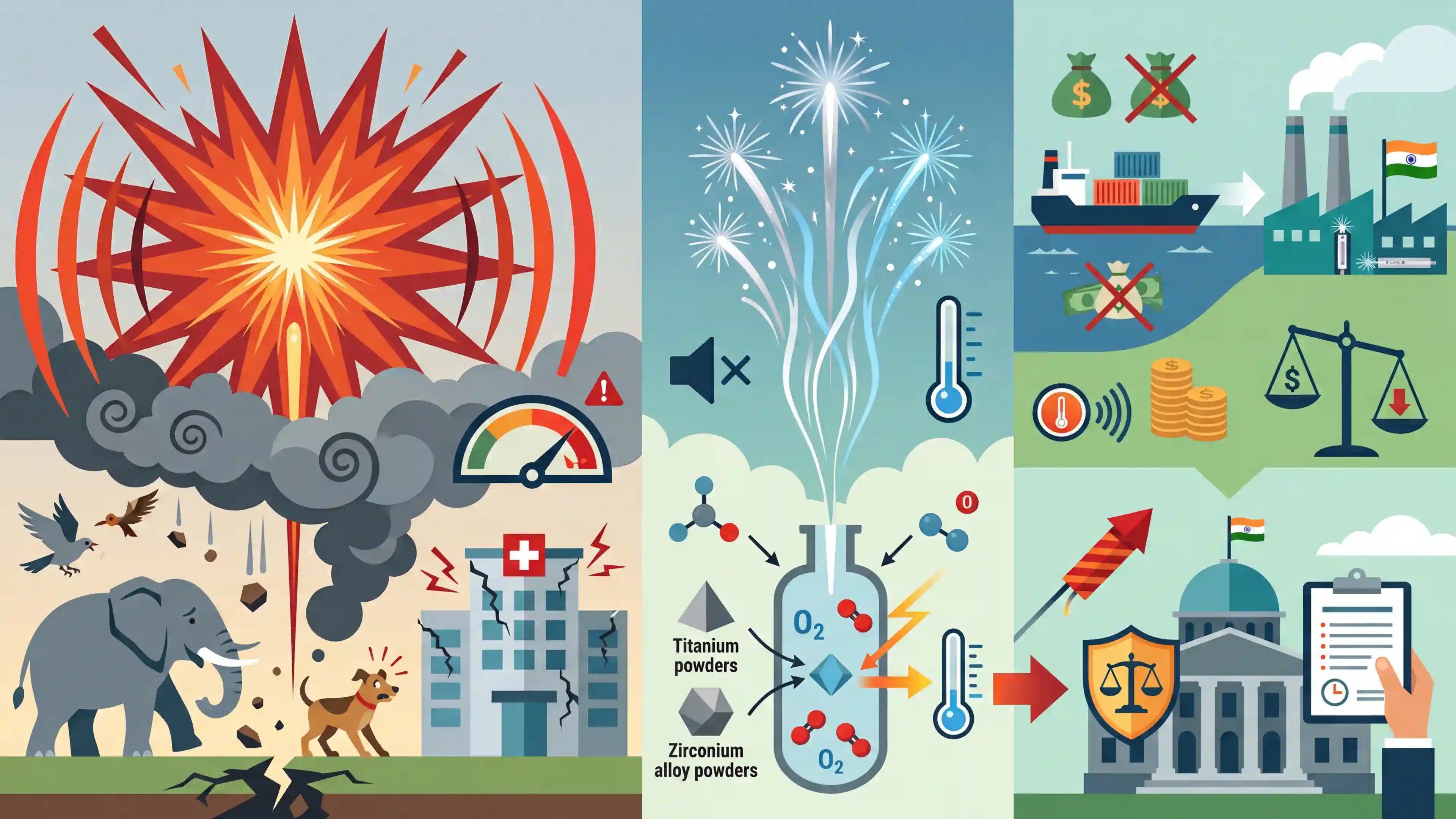
The severe noise pollution generated by traditional fireworks, recently highlighted by the 122.4-decibel levels at Kerala's Thrissur Pooram festival, has raised alarming environmental and health concerns for both wildlife and nearby hospitals. To combat this, experts advocate for the adoption of "cold spark" technology as a safer, noiseless alternative. This technology utilizes a chemical combustion reaction involving titanium and zirconium alloy powders, which react with oxygen to emit a sparkler-like light at much lower temperatures (60-100°C) without the explosive noise or heavy smoke of traditional firecrackers. While currently expensive and mostly imported, scaling up indigenous production and mandating transition strategies could significantly mitigate the environmental hazards associated with festive celebrations while preserving visual spectacle.
Key Points
- During the Thrissur Pooram festival, fireworks generated noise levels of 122.4 decibels, severely disorienting elephants and posing risks to nearby neonatal ICUs.
- The CPCB mandates that firecracker noise should not exceed 125 decibels at a 4-metre distance, while ambient noise standards require 40-50 decibels in silence zones like hospitals.
- 'Cold spark' technology presents a noiseless alternative to traditional fireworks by utilizing fine granulated metal alloy powders of titanium and zirconium.
- Unlike traditional fireworks that burn at 1,200°C, cold sparkulars trigger a rapid exothermic reaction with oxygen at just 60-100°C, producing light without loud explosions or heavy smoke.
- Transitioning to cold spark technology requires scaling up indigenous production to reduce costs, alongside stricter regulatory enforcement by local bodies.
Important Terms
Central Pollution Control Board (CPCB)

The apex statutory organization under the Ministry of Environment, Forest and Climate Change, responsible for preventing pollution and setting environmental quality standards across India.
UPSC context
GS-III (Environment); essential for topics on environmental governance, statutory bodies, and pollution control mechanisms.
Noise Standards for Firecrackers
Regulatory limits under the Environment (Protection) Rules, 1986, prohibiting firecrackers exceeding 125 dB(AI) or 145 dB(C)pk at four meters from the point of bursting.
UPSC context
GS-III (Pollution); relevant for questions on environmental regulations and public health safety during festivals.
National Ambient Noise Monitoring Network (NANMN)
A CPCB-managed network of real-time monitoring stations in major Indian cities designed to track 24/7 ambient noise levels for data-driven policy interventions.
UPSC context
GS-III (Infrastructure/Environment); tests knowledge of monitoring frameworks for urban environmental quality.
Cold Spark Technology
A pyrotechnic alternative using titanium-zirconium alloy powders that create visual sparks at low temperatures (60-100°C) without the explosive noise or toxic smoke of traditional fireworks.
UPSC context
GS-III (Science & Technology); applicable to sustainable innovation and indigenous manufacturing (Make in India).
Kerala State Pollution Control Board (KSPCB)
A state-level statutory body that monitors and implements environmental laws in Kerala, particularly oversight of industrial and festive pollution.
UPSC context
GS-III (Pollution); relevant for center-state environmental coordination and regional implementation of pollution rules.
WHO Noise Level Guidelines
Health benchmarks identifying noise pollution (above 65 dB) as a major environmental threat, with specific limits (e.g., 35 dB) for hospitals and sleeping areas.
UPSC context
GS-II (Social Justice/Health); provides international standards for evaluating domestic policy effectiveness in noise management.
Prelims Trap
The Noise Pollution (Regulation and Control) Rules, 2000 were framed under the Air (Prevention and Control of Pollution) Act, 1981.
The Noise Pollution Rules were actually enacted under the Environment (Protection) Act, 1986. UPSC frequently swaps parent legislations to create deceptive statements.
Static Concepts Connected
What is the regulatory framework governing noise pollution in India?
- Parent Act: The Noise Pollution (Regulation and Control) Rules, 2000, were enacted under the Environment (Protection) Act, 1986, not the Air Act.
- Ambient Standards: Ambient limits for silence zones (around hospitals/schools) are restricted to 50 decibels (dB) during the day and 40 dB at night.
- Firecracker Limits: The CPCB mandates that noise from individual firecrackers must not exceed 125 dB at a distance of 4 metres.
How does 'Cold Spark' technology chemically differ from traditional fireworks?
- Chemical Composition: It uses fine granulated metal alloy powders, typically titanium and zirconium, avoiding traditional gunpowder mixtures.
- Operating Temperature: It triggers a rapid exothermic reaction with oxygen at just 60-100°C, whereas traditional fireworks combust explosively at around 1,200°C.
- Emission Profile: Because it lacks explosive combustion, it produces a visual sparkler effect with minimal smoke and virtually no noise.
Cross-Topic Patterns
Pyrotechnic chemicals and pollution
UPSC frequently tests chemical compositions of fireworks (e.g., Barium for green). The use of Titanium and Zirconium in cold sparks adds a new S&T dimension to this established static list.
Wildlife welfare vs. Cultural festivals
The disorientation of captive elephants by 122+ dB noise links environmental pollution directly with animal welfare, contrasting cultural rights against the Prevention of Cruelty to Animals Act.

Expect a 2026 Prelims question comparing 'Cold Spark' tech (Titanium/Zirconium) with CSIR-NEERI's 'Green Crackers' and their parent Acts.
Linked PYQs · 3
Linked PYQs · 3
- 2022PrelimsGS1
In the context of WHO Air Quality Guidelines, consider the following statements: 1. The 24-hour mean of PM2.5 should not exceed 15 µg/m³ and annual mean of PM2.5 should not exceed 5 µg/m³. 2. In a year, the highest levels of ozone pollution occur during the periods of inclement weather. 3. PM10 can penetrate the lung barrier and enter the bloodstream. 4. Excessive ozone in the air can trigger asthma. Which of the statements given above are correct?
- 2019PrelimsGS1
Consider the following statements : The Environment Protection Act, 1986 empowers the Government of India to 1. state the requirement of public participation in the process of environmental protection, and the procedure and manner in which it is sought 2. lay down the standards for emission or discharge of environmental pollutants from various sources Which of the statements given above is/are correct?
- 2004PrelimsGS1
Salts of which of the following elements provide colours to fireworks?
