Carbon Capture and Utilisation Technologies in Climate Mitigation
Source:The Hindu ↗
Why It Matters
CCUS is a recurring, high-priority topic in both Prelims and Mains (e.g., DAC appeared in Prelims 2025, and CCUS in Mains 2025). Understanding the distinction between storage and utilisation, and the specific technological applications (like synthetic fuels or mineralisation), provides high-value fodder for GS3 Environment and Science & Technology answers.
Summary
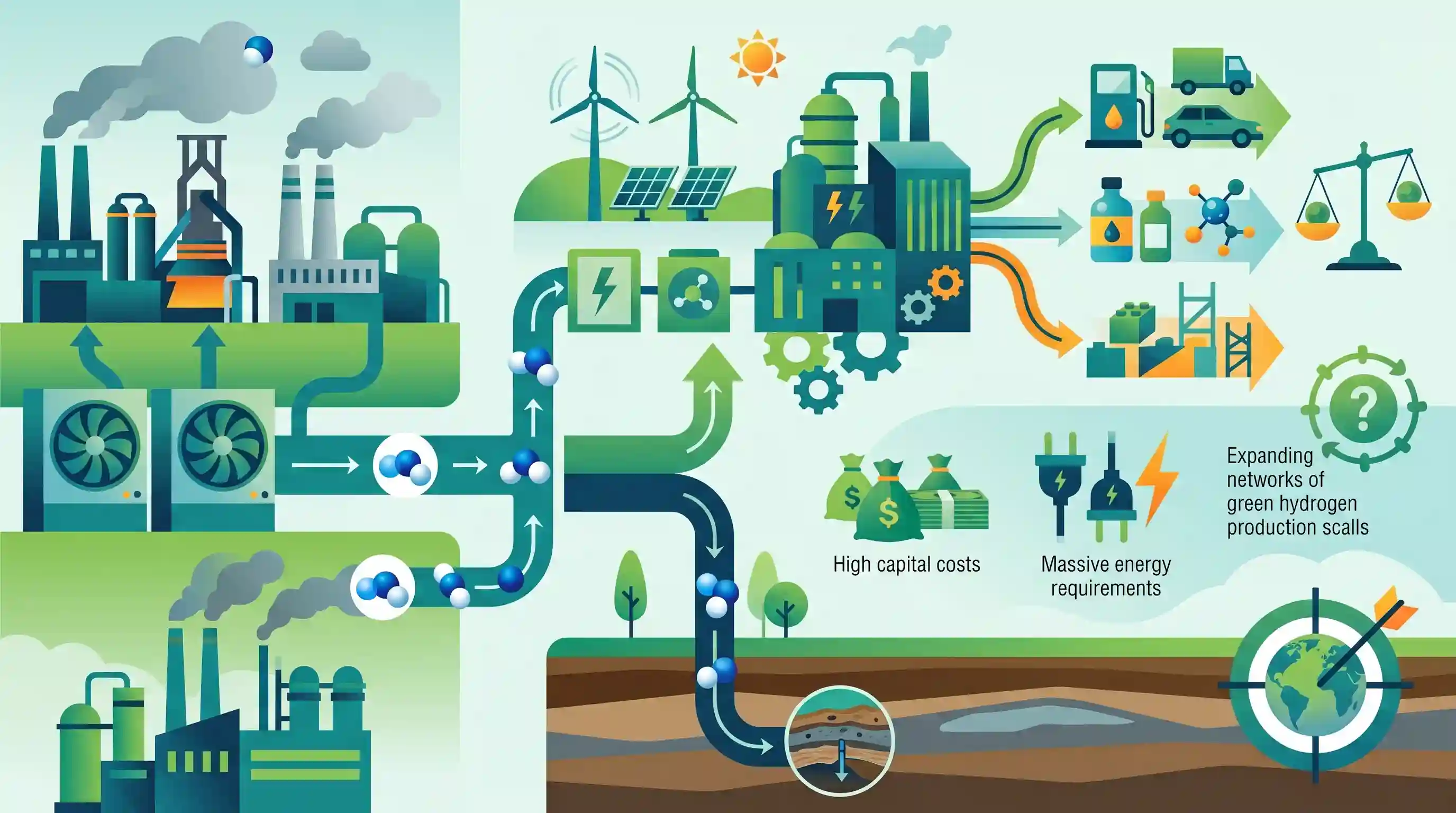
The article explains Carbon Capture and Utilisation (CCU) technologies, which capture carbon dioxide from industrial point sources or directly from the atmosphere and recycle it into economically valuable products such as synthetic fuels, chemicals, and building materials. Unlike conventional Carbon Capture and Storage (CCS), which focuses purely on permanent geological sequestration, CCU creates an economic incentive for emission reduction. While essential for decarbonising hard-to-abate sectors and achieving global net-zero targets, CCU faces significant barriers, including high capital costs, massive energy requirements for conversion processes, and the need for scalable green hydrogen infrastructure to ensure true climate benefits.
Key Points
- Carbon Capture and Utilisation (CCU) diverges from Carbon Capture and Storage (CCS) by converting captured CO2 into economically valuable products rather than merely sequestering it permanently underground.
- Captured CO2 can be utilised in various pathways: chemically (e.g., combined with green hydrogen to make synthetic sustainable aviation fuels or plastics), biologically (e.g., feeding microalgae), or via mineralisation (e.g., curing concrete and building materials).
- Direct Air Capture (DAC) is an emerging technology under the CCU umbrella that extracts CO2 directly from the ambient atmosphere, rather than from point-source industrial emissions.
- Major challenges for large-scale CCU deployment include high energy intensity, the necessity for abundant green energy to ensure lifecycle emissions remain net-negative, and the current lack of economic viability compared to conventional feedstocks.
- CCU is seen as a critical transitional and long-term technology for decarbonising 'hard-to-abate' sectors like cement, steel, and aviation, which are difficult to electrify entirely.
Important Terms
Paris Agreement

A legally binding 2015 treaty aiming to limit global warming to well below 2°C, preferably 1.5°C, through self-determined climate targets known as NDCs.
UPSC context
GS Paper 3/Environment; tested via NDCs, global stocktakes, and India's evolving climate commitments.
Net Zero 2070 (India)
India's commitment to achieve a balance between greenhouse gases emitted and those removed from the atmosphere by 2070, as announced at COP26.
UPSC context
GS Paper 3/Environment; crucial for understanding India's 'Panchamrit' strategy and long-term decarbonization roadmap.
Hard-to-Abate Sectors
Industries such as steel, cement, and chemicals where emissions are structurally difficult to reduce due to high-temperature processes or chemical byproducts.
UPSC context
GS Paper 3/Economy & Environment; focuses on industrial decarbonization challenges and the role of new technologies.
Carbon Capture, Utilisation and Storage (CCUS)
Technologies that capture CO2 from industrial sources or the air, then either recycle it for industrial use (Utilisation) or store it underground (Storage).
UPSC context
GS Paper 3/Science & Tech; evaluated as a 'bridging technology' for achieving net-zero targets.
UNFCCC
The 1992 international treaty established to stabilize greenhouse gas concentrations; it serves as the parent treaty for the Kyoto Protocol and Paris Agreement.
UPSC context
GS Paper 2/International Relations; essential for questions on global climate governance and multilateral environmental agreements.
Intergovernmental Panel on Climate Change (IPCC)
The UN scientific body that assesses climate change research to provide policymakers with objective data on risks, impacts, and mitigation options.
UPSC context
GS Paper 3/Environment; reports often form the basis for Mains questions on climate science and policy.
Direct Air Capture (DAC)
A technology that captures CO2 directly from the ambient air, rather than from a concentrated industrial point source like a factory chimney.
UPSC context
GS Paper 3/Science & Tech; relevant for negative emissions technologies and achieving mid-century climate goals.
Prelims Trap
Synthetic fuels produced through Carbon Capture and Utilisation (CCU) emit no carbon dioxide when combusted.
These fuels do emit CO2 when burned. Their climate benefit is being 'net-neutral' (using recycled carbon), not 'zero-emission' at the tailpipe.
Static Concepts Connected
What distinguishes CCS, CCU, and DAC in carbon management?
- CCS (Storage): Captures CO2 from industrial point sources (flue gases) and permanently sequesters it deep underground in geological formations.
- CCU (Utilisation): Converts captured CO2 into commercially viable products like synthetic fuels, chemicals, plastics, or building materials.
- DAC (Direct Air Capture): Extracts CO2 directly from ambient atmospheric air rather than from concentrated industrial emission sources.
What makes an industry "hard-to-abate" in climate economics?
- Definition: Sectors where reducing emissions is technically complex or prohibitively expensive because processes cannot easily be electrified.
- Key Examples: Include steel, cement, fertilizers, aviation, and heavy shipping. They require high heat or chemical reduction agents like carbon.
- Decarbonisation Pathway: These sectors heavily rely on transitional technologies like CCUS, green hydrogen, and biofuels to meet net-zero targets.
Cross-Topic Patterns
CCUS and the Green Hydrogen Mission
Synthesizing sustainable aviation fuels or methanol from captured CO2 requires massive amounts of green hydrogen, explicitly linking CCU viability to India's National Green Hydrogen Mission.
Carbon Mineralization vs. Enhanced Weathering
The chemical process of trapping CO2 in concrete (CCU) relies on the same carbonation principles as enhanced rock weathering, a frequent geoengineering topic in UPSC Prelims.

Expect a 2026 Prelims question contrasting CCS, CCU, and DAC, explicitly testing if CCU-derived synthetic fuels are 'zero-emission'.
Linked PYQs · 3
Linked PYQs · 3
- 2025PrelimsGS1
With reference to 'Direct Air Capture', an emerging technology, which of the following statements is/are correct? I. It can be used as a way of carbon sequestration. II. It can be a valuable approach for plastic production and in food processing. III. In aviation, it can be a source of carbon for combining with hydrogen to create synthetic low-carbon fuel. Select the correct answer using the code given below.
- 2023PrelimsGS1
Consider the following activities: 1. Spreading finely ground basalt rock on farmlands extensively 2. Increasing the alkalinity of oceans by adding lime 3. Capturing carbon dioxide released by various industries and pumping it into abandoned subterranean mines in the form of carbonated waters How many of the above activities are often considered and discussed for carbon capture and sequestration?
- 2025MainsGS3
What is Carbon Capture, Utilization and Storage (CCUS)? What is the potential role of CCUS in tackling climate change?
