Edge Computing and Neural Processing Units in Modern PCs
Source:The Hindu ↗
Why It Matters
Understanding the shift from cloud-based AI to on-device AI (edge computing) is crucial for the Science & Technology syllabus. It highlights the hardware evolution (NPUs) and introduces complex regulatory challenges regarding data privacy and cybersecurity that future civil servants must navigate.
Summary
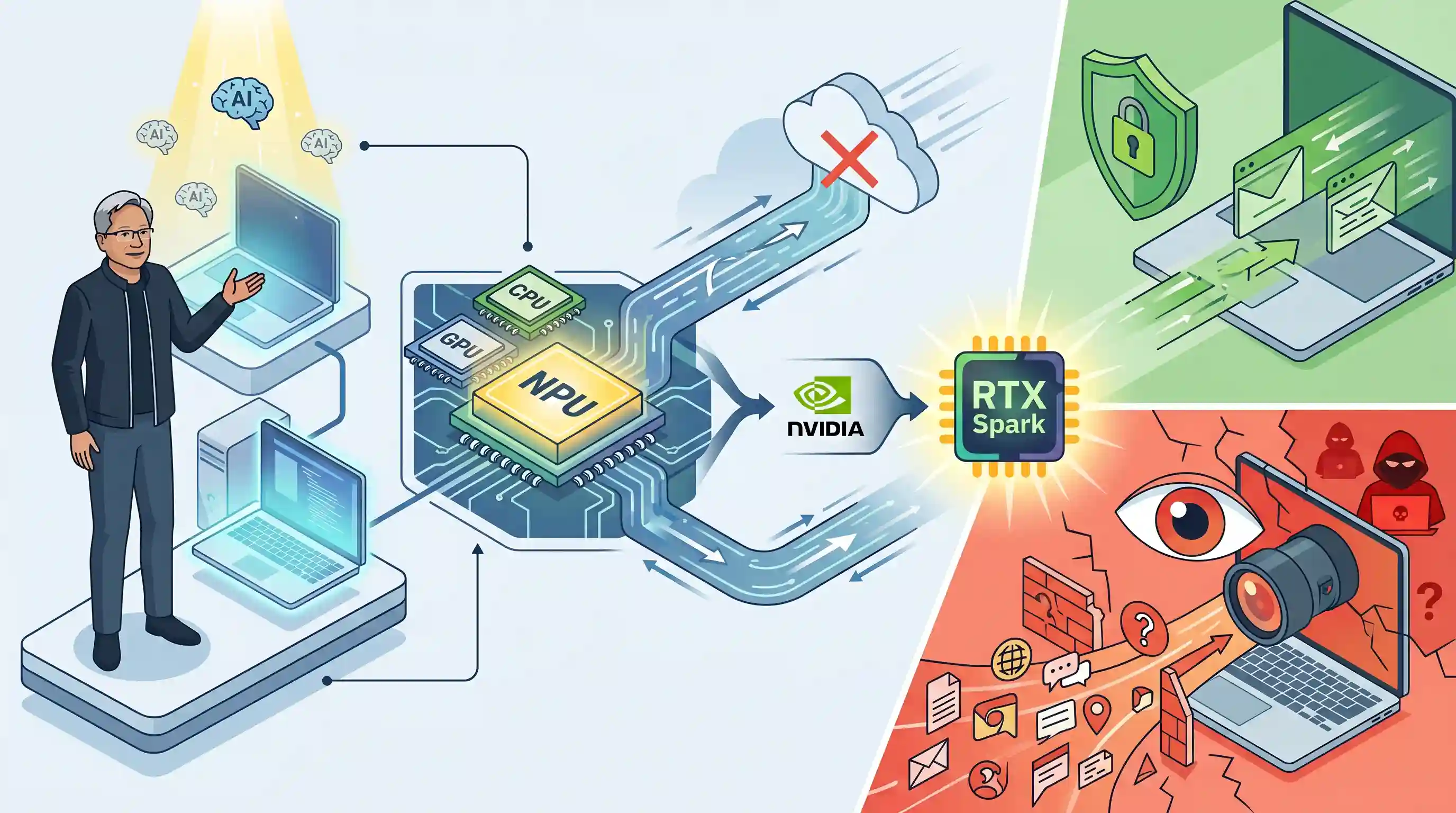
Nvidia CEO Jensen Huang is championing a new era of personal computing driven by "AI PCs." These advanced laptops and desktops incorporate Neural Processing Units (NPUs) alongside standard CPUs and GPUs to execute artificial intelligence tasks and run AI agents directly on the device. This shift towards edge computing reduces reliance on cloud servers, significantly improving processing speeds and potentially enhancing data privacy. Nvidia and MediaTek are collaborating to produce chips like the RTX Spark to facilitate this transition. However, the rise of local AI also introduces complex privacy concerns, exemplified by features like Microsoft's 'Recall' that inherently track and log extensive user activity.
Key Points
- AI PCs are a new category of computers equipped with specialized Neural Processing Units (NPUs) designed to handle artificial intelligence workloads locally.
- By processing AI tasks directly on the device rather than relying on cloud data centers, AI PCs offer lower latency, offline functionality, and improved data privacy.
- Nvidia has partnered with MediaTek to develop the 'RTX Spark' chip, aiming to power local AI agents that can assist users seamlessly.
- While on-device processing can enhance privacy, features like Microsoft's 'Recall' (which continuously screenshots user activity) highlight emerging data privacy and cybersecurity risks associated with local AI.
Important Terms
AI PCs

Personal computers equipped with dedicated Neural Processing Units (NPUs) to run AI tasks locally on-device, rather than relying on centralized cloud servers.
UPSC context
GS Paper 3: Science and Technology. Tests awareness of emerging IT trends and their practical applications in daily life.
Neural Processing Unit (NPU)
A specialized microprocessor optimized for accelerating neural network and machine learning tasks, offering higher efficiency and lower power consumption than standard CPUs for AI workloads.
UPSC context
GS Paper 3: Awareness in the field of IT and Computers. Important for understanding hardware-level AI advancements.
Edge Computing
A distributed computing model where data is processed near the source of generation (the 'edge') rather than a centralized data center, reducing latency and bandwidth usage.
UPSC context
GS Paper 3: Science and Tech (IT). Tests knowledge of distributed architecture, 5G, and real-time data processing.
Semiconductor
Materials with electrical conductivity between conductors and insulators, serving as the foundational building blocks for all modern electronic devices and integrated circuits.
UPSC context
GS Paper 3: Economy and Science. Relevant to 'Atmanirbhar Bharat' and the India Semiconductor Mission (ISM).
Data Privacy
The legal and ethical framework for protecting personal information from unauthorized access, processing, or misuse, ensuring individuals' rights over their digital identity.
UPSC context
GS Paper 2 (Governance) & GS Paper 3 (Internal Security). Tests understanding of fundamental rights and cybersecurity challenges.
AI Agents
Autonomous software entities capable of performing complex tasks on behalf of a user, such as managing schedules or drafting emails, by interacting with various applications.
UPSC context
GS Paper 3: Science and Technology. Relevant to the evolution of AI-human interaction and automation.
Prelims Trap
AI PCs eliminate all data privacy and cybersecurity risks because they process AI workloads locally offline.
Local processing reduces cloud transmission risks but creates massive endpoint vulnerabilities. Intrusive local AI tools (like continuous screenshots) can be devastatingly exploited if hacked locally.
Static Concepts Connected
What is Edge Computing and how does it differ from Cloud Computing?
- Data Location: Edge processes data locally at the source device (endpoint), while cloud relies on centralized remote servers for data processing.
- Latency Reduction: Local processing eliminates the delay of sending data to remote servers, offering real-time capability essential for autonomous AI agents.
- Bandwidth and Offline: It minimizes internet bandwidth usage and allows devices to maintain core functionalities even when completely offline.
How do Neural Processing Units (NPUs) function compared to CPUs and GPUs?
- Specialized Hardware: Unlike general-purpose CPUs, NPUs are dedicated hardware accelerators built exclusively to handle complex machine learning and neural network mathematics.
- Energy Efficiency: While GPUs also offer parallel processing, NPUs are designed to execute heavy AI workloads with significantly lower power consumption.
Cross-Topic Patterns
Edge Computing + 5G IoT Integration
AI PCs reflect a broader shift to edge computing, which is essential for 5G and IoT infrastructure to deliver low-latency, real-time processing for smart cities and autonomous vehicles.
Local AI Privacy vs DPDP Act 2023
Local AI agents tracking continuous user activity create massive endpoint vulnerabilities, testing data minimization and consent frameworks under India's Digital Personal Data Protection (DPDP) Act and Article 21.

A comparative prelims question on CPU vs GPU vs NPU, or Edge vs Cloud computing applications in AI, is highly probable in 2026.
Linked PYQs · 3
Linked PYQs · 3
- 2023MainsGS3
Introduce the concept of Artificial Intelligence (AI). How does Al help clinical diagnosis? Do you perceive any threat to privacy of the individual in the use of Al in healthcare?
- 2020PrelimsGS1
With the present state of development, Artificial Intelligence can effectively do which of the following? 1. Bring down electricity consumption in industrial units 2. Create meaningful short stories and songs 3. Disease diagnosis 4. Text-to-Speech Conversion 5. Wireless transmission of electrical energy Select the correct answer using the code given below:
- 2025PrelimsGS1
Consider the following statements: I. It is expected that Majorana 1 chip will enable quantum computing. II. Majorana 1 chip has been introduced by Amazon Web Services (AWS). III. Deep learning is a subset of machine learning. Which of the statements given above are correct?
