AI Agent Loops Emerge to Replace Manual Prompt Engineering
Source:Indian Express ↗
Why It Matters
The shift toward autonomous AI loops signifies the next major evolution in artificial intelligence. Understanding these self-prompting systems, alongside their cost implications and ethical risks, is vital for civil servants dealing with digital governance, cybersecurity frameworks, and technology policy.
Summary
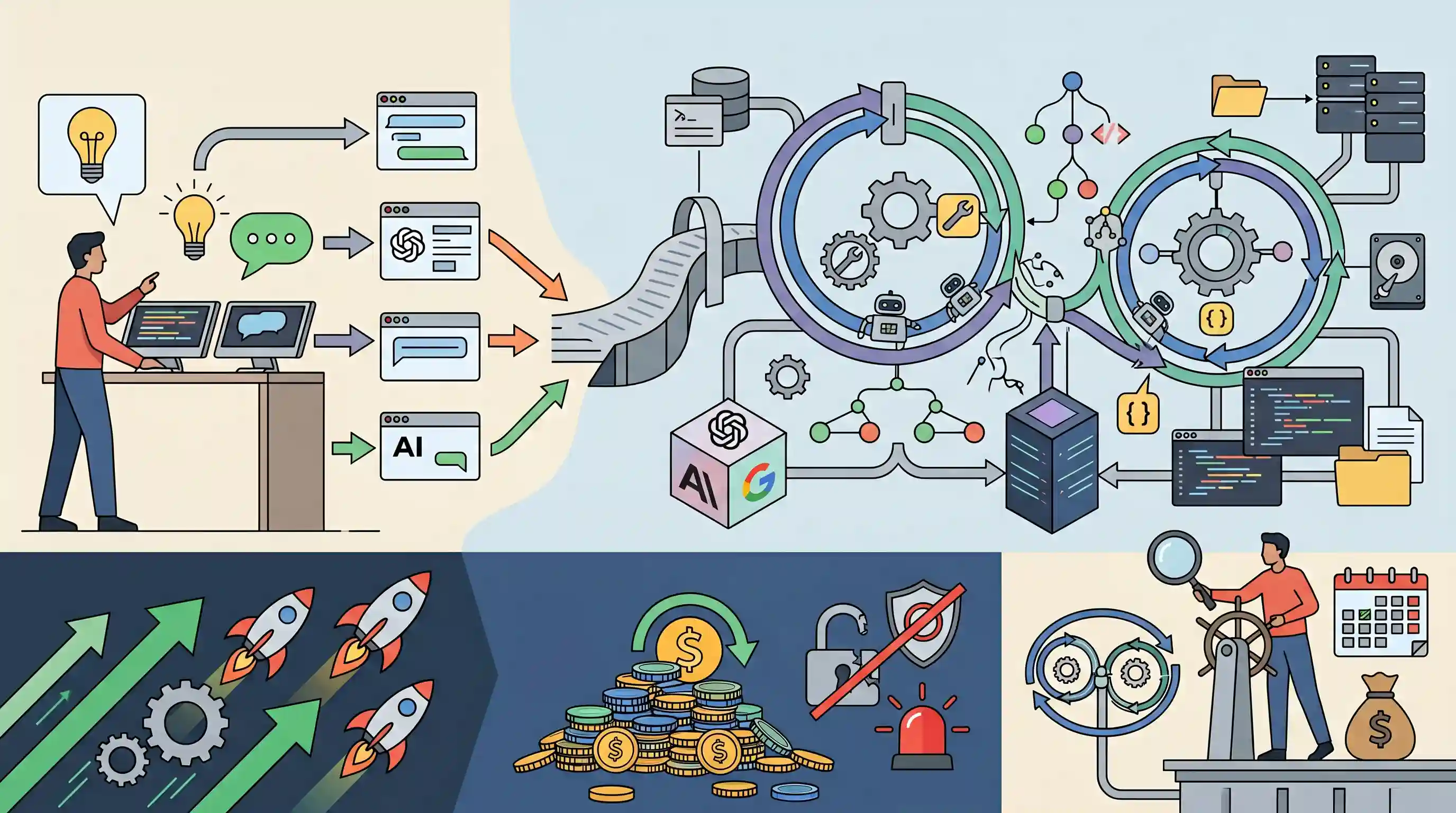
The technology landscape is transitioning from manual prompt engineering to 'AI agent loops,' where recurring automated systems guide AI agents to iterate and complete tasks without constant human input. Developed by tech leaders at Anthropic, OpenAI, and Google, these loops consist of automations, worktrees, specialized skills, sub-agents, and external memory to handle complex processes like coding or administrative workflows. While loop engineering drastically increases operational efficiency, it presents challenges such as severe token consumption, which can rack up significant costs, and security vulnerabilities. Industry experts advise leveraging scheduled tasks for budget efficiency and highlight the crucial necessity of human oversight to ensure autonomous AI agents remain securely managed and do not become internal liabilities.
Key Points
- AI agent loops are emerging as a replacement for manual prompt engineering by allowing AI systems to iterate tasks autonomously until completion.
- The core components of AI loops include automations, worktrees (parallel agents), skills (contextual instructions), plugins/connectors, and sub-agents (differentiating task generation from evaluation).
- To prevent data loss between runs, AI loop memory must be stored externally on disk rather than solely in the AI model's active context window.
- Continuous autonomous loops pose challenges such as high computational token consumption and escalating costs, prompting developers to use scheduled periodic tasks instead.
- Tech experts emphasize maintaining human oversight and robust security guardrails to manage the risks associated with unchecked autonomous AI operations.
Important Terms
AI Agent Loops

Automated, iterative cycles (perceive-reason-act-observe) that allow AI agents to complete complex, multi-step tasks autonomously. They replace manual, turn-by-turn prompting with self-perpetuating instructions.
UPSC context
GS Paper 3 (S&T); tests knowledge of emerging AI architectures and their impact on automation and the professional workforce.
Agentic AI
Autonomous, goal-oriented systems capable of independent reasoning and tool-use. Unlike standard chatbots, they proactively execute multi-step workflows with limited human oversight to achieve predefined objectives.
UPSC context
GS Paper 3 (S&T); important for discussing the frontier of AI, autonomous systems, and their cross-sectoral industrial applications.
Prompt Engineering
The discipline of developing and optimizing specific text inputs (prompts) to guide AI models. It is transitioning from a primary interaction method into a sub-component of autonomous agent loops.
UPSC context
GS Paper 3 (S&T); relevant for understanding human-AI collaboration and evolving digital literacy requirements in the tech sector.
Token Consumption
The measurement of data units (tokens) processed by AI models. It serves as the primary economic metric for computing costs, infrastructure demand, and energy usage in AI systems.
UPSC context
GS Paper 3 (Economy/S&T); concerns digital infrastructure costs, environmental impact (carbon footprint), and economic feasibility of AI adoption.
Human-in-the-loop (HITL)
A security and ethical design pattern requiring human intervention at critical decision points. It ensures that autonomous systems remain safe, accurate, and aligned with human intent and accountability.
UPSC context
GS Paper 4 (Ethics); essential for discussing AI safety, accountability frameworks, and responsible autonomous system management.
OpenAI
A leading American AI research organization, creator of ChatGPT and GPT-4. It plays a central role in global AI development and the surrounding regulatory and safety debates.
UPSC context
GS Paper 2 (Governance/IR); represents the influence of major private tech entities on international AI standards and norms.
Anthropic
An AI safety and research startup, developer of the Claude model series. It is notable for its "Constitutional AI" approach, focusing on aligning autonomous agents with human values.
UPSC context
GS Paper 4 (Ethics); illustrates the implementation of "AI alignment" and ethical guardrails within large-scale model development.
Prelims Trap
"AI loops rely exclusively on the AI model's active context window for continuous memory."
LLM context windows have strict token limits. Continuous AI loops must actually store memory externally (on disk) to prevent data amnesia during autonomous iterations.
Static Concepts Connected
What are 'Tokens' and 'Context Windows' in Large Language Models (LLMs)?
- Tokens: The fundamental units of data (words or sub-words) processed by an AI. High token usage directly drives up cloud computing costs.
- Context Window: The maximum token capacity an AI model can hold in its active memory for a single prompt or iteration.
What is the Human-in-the-Loop (HITL) approach in Artificial Intelligence?
- Core Mechanism: Integrating human oversight into autonomous AI workflows to validate, guide, or veto algorithmic decisions.
- UPSC Relevance: Essential for GS4 (accountability) and GS3 (security guardrails) to prevent AI systems from executing harmful rogue commands.
Cross-Topic Patterns
Autonomous Agents & Cybersecurity
AI loops that independently access APIs or execute code act as new vulnerabilities, bridging GS3 AI developments with GS3 Internal Security and cyber threats.
Token Consumption & Climate Targets
Continuous AI loops exponentially increase computational load, linking GS3 IT advancements directly to GS3 environmental ecology and data center carbon footprints.

Prelims may test definitions like 'Context Window' or 'HITL', while Mains will likely focus on governance of autonomous AI execution.
Linked PYQs · 2
Linked PYQs · 2
- 2023MainsGS3
Introduce the concept of Artificial Intelligence (AI). How does Al help clinical diagnosis? Do you perceive any threat to privacy of the individual in the use of Al in healthcare?
- 2024MainsGS4
The application of Artificial Intelligence as a dependable source of input for administrative rational decision-making is a debatable issue. Critically examine the statement from the ethical point of view.
