Food security policies must prioritize nutritional adequacy
Source:The Hindu ↗
Why It Matters
Food security and malnutrition are perennial themes in both Prelims and Mains (GS2 and GS3). Understanding the shift from 'caloric security' to 'nutritional security' and the impacts of food inflation on poverty and human capital is crucial for policy-related questions and essays.
Summary
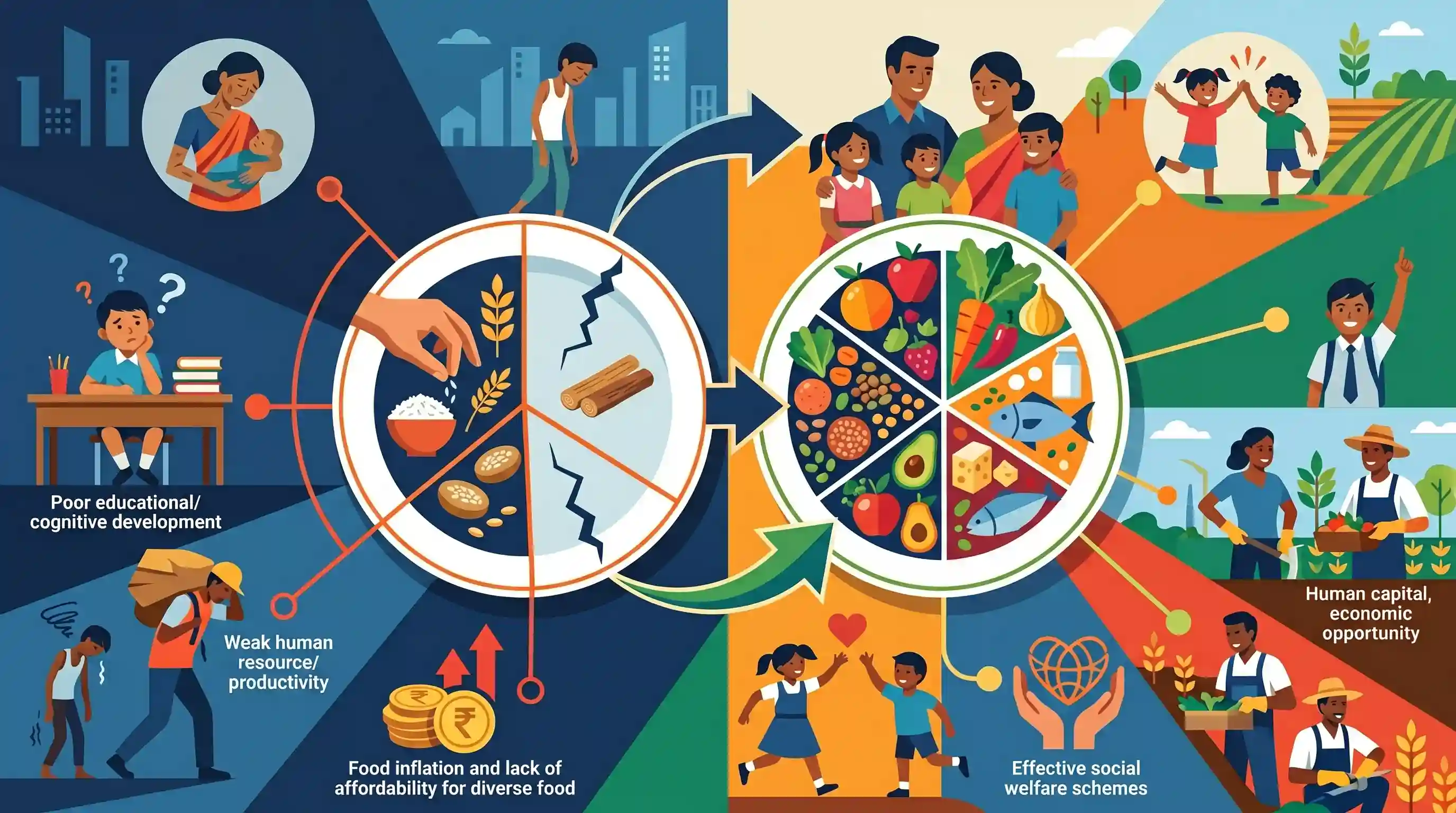
The article uses the powerful metaphor of an 'empty plate' to reflect on the deeper systemic issues of hunger, malnutrition, and food insecurity in India. While the country has made strides through the National Food Security Act and the Public Distribution System, the focus has largely remained on caloric sufficiency rather than nutritional security. The piece argues that true food security requires addressing 'hidden hunger' and the affordability of a diverse, nutritious diet amidst food inflation. It emphasizes the need for a holistic approach, recognizing that an empty plate symbolizes the failure of multiple developmental metrics, including maternal health, poverty alleviation, and human capital formation, urging a shift towards comprehensive nutritional interventions.
Key Points
- The concept of the 'empty plate' serves as a stark reminder of the persistent challenges of malnutrition, hunger, and food insecurity despite broader economic growth.
- Food security policies must transition from merely providing caloric sufficiency (cereal-centric PDS) to ensuring comprehensive nutritional security, combating hidden hunger and micronutrient deficiencies.
- There is a growing divergence between poverty reduction and hunger eradication, with food inflation further squeezing the food budgets of vulnerable households.
- Addressing malnutrition and ensuring a diverse food plate is critical for human capital formation and requires systemic improvements in health, sanitation, and female empowerment alongside schemes like Poshan Abhiyan.
Important Terms
National Food Security Act (NFSA), 2013

A 2013 law providing legal entitlement to subsidized food grains to 67% of the population (75% rural, 50% urban), shifting food security from a 'welfare' to a 'rights-based' approach.
UPSC context
GS Paper 2: Social Justice; GS Paper 3: Food Security. Tests understanding of statutory safety nets and beneficiary identification.
Public Distribution System (PDS)
The delivery mechanism for food grains where the Centre (FCI) procures stock and States distribute it at subsidized rates through a network of Fair Price Shops (FPS).
UPSC context
GS Paper 3: PDS objectives, functioning, and reforms. Tests knowledge of procurement, buffer stocks, and technology-led leak-proofing.
Poshan Abhiyan
India's flagship 'National Nutrition Mission' launched in 2018 to improve nutritional outcomes for children, pregnant women, and lactating mothers by targeting stunting, wasting, and anemia.
UPSC context
GS Paper 2: Health/Welfare Schemes. Evaluates multi-ministerial convergence and behavioral change (Jan Andolan) in improving developmental metrics.
Hidden Hunger
A form of undernutrition where individuals consume enough calories but lack essential vitamins and minerals (micronutrients), often due to poor diet diversity.
UPSC context
GS Paper 2: Issues relating to hunger. Tests the ability to distinguish between caloric sufficiency and micronutrient deficiency.
Food Inflation
A sustained rise in food prices that erodes household purchasing power, disproportionately affecting the poor’s access to a diverse and nutritious diet.
UPSC context
GS Paper 3: Indian Economy. Tests understanding of supply-side shocks and their impact on poverty and nutritional security.
Nutritional Security
A state where all people have physical and economic access to a balanced diet providing both adequate energy (calories) and essential micronutrients.
UPSC context
GS Paper 2: Health/Governance. Tests the conceptual shift in policy from merely ending hunger to ensuring holistic human capital formation.
Prelims Trap
"The National Food Security Act (NFSA) legally guarantees a balanced, multi-nutrient diet to all its beneficiaries."
The NFSA guarantees caloric security via subsidized cereals, not a diverse multi-nutrient diet. 'Hidden hunger' persists precisely because the PDS is heavily cereal-centric, lacking protein and micronutrient guarantees.
Static Concepts Connected
What constitutes 'Hidden Hunger' and what are its primary drivers in India?
- Definition: A chronic lack of essential vitamins and minerals (such as iron, zinc, iodine, and vitamin A), occurring even when a person's caloric intake is sufficient.
- Primary drivers: Heavily cereal-centric diets, lack of dietary diversity, poor maternal health, high food inflation making pulses/vegetables unaffordable, and poor sanitation inhibiting nutrient absorption.
- State interventions: Promotion of biofortified crops, mandatory fortification of PDS rice (with iron, folic acid, vitamin B12), and Poshan Abhiyan targeting micronutrient delivery to women and children.
What are the core statutory entitlements under the National Food Security Act (NFSA) 2013?
- Coverage and Quota: Covers 75% of rural and 50% of urban populations. Priority households receive 5kg/person/month; Antyodaya Anna Yojana (AAY) households receive 35kg/household/month of subsidized cereals.
- Maternal benefits: Pregnant women and lactating mothers are legally entitled to a maternity benefit of not less than ₹6,000 (currently implemented via the PM Matru Vandana Yojana).
- Children's entitlements: Guaranteed daily free meals meeting prescribed nutritional norms for children aged 6 months to 14 years through Anganwadis and the Mid-Day Meal (PM POSHAN) scheme.
Cross-Topic Patterns
Hidden Hunger + Climate-Resilient Agriculture
Climate-resilient crops like millets (Shree Anna) serve a dual purpose: they withstand erratic monsoons (GS3 Agriculture) while offering high micronutrient density to combat hidden hunger (GS2 Social Justice).
Malnutrition + Sanitation infrastructure (WASH)
Poor sanitation causes environmental enteropathy, preventing intestinal nutrient absorption. True nutritional security thus relies as much on Jal Jeevan Mission and Swachh Bharat as it does on food distribution.

A 2026 GS2 question will likely ask to evaluate India's transition from caloric sufficiency (NFSA) to nutritional security (Poshan 2.0).
Linked PYQs · 5
Linked PYQs · 5
- 2013MainsGS3
Food Security Bill is expected to eliminate hunger and malnutrition in India. Critically discuss various apprehensions in its effective implementation along with the concerns it has generated in WTO.
- 2021MainsGS3
What are the salient features of the National Food Security Act, 2013? How has the Food Security Bill helped in eliminating hunger and malnutrition in India?
- 2019MainsGS2
There is a growing divergence in the relationship between poverty and hunger in India. The shrinking of social expenditure by the government is forcing the poor to spend more on non-food essential items squeezing their food-budget. - Elucidate.
- 2024MainsGS2
Poverty and malnutrition create a vicious cycle, adversely affecting human capital formation. What steps can be taken to break the cycle ?
- 2018PrelimsGS1
With reference to the provisions made under the National Food Security Act, 2013, consider the following statements : 1. The families coming under the category of 'below poverty line (BPL)' only are eligible to receive subsidised food grains. 2. The eldest woman in a household, of age 18 years or above, shall be the head of the household for the purpose of issuance of a ration card. 3. Pregnant women and lactating mothers are entitled to a 'take-home ration' of 1600 calories per day during pregnancy and for six months thereafter. Which of the statements given above is/are correct?
