Water Wise City Paradigm for Urban Water Management in India
Source:The Hindu ↗
આ શા માટે મહત્વનું છે
India is witnessing rapid urbanization alongside severe water distress and urban flooding. The concept of water-wise cities provides a direct policy and planning framework relevant to GS1 (Urbanization problems/remedies and Geography) and GS3 (Environment and Disaster Management).
સારાંશ
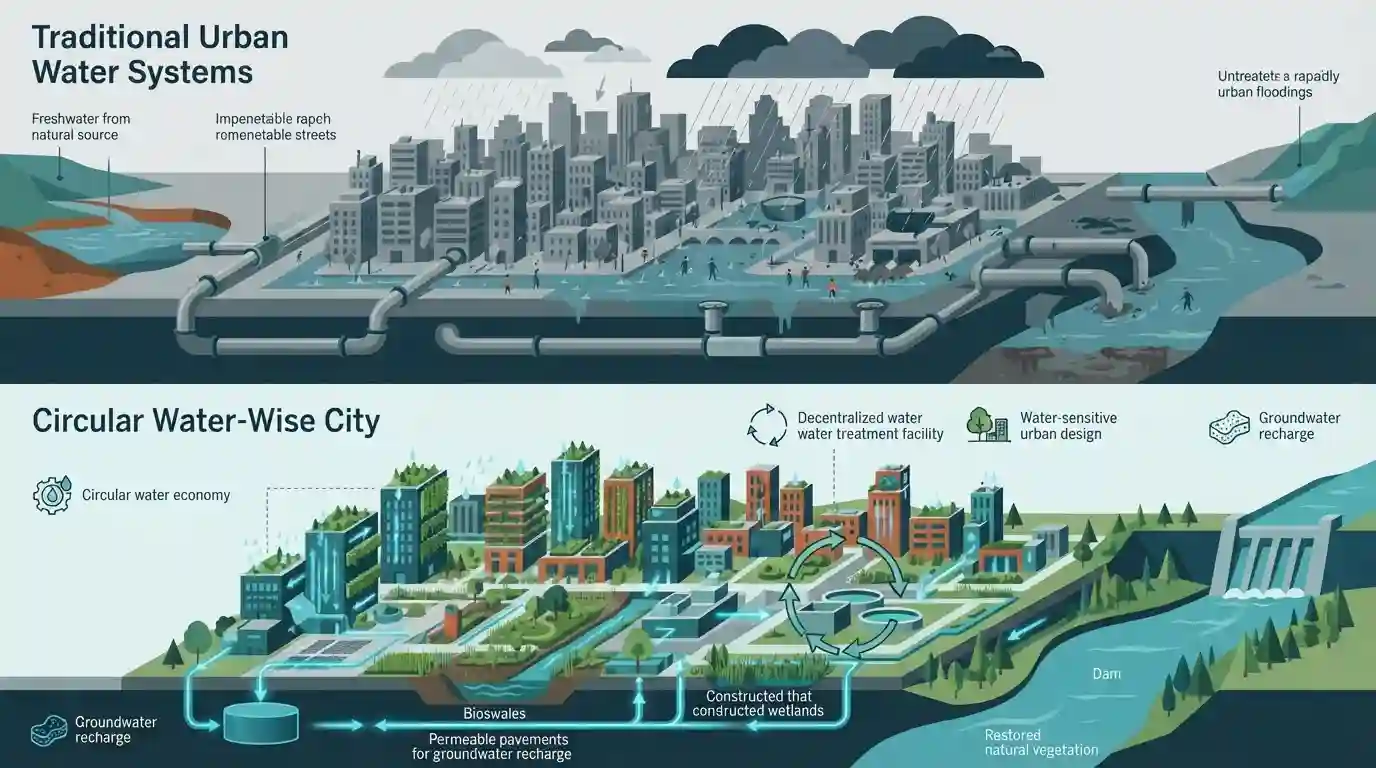
The article explores the paradigm of 'water-wise cities' as a necessary evolution for sustainable urban water management. It advocates moving away from traditional, infrastructure-heavy, linear water systems towards a circular water economy that values wastewater reuse, decentralized treatment, and water-sensitive urban design. By integrating blue-green infrastructure, cities can enhance groundwater recharge and mitigate the devastating impacts of urban flooding. For India, which faces acute water stress and frequent urban floods due to the unchecked reclamation of water bodies, adopting water-wise principles is critical. The path forward involves protecting local ecological assets, promoting extensive urban rainwater harvesting, and effectively implementing urban renewal missions like AMRUT to build climate-resilient cities.
મુખ્ય મુદ્દા
- A 'water-wise city' transitions from a linear water management model (take-use-dispose) to a circular economy focused on reducing consumption, treating wastewater at the source, and maximizing reuse.
- Emphasizes 'Blue-Green Infrastructure'—integrating natural ecosystems like wetlands, lakes, and parks within urban spaces to act as sponges, thereby mitigating urban flooding and aiding groundwater recharge.
- Recognizes the intrinsic link between city planning and the broader river basin ecology, advocating for Water Sensitive Urban Design (WSUD).
- In India, unregulated urbanization and the reclamation of traditional water bodies have caused severe urban water crises, exemplified by alternating severe droughts and flash floods in major metropolises.
- Achieving water-wise status in India necessitates stricter enforcement of rainwater harvesting, protection of urban wetlands, community participation, and leveraging government initiatives like AMRUT and Jal Jeevan Mission (Urban) for resilient infrastructure.
મહત્વપૂર્ણ શબ્દો
AMRUT (Atal Mission for Rejuvenation and Urban Transformation)

A centrally sponsored scheme launched in 2015 by India's MoHUA to improve urban infrastructure, focusing primarily on universal water supply, sewerage, septage management, storm-water drainage, and green spaces across 500 cities.
UPSC context
GS Paper 2 (Government Schemes) and GS Paper 3 (Infrastructure); tests sustainable urban renewal and cooperative federalism mechanisms.
Jal Jeevan Mission (Urban)
A mission designed to provide universal household water supply through functional taps in statutory towns. It was launched as AMRUT 2.0 to make cities water secure, promote circular water economy, and rejuvenate local water bodies.
UPSC context
GS Paper 2 (Welfare Schemes) and GS Paper 3 (Water Resources); tests urban sanitation, water security, and service delivery performance.
Smart Cities Mission
An urban renewal and retrofitting initiative launched in 2015 to develop 100 cities with smart solutions, adequate infrastructure, digital connectivity, and sustainable planning, aiming to improve citizen quality of life.
UPSC context
GS Paper 1 (Urbanization) and GS Paper 3 (Infrastructure); tests technology-driven urban models and sustainable city planning practices.
International Water Association (IWA)
A prominent global network of water professionals and researchers dedicated to sustainable water management, which formulated the "Principles for Water-Wise Cities" to guide climate-resilient and integrated urban planning.
UPSC context
GS Paper 3 (Environmental Conservation/Disaster Management); tests global frameworks and standard methodologies for water-sensitive urban design.
Ministry of Housing and Urban Affairs (MoHUA)
The apex Indian government ministry responsible for formulation, coordination, and administration of housing policies, urban planning, municipal governance, and flagship infrastructure initiatives like AMRUT and Smart Cities.
UPSC context
GS Paper 2 (Governance/Policy Formulation); tests institutional mechanisms overseeing urban development, municipal reforms, and welfare schemes.
પ્રિલિમ્સ ટ્રેપ
AMRUT 2.0 mandates 100% recycling of treated wastewater for municipal supply.
Aspirants often conflate universal supply targets with reuse targets. AMRUT 2.0 aims for 20% municipal and 40% industrial demand to be met via recycled water, not 100%.
સંલગ્ન સ્થિર ખ્યાલો
What defines Blue-Green Infrastructure (BGI) in urban planning?
- Blue assets: Rivers, lakes, wetlands, floodplains, and engineered water retention basins that manage hydrological flows.
- Green assets: Parks, urban forests, green roofs, and bio-swales that act as natural sponges.
- System integration: Combines these natural assets to manage stormwater, reduce heat islands, and enhance biodiversity rather than relying purely on concrete 'grey' infrastructure.
What constitutes a Circular Economy of Water?
- Reduce: Minimizing water consumption at the source through efficient fixtures and water-sensitive urban design.
- Reuse & Recycle: Treating wastewater to make it suitable for non-potable uses like urban agriculture, industrial cooling, or landscaping.
- Recharge: Using treated stormwater or wastewater to replenish groundwater aquifers, replacing the linear "take-make-dispose" model.
આંતર-વિષય પેટર્ન
Urban Floods and Ramsar Degradation
The shrinking of peri-urban wetlands (e.g., East Kolkata Wetlands, Deepor Beel) directly exacerbates urban flooding, bridging wetland conservation with urban disaster management.
WSUD within Urban Renewal Missions
Water-Sensitive Urban Design (WSUD) moves beyond conventional concrete drainage, embedding ecological sponges into urban renewal frameworks, linking ecology directly with municipal infrastructure financing.

Mains 2026 likely to link AMRUT 2.0's circular water economy targets with urban flood mitigation via Blue-Green Infrastructure.
સંલગ્ન PYQ · 4
સંલગ્ન PYQ · 4
- 2018MainsGS1
The ideal solution of depleting ground water resources in India is water harvesting system." How can it be made effective in urban areas?
- 2020MainsGS1
Account for the huge flooding of million cities in India including the smart ones like Hyderabad and Pune. Suggest lasting remedial measures.
- 2021MainsGS1
What are the environmental implications of the reclamation of water bodies into urban land use ? Explain with examples.
- 2024MainsGS3
The world is facing an acute shortage of clean and safe freshwater. What are the alternative technologies which can solve this crisis? Briefly discuss any three such technologies citing their key merits and demerits.
