Super El Nino Threatens Indian Monsoon and Agricultural Output
Source:The Hindu ↗
Why It Matters
The Indian monsoon's dependence on global climatic phenomena like ENSO makes El Nino a perennial hot topic for UPSC. Understanding the mechanics of a 'super El Nino' and its socio-economic fallout is crucial for both GS1 (Geography) and GS3 (Economy/Agriculture).
Summary
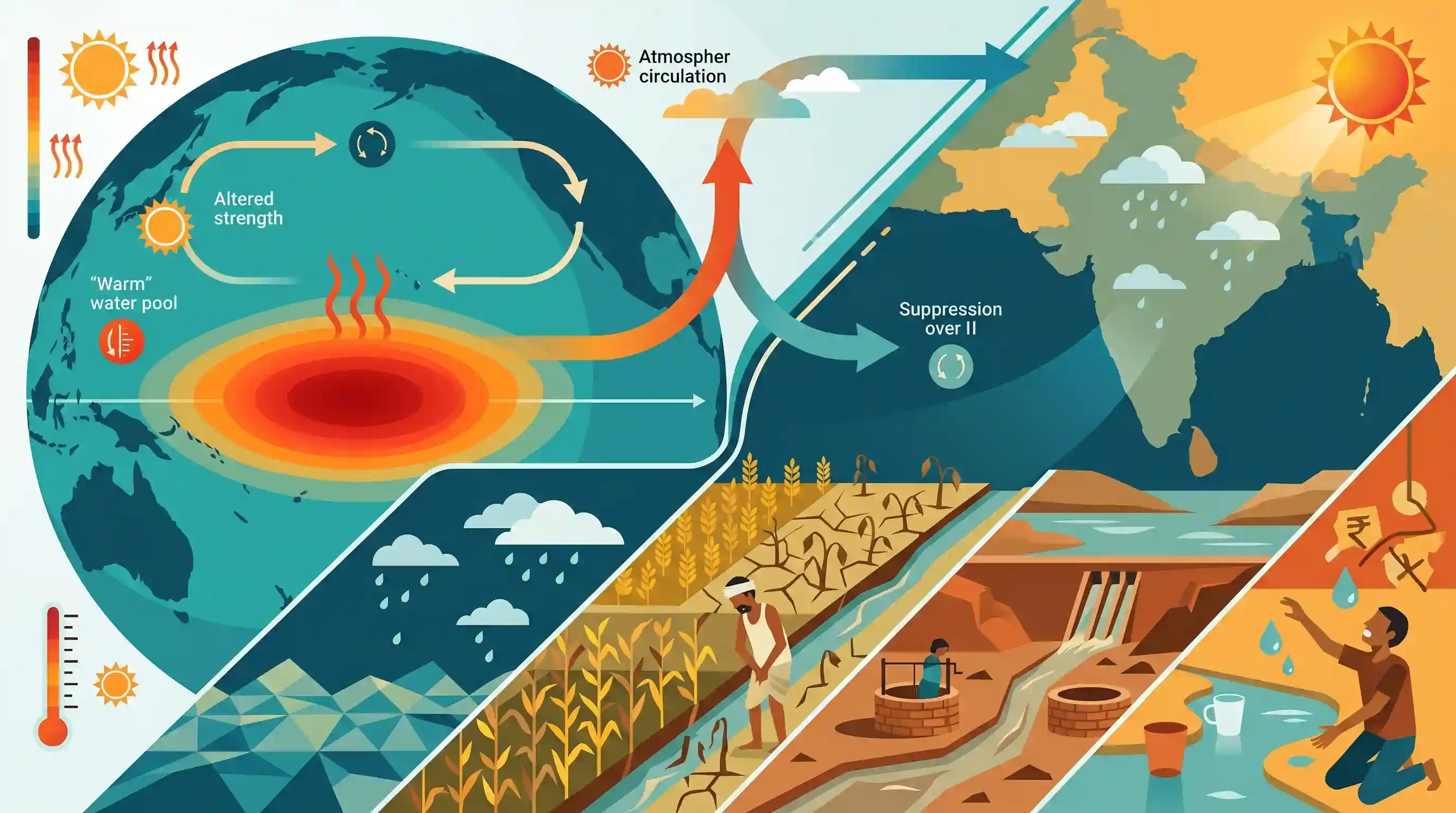
The article examines the potential emergence of a 'super El Nino' and its profound implications for the Indian summer monsoon. El Nino, characterized by unusual warming in the equatorial Pacific, typically suppresses rainfall over the Indian subcontinent by altering atmospheric circulation. A particularly strong or 'super' El Nino threatens to cause severe rainfall deficits, which could lead to widespread drought, impacting agriculture, water security, and the broader economy that relies heavily on the southwest monsoon.
Key Points
- El Nino is a climate pattern involving the anomalous warming of surface waters in the eastern and central equatorial Pacific Ocean.
- A 'super El Nino' occurs when sea surface temperature anomalies exceed a high threshold (e.g., 2°C or more), leading to more extreme global weather disruptions.
- For India, El Nino is historically correlated with a weakened southwest monsoon, leading to deficient rainfall and drought-like conditions.
- A super El Nino could severely impact agricultural output, deplete water reservoirs, and create inflationary pressures on the Indian economy due to crop failures.
Important Terms
El Niño-Southern Oscillation (ENSO)

A periodic fluctuation in sea surface temperatures and atmospheric pressure across the tropical Pacific Ocean, consisting of El Niño (warm), La Niña (cool), and neutral phases.
UPSC context
Core Geography (GS Paper I) topic; essential for understanding global climate variability and monsoon teleconnections.
El Niño
The warm phase of ENSO, characterized by unusual equatorial Pacific warming that weakens trade winds and typically causes rainfall deficits and droughts in India.
UPSC context
Critical for GS Paper I (Climatology) and GS Paper III (Agricultural productivity and food security).
Super El Niño
An exceptionally intense El Niño event where sea surface temperature anomalies in the central-eastern Pacific exceed +2°C, leading to severe global weather disruptions.
UPSC context
Relevant for GS Paper III (Disaster Management) and GS Paper I (Extreme weather phenomena).
Indian Ocean Dipole (IOD)
The difference in sea surface temperatures between the western and eastern Indian Ocean; a 'positive' IOD can often offset El Niño’s drying effects on India.
UPSC context
Key UPSC Geography concept explaining regional variations in the Indian Summer Monsoon.
India Meteorological Department (IMD)
India’s principal government agency under the Ministry of Earth Sciences responsible for meteorological observations, weather forecasting, and tracking tropical cyclones.
UPSC context
Important for GS Paper I (Geography) and GS Paper III (Disaster Management preparedness).
World Meteorological Organization (WMO)
A specialized United Nations agency that coordinates international cooperation on atmospheric science, climatology, hydrology, and geophysical research.
UPSC context
Significant for GS Paper II (International Organizations) and global climate governance.
Prelims Trap
"El Nino is characterized by the anomalous warming of the western equatorial Pacific Ocean."
UPSC frequently swaps eastern with western. El Nino involves warming in the central and eastern Pacific, while the western Pacific experiences high pressure and cooler waters.
Static Concepts Connected
How does El Nino alter the Walker Circulation to affect India?
- Normal Phase: Trade winds push warm surface water westward, creating low pressure over Indonesia and high pressure off the coast of Peru.
- El Nino Phase: Trade winds weaken. Warm water pools in the central/eastern equatorial Pacific, shifting the global convection zone eastward.
- Monsoon Impact: This disrupts the Walker Circulation, causing high pressure and descending dry air over the Indian subcontinent, effectively suppressing monsoon rainfall.
What is the Indian Ocean Dipole (IOD) and its relation to El Nino?
- IOD Mechanism: An ocean-atmosphere phenomenon involving anomalous sea surface temperature differences between the western (Arabian Sea) and eastern Indian Ocean.
- Positive IOD: A warmer western Indian Ocean brings more moisture and convection to India, which can mitigate or neutralize El Nino-induced droughts.
- Negative IOD: A cooler western Indian Ocean reduces moisture supply, which exacerbates the drought-like conditions caused by an active El Nino.
Cross-Topic Patterns
El Nino & Macroeconomic Inflation
Deficient rainfall shrinks rainfed crop yields (like pulses and oilseeds), spiking food inflation. This complicates the RBI's inflation-targeting mandate, often forcing a tighter monetary policy.
Extreme ENSO & Coral Bleaching
Prolonged sea surface temperature spikes during Super El Ninos trigger catastrophic global coral bleaching, linking climatology directly to marine biodiversity loss in the Environment syllabus.

A 2026 prelims question will likely blend El Nino’s atmospheric physics (Walker cell) with its economic fallout (food inflation & RBI).
Linked PYQs · 4
Linked PYQs · 4
- 2011PrelimsGS1
La Nina is suspected to have caused recent floods in Australia. How is La Nina different from El Nino? 1. La Nina is characterised by unusually cold ocean temperature in equatorial Indian Ocean whereas El Nino is characterised by unusually warm ocean temperature in the equatorial Pacific Ocean. 2. El Nino has adverse effect on south-west monsoon of India, but La Nina has no effect on monsoon climate. Which of the statements given above is/are correct?
- 2002PrelimsGS1
For short-term climate prediction, which one of the following events, detected in the last decade, is associated with occasional weak monsoon rains in the India subcontinent?
- 2017PrelimsGS1
With reference to 'Indian Ocean Dipole (IOD)' sometimes mentioned in the news while forecasting Indian monsoon, which of the following statements is/are correct? 1. IOD phenomenon is characterised by a difference in sea surface temperature between tropical Western Indian Ocean and tropical Eastern Pacific Ocean. 2. An IOD phenomenon can influence an El Nino's impact on the monsoon. Select the correct answer using the code given below:
- 2014MainsGS1
Most of the unusual climatic happenings are explained as an outcome of the El-Nino effect. Do you agree?
