Geopolitical Implications of Post-Assad Syria for China
Source:The Hindu ↗
Why It Matters
The geopolitical restructuring of West Asia directly impacts global stability, energy security, and major power competition. As China's regional strategy faces disruption in the Levant, it creates opportunities for India to project its own strategic alternatives (like the India-Middle East-Europe Economic Corridor). Furthermore, the geography of the Levant and countries bordering the Mediterranean Sea is a highly recurrent theme in UPSC Prelims.
Summary
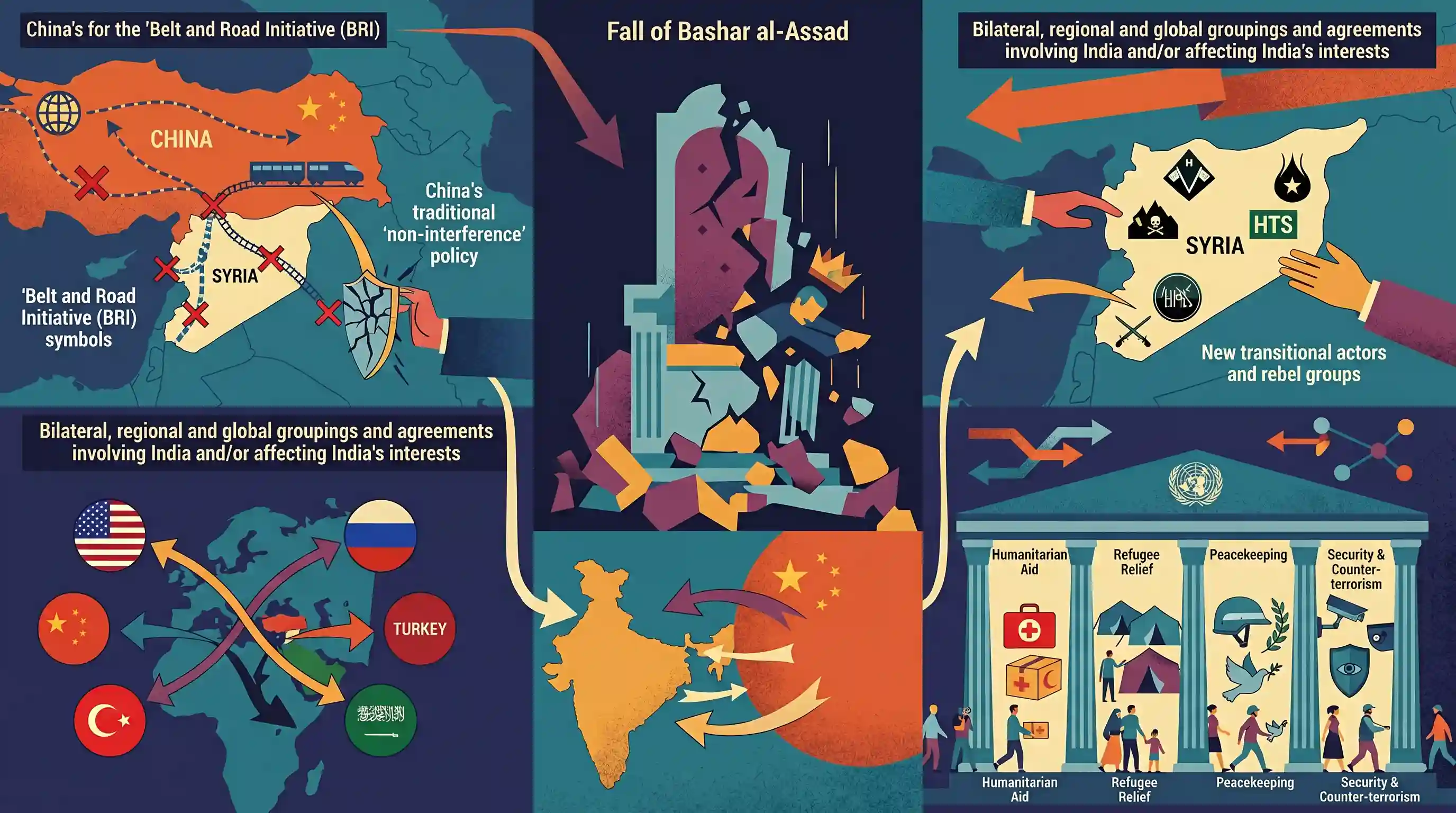
The sudden collapse of Bashar al-Assad's regime in Syria represents a critical geopolitical pivot with profound implications for China's strategy in West Asia. Having heavily backed Assad and integrated Syria into the Belt and Road Initiative (BRI) to secure a strategic foothold in the Levant, Beijing now faces a power vacuum and endangered investments. The transition tests China's traditional 'non-interference' policy, forcing it to pragmatically engage with new transitional actors, potentially including Hayat Tahrir al-Sham (HTS). As regional dynamics shift, China must navigate intensified competition with the US, Russia, and regional powers, while the resulting instability and realignment offer broader implications for global supply chains and strategic counter-balancing by nations like India.
Key Points
- Prior to the regime's collapse, China had heavily integrated Bashar al-Assad's Syria into its Belt and Road Initiative (BRI), capitalizing on his international isolation.
- The abrupt fall of Assad creates a strategic vacuum in the Levant, jeopardizing existing Chinese infrastructure investments and its regional foothold.
- China's traditional diplomatic doctrine of 'non-interference' will be tested as it navigates relations with a fragmented transitional government and groups like HTS.
- The transition forces Beijing to rely on its pragmatic diplomacy—similar to its approach in brokering the Saudi-Iran detente—to protect its interests amidst competing influences from the US, Russia, Turkey, and Iran.
- The geopolitical realignment in West Asia opens strategic windows for other global players, including India, to bolster alternative connectivity and supply chain initiatives in the region.
Important Terms
Belt and Road Initiative (BRI)

A global infrastructure strategy launched by China in 2013, aiming to connect Asia with Africa and Europe via land and sea routes to enhance trade and regional influence.
UPSC context
GS Paper II: Bilateral and global groupings. Tests understanding of China's expansionism and impact on India's strategic interests.
Hayat Tahrir al-Sham (HTS)
A Sunni Islamist militant group in Syria that spearheaded the 2024 offensive toppling the Assad regime; formerly an Al-Qaeda affiliate that now seeks political legitimacy.
UPSC context
GS Paper II: Regional security. Relevant for analyzing stability, terrorism, and the role of non-state actors in West Asia.
Non-interference Policy
A core principle of Chinese foreign policy asserting that states should not intervene in the internal affairs of others, prioritizing sovereignty over Western-style humanitarian or democratic interventionism.
UPSC context
GS Paper II: Foreign policies of major powers. Tests understanding of China's diplomatic pragmatism during regime changes in partner nations.
Levant
A geographical and cultural region in the Eastern Mediterranean, encompassing modern-day Syria, Lebanon, Israel, Jordan, and Palestine, serving as a historic crossroads between three continents.
UPSC context
GS Paper I: World Geography. Vital for understanding the geopolitical significance and territorial disputes of the Eastern Mediterranean.
West Asia
The westernmost part of Asia, often called the Middle East, encompassing 18 countries and serving as a critical pillar for India’s energy security and diaspora welfare.
UPSC context
GS Paper II: India's extended neighborhood. Essential for analyzing strategic maritime routes and the 'Link West' policy.
Strategic Counter-balancing
A geopolitical strategy where states employ alliances, economic initiatives, or military capabilities to prevent a rival power from achieving regional or global hegemony.
UPSC context
GS Paper II: India’s strategic interests. Key for evaluating India's maneuvers against China’s growing presence in the Middle East.
Prelims Trap
"China’s 'non-interference' policy strictly prohibits diplomatic engagement with unrecognized non-state actors."
Aspirants assume non-interference means ignoring militants. However, China adopts 'pragmatic diplomacy,' actively engaging non-state actors (like the Taliban and HTS) to protect overseas assets.
Static Concepts Connected
What constitutes the geographic region of the Levant and Syria's border profile?
- Levant Region: Historical term for the Eastern Mediterranean region, typically including Syria, Lebanon, Jordan, Israel, Palestine, and Cyprus.
- Syrian Borders: Shares land borders with Turkey, Iraq, Jordan, Israel, and Lebanon, with a western coastline on the Mediterranean Sea.
- Geopolitical Value: Acts as a vital geographical gateway connecting Asia and Europe, crucial for major trade and infrastructure networks like BRI and IMEC.
What is the historical basis of China's 'non-interference' foreign policy doctrine?
- Panchsheel Origins: Rooted in the Five Principles of Peaceful Coexistence (Panchsheel), originally formalized in a 1954 agreement between India and China.
- Core Tenets: Mandates mutual non-interference in each other's internal affairs, mutual non-aggression, and respect for territorial integrity.
- Modern Application: China traditionally uses this doctrine to contrast itself with Western interventionism, though its massive BRI investments increasingly force pragmatic compromises.
Cross-Topic Patterns
IMEC vs BRI in the Levant
The stalling of China's BRI investments in a destabilized Syria offers a strategic geopolitical opening to advance the India-Middle East-Europe Economic Corridor (IMEC) through alternative regional partners.
Pragmatic diplomacy: Taliban to HTS
Mirroring its post-US Afghanistan strategy with the Taliban, Beijing shows a growing pattern of engaging transitional militant actors to secure infrastructure and mineral assets, challenging its strict non-interference claims.
China as a West Asian Peacemaker
China's 2023 mediation between Saudi Arabia and Iran established its new ambition as a West Asian security guarantor, a diplomatic model it must now adapt to a fragmented Syria.

Expect a 2026 mapping question on the Levant's borders (Syria/Israel) paired with statements on IMEC's Mediterranean connectivity route.
Linked PYQs · 5
Linked PYQs · 5
- 2024MainsGS2
‘The West is fostering India as an alternative to reduce dependence on China's supply chain and as a strategic ally to counter China's political and economic dominance.’ Explain this statement with examples.
- 2025MainsGS2
"The reform process in the United Nations remains unresolved, because of the delicate imbalance of East and West and entanglement of the USA vs. Russo-Chinese alliance.” Examine and critically evaluate the East-West policy confrontations in this regard.
- 2019PrelimsGS1
Consider the following pairs: Sea Bordering country 1. Adriatic Sea : Albania 2. Black Sea : Croatia 3. Caspian Sea : Kazakhstan 4. Mediterranean Sea : Morocco 5. Red Sea : Syria Which of the pairs given above are correctly matched?
- 2017PrelimsGS1
Mediterranean Sea is a border of which of the following countries? 1. Jordan 2. Iraq 3. Lebanon 4. Syria Select the correct answer using the code given below:
- 2015PrelimsGS1
Which one of the following countries of South-West Asia does not open out to the Mediterranean Sea?
