Western Ghats ESA Plan and State Opposition to Conservation Norms
Source:Indian Express ↗
Why It Matters
Understanding the policy friction between central environmental protection norms and state-level developmental demands is crucial for evaluating India's federal environmental governance and climate commitments.
Summary
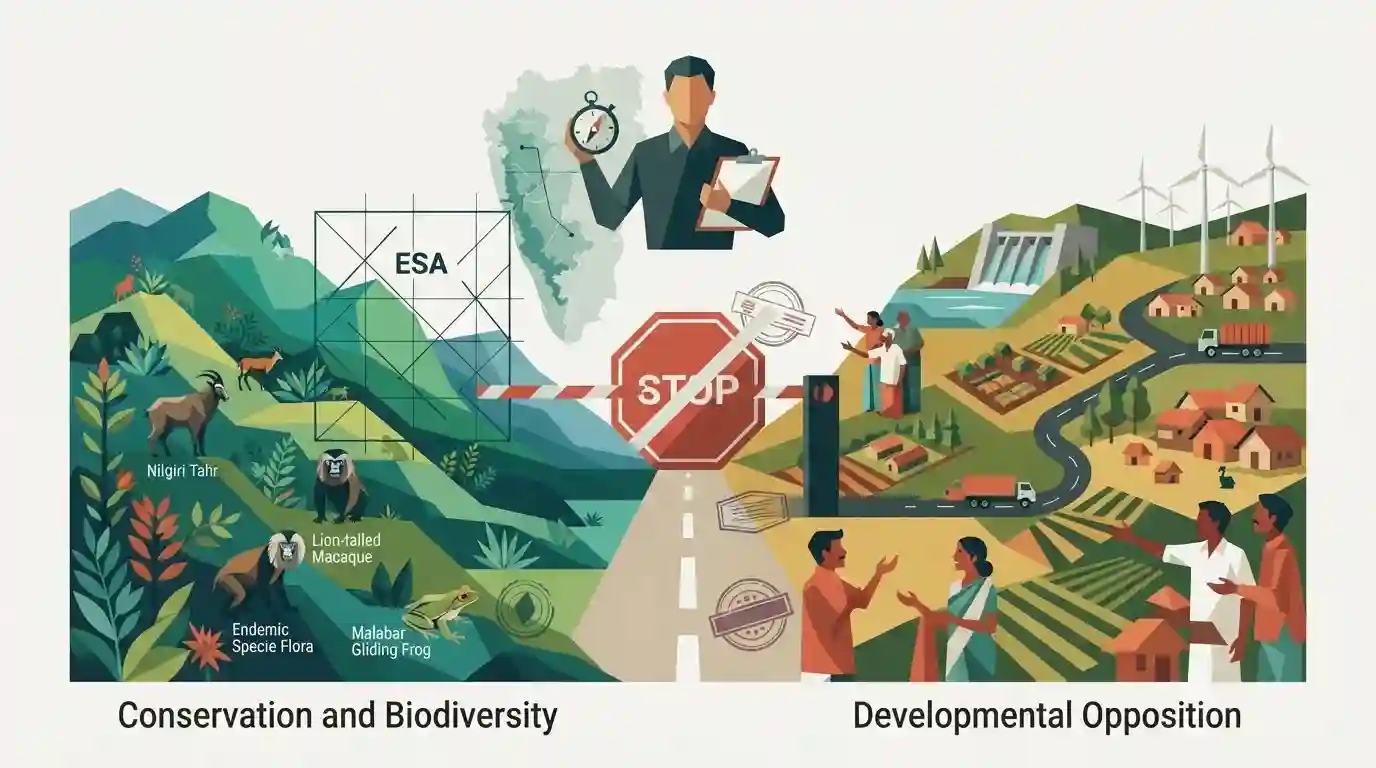
The article explores the ongoing controversy and bureaucratic delays surrounding the Ecologically Sensitive Area (ESA) notification for the Western Ghats. Based on recommendations from the Kasturirangan Committee, the central government aims to protect the fragile biodiversity hotspot by restricting harmful economic and industrial activities. However, the move faces stiff opposition from several Western Ghats states due to concerns over local livelihoods, land rights, and socio-economic development.
Key Points
- The Ministry of Environment, Forest and Climate Change (MoEFCC) has been pushing to notify Ecologically Sensitive Areas (ESAs) in the Western Ghats based on the Kasturirangan Committee report.
- The draft notifications aim to restrict certain developmental activities like mining, large construction, and thermal power plants across designated regions in six Western Ghats states.
- State governments (such as Kerala and Karnataka) have opposed portions of the notification, citing concerns over livelihood disruptions for local communities, traditional agricultural practices, and constraints on infrastructure development.
- The Western Ghats spans six states and is recognized globally as a biodiversity hotspot, facing persistent tensions between ecological conservation and developmental imperatives.
Important Terms
Ecologically Sensitive Area (ESA) notification

A formal notification by the government designating fragile geographical zones around protected areas to restrict harmful industrial, mining, and developmental activities, thereby conserving local biodiversity.
UPSC context
UPSC CSE Paper III (Environment & Ecology): Tests knowledge of environmental impact assessment, conservation policies, and developmental conflicts.
Ministry of Environment, Forest and Climate Change (MoEFCC)
The central government ministry responsible for planning, promoting, and implementing environmental and forestry policies, including wildlife conservation and climate change mitigation in India.
UPSC context
UPSC CSE Paper II & III: Tests administrative governance, environmental statutory frameworks, and policy implementation structures.
Gadgil Committee (WGEEP)
The Western Ghats Ecology Expert Panel (WGEEP), headed by Madhav Gadgil, which recommended classifying the entire Western Ghats into ecological zones with strict curbs on development.
UPSC context
UPSC CSE Paper III (Biodiversity Conservation): Crucial for understanding developmental vs ecological debates and expert recommendations on protected areas.
Kasturirangan Committee (HLWG)
A High-Level Working Group chaired by K. Kasturirangan that proposed a moderated ESA model, covering about 37% of the Western Ghats while excluding cultural landscapes from strict regulations.
UPSC context
UPSC CSE Paper III: Important for balancing sustainable development with environmental protection in biodiversity-rich regions.
Prelims Trap
The Kasturirangan Committee recommended declaring the entire Western Ghats region as an Ecologically Sensitive Area.
Aspirants often assume the Kasturirangan Committee recommended declaring 100% of the Western Ghats as an ESA, when it actually proposed only about 37%.
Static Concepts Connected
What are the key committee recommendations and differences for Western Ghats conservation?
- Gadgil Report: WGEEP (Gadgil Committee) recommended treating the entire Western Ghats as ecologically sensitive, phasing out chemical agriculture, and banning mining completely.
- Kasturirangan Report: HLWG (Kasturirangan Committee) recommended bringing only 37% of the Western Ghats under ESA, permitting sustainable development while banning red-category industries like mining and thermal power.
- Legal Basis: Ecologically Sensitive Areas (ESAs) are notified under the Environment (Protection) Act, 1986, to regulate development around Protected Areas.
Cross-Topic Patterns
ESA Notifications vs Federal Cooperative Governance
The friction between environmental protection in biodiversity hotspots and tribal/local land rights touches both Article 21 jurisprudence and Schedule V/VI autonomous administration.
Gadgil vs Kasturirangan: Participatory vs Top-Down Conservation
Comparing Gadgil and Kasturirangan committees tests an aspirant's understanding of how scientific expert panels transition from participatory ecological models to pragmatic regulatory drafts.

Kasturirangan vs Gadgil committee recommendations + ESA criteria likely to feature in a statement-based environment prelims question.
Linked PYQs · 2
Linked PYQs · 2
- 2016PrelimsGS1
'Gadgil Committee Report' and 'Kasturirangan Committee Report', sometimes seen in the news, are related to
- 2024MainsGS3
What role do environmental NGOs and activists play in influencing Environmental Impact Assessment (EIA) outcomes for major projects in India? Cite four examples with all important details.
