Western Ghats Habitat Reduction and Hydrological Disruption
Source:The Hindu ↗
Why It Matters
The Western Ghats are a critical global biodiversity hotspot and the water tower for peninsular India; findings on habitat degradation and disrupted hydrological cycles are vital for environmental geography and conservation policy.
Summary
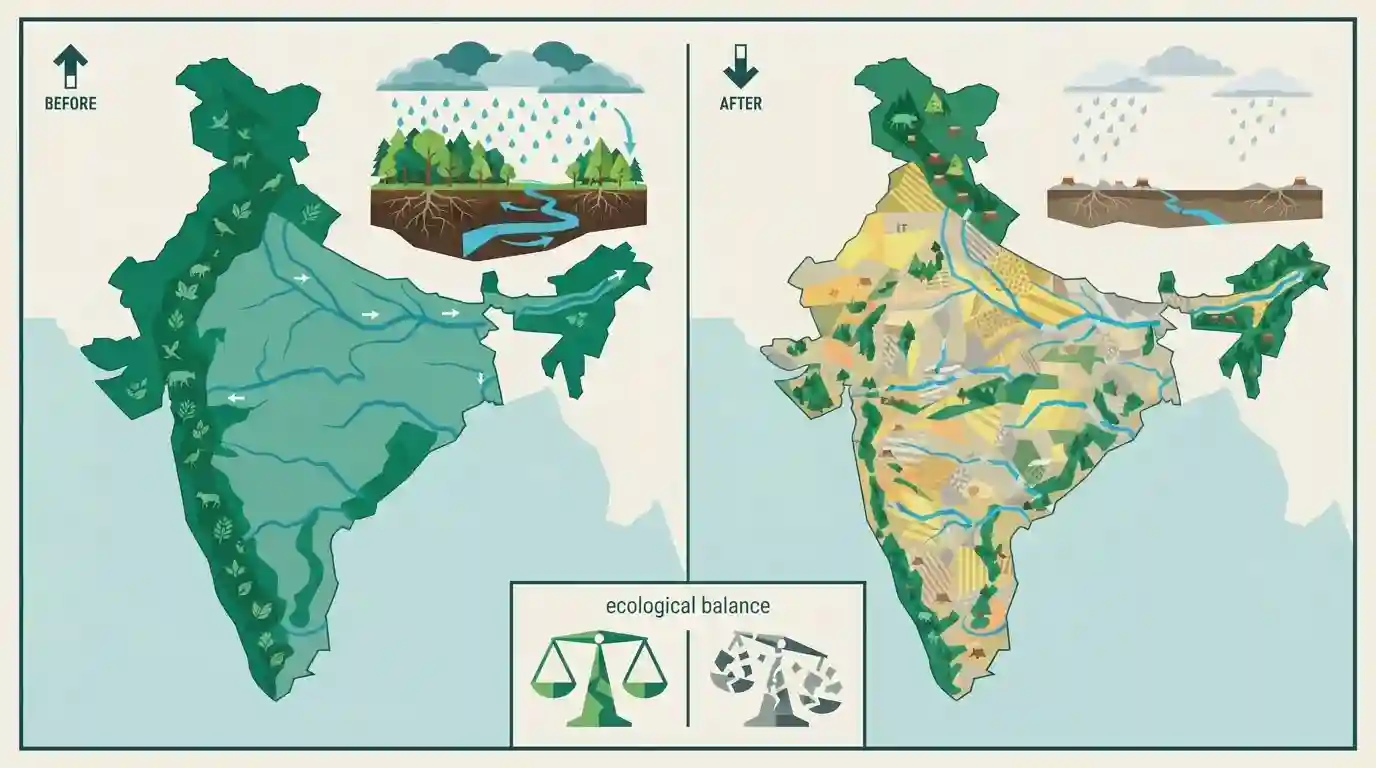
A recent review article notes that native habitats in the Western Ghats have shrunk to one-third of their original coverage, severely impairing hydrological regulation and ecological balance across peninsular India.
Key Points
- A recent review article highlights that native habitats in the Western Ghats have been reduced to one-third of their original extent due to anthropogenic pressures.
- Deforestation and land-use changes in the Western Ghats have severely disrupted hydrological regulation, affecting water retention, river flows, and regional climate patterns.
- The Western Ghats remain a global biodiversity hotspot characterized by high endemism, making habitat fragmentation a critical threat to regional ecological security.
Important Terms
Western Ghats

A globally recognized biodiversity hotspot running parallel to India's west coast, harboring 30% of the country's plant and animal species and serving as a crucial water source for peninsular India.
UPSC context
MPSC Geography and Environment (Paper I/III): Tests knowledge of biodiversity hotspots, ecological degradation, Western Ghats ecology reports (Gadgil/Kasturirangan), and regional geography.
Hydrological Regulation
The ecosystem service provided by natural forests and wetlands to absorb, retain, and gradually release rainwater, which has been severely impaired across the Western Ghats.
UPSC context
MPSC Environment & Ecology: Tests understanding of ecosystem services, watershed management, and how habitat loss triggers floods and water scarcity in peninsular India.
Landscape Fragmentation
The breaking up of continuous natural habitats into smaller, isolated patches due to roads, railways, plantations, and urban expansion, threatening wildlife connectivity.
UPSC context
MPSC Environment and Biodiversity: Tests awareness of anthropogenic pressures, linear infrastructure impacts, and wildlife corridor conservation strategies.
Prelims Trap
Both Gadgil and Kasturirangan committees recommended identical restrictions on mining, quarrying, and thermal power plants across the entire Western Ghats region.
Aspirants often confuse the Gadgil Committee (Western Ghats Ecology Expert Panel, which recommended strict curbs across all zones) with the Kasturirangan Committee (High-Level Working Group, which recommended restricting regulations to 37% of the area).
Static Concepts Connected
What are the key recommendations and differences between the Gadgil and Kasturirangan committees on the Western Ghats?
- Gadgil Panel: Gadgil Committee (WGEEP) designated the entire Western Ghats as an Ecologically Sensitive Area (ESA) and advised against all large dams and mining.
- Kasturirangan Panel: Kasturirangan Panel recommended bringing only 37% of the Western Ghats under ESA, permitting 'red' industries only outside this zone.
- Common Focus: Both reports stress curbing unsustainable land-use changes, shifting agriculture, and unplanned infrastructure projects to protect peninsular hydrology.
Cross-Topic Patterns
Western Ghats Forestry + Peninsular River Hydrology
Peninsular rivers originating in the Western Ghats depend directly on catchment health, linking forest conservation with inter-state river water disputes and tribunal allocations.
ESA Notifications + Federal Developmental Pressures
The debate over Ecologically Sensitive Area (ESA) notifications under the Environment Protection Act highlights the tension between developmental infrastructure and grassroots conservation.

Expect a multi-statement question contrastingGadgil and Kasturirangan committee recommendations on Western Ghats ESAs.
Linked PYQs · 3
Linked PYQs · 3
- 2017MPSC_PRELIMSGS1
Which of the following mountains are considered as one of the top biodiversity hot spots ?
- 2023MPSC_PRELIMSGS1
Observe the following statements : A. There is loss of bio-diversity due to dumping of toxic waste into soil. B. Deforestation is responsible for frequent floods in river. C. Fransisco Mendez was known as 'Amazon Gandhi' due to his work in energy field.
- 2022MPSC_PRELIMSGS1
In India, which of the following has become a hot-spot with reference to threats to biodiversity ?
