Western Ghats ecologically sensitive area notifications discussed
Source:nextias ↗
Why It Matters
Important for MPSC Combined Prelims as it covers geography and ecology of the Western Ghats, biodiversity hotspots, and environmental committee reports like Gadgil and Kasturirangan.
Summary
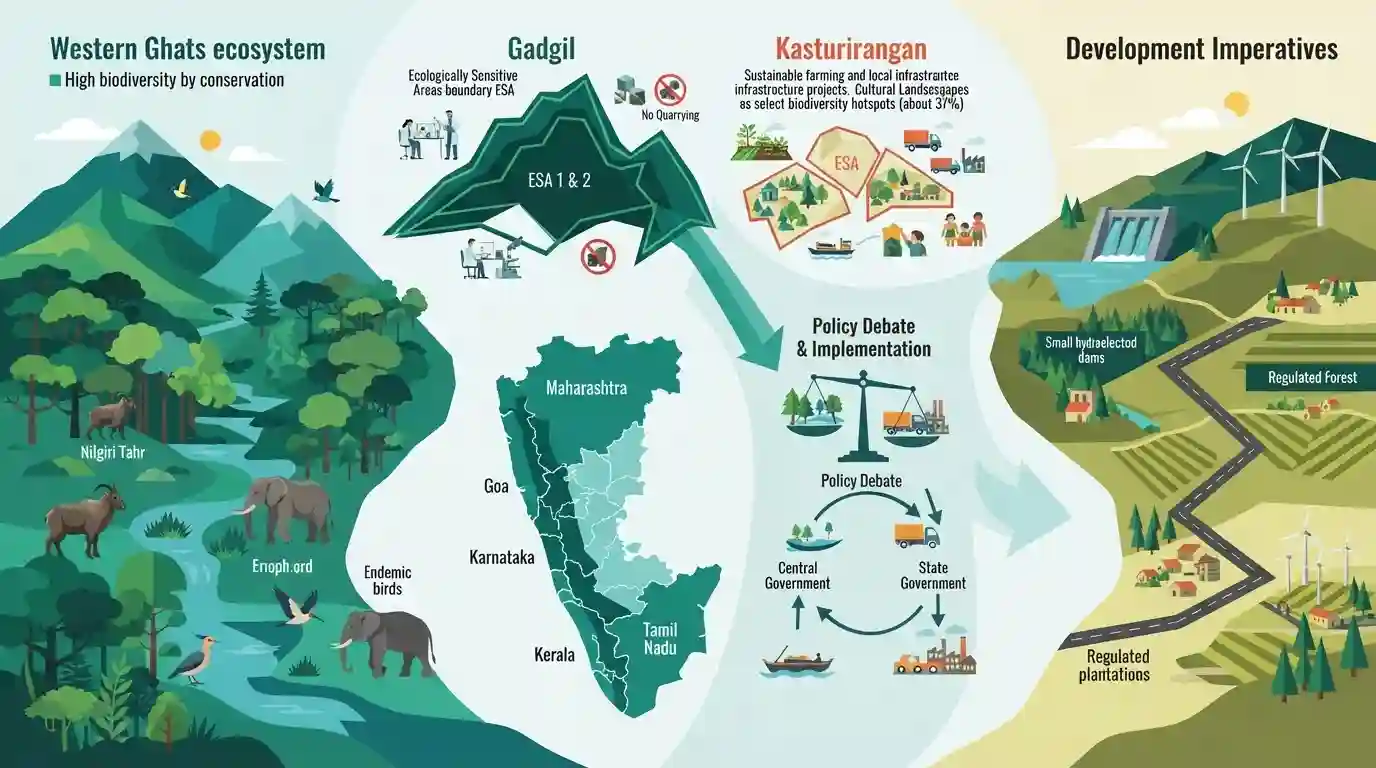
This article focuses on the developments, updates, and ecological significance of the Ecologically Sensitive Area (ESA) notifications in the Western Ghats, highlighting the policy debates between conservation frameworks proposed by committees like the Gadgil and Kasturirangan committees and regional developmental imperatives across Western Ghats states.
Key Points
- The Western Ghats Ecologically Sensitive Area (ESA) notifications and committee recommendations remain a crucial environmental governance topic.
- Discussions typically revolve around balancing developmental needs (such as infrastructure, mining, and agriculture) with biodiversity conservation in the Western Ghats states including Maharashtra, Goa, Karnataka, Kerala, and Tamil Nadu.
- Madhav Gadgil (WGEG) and Kasturirangan (HLWG) committees are key foundational pillars for ESA demarcations.
Important Terms
Ecologically Sensitive Area ESA Notification

Zones designated by the central government under the Environment Protection Act, 1986 to restrict commercial and industrial activities around protected areas to protect fragile ecosystems.
UPSC context
MPSC Paper I/III (Environment & Geography): Tests understanding of biodiversity conservation policies, regulatory frameworks, and center-state developmental debates.
Ministry of Environment Forest and Climate Change
The nodal central government ministry responsible for planning, promoting, and implementing environmental and forestry policies, including the notification of Western Ghats ESAs.
UPSC context
MPSC Paper III (Governance & Environment): Tests knowledge of institutional frameworks implementing environmental protection statutes in India.
Gadgil Committee
The Western Ghats Ecology Expert Panel (2010) chaired by Madhav Gadgil, which recommended declaring the entire Western Ghats an ecologically sensitive zone with bottom-up conservation.
UPSC context
MPSC Paper III/I (Environment & Ecology): Tests knowledge of major committee reports and balancing ecological preservation with regional development.
Kasturirangan Committee
The High-Level Working Group (2013) chaired by K. Kasturirangan that recommended protecting about 37 percent of the Western Ghats as an ESA using satellite-based mapping.
UPSC context
MPSC Paper III (Environment & Geography): Evaluates candidate knowledge on sustainable development models and committee recommendations for Western Ghats.
Prelims Trap
Both the Gadgil and Kasturirangan committees recommended declaring the entire Western Ghats region as an Ecologically Sensitive Area.
Aspirants often confuse Gadgil Committee's recommendation (entire Western Ghats as ESA) with Kasturirangan Committee's recommendation (only 37% under ESA).
Static Concepts Connected
What are the core recommendations and differences between the Gadgil and Kasturirangan Committees on the Western Ghats?
- Gadgil Committee: WGEEP (2010) classified the entire Western Ghats as an Ecologically Sensitive Area (ESA) with 3 zones and proposed a statutory Western Ghats Ecology Authority.
- Kasturirangan Committee: HLWG (2013) recommended bringing only 37% (approx. 60,000 sq km) of the Western Ghats under ESA, focusing on natural landscape and prohibiting mining/red industries.
- Geographical Scope: Spans 6 states: Gujarat, Maharashtra, Goa, Karnataka, Kerala, and Tamil Nadu, recognized globally as one of the 8 hottest biodiversity hotspots.
Cross-Topic Patterns
Western Ghats ESA + Federalism & Centre-State Relations
Western Ghats ecological notifications intersect with federal disputes over land-use powers and state-level resistance to Centre-notified ESAs under Article 248/Concurrent List.
Ecological Zoning + Disaster Management & Landslide Mitigation
Balancing landslide-prone terrain development with stringent ESA restrictions links ecological zoning directly to disaster management and urban resilience planning in Maharashtra and Kerala.

Expect a statement-based MPSC question contrasting Gadgil (100% ESA, WGEA) vs Kasturirangan (37% ESA, cultural landscape approach) committee findings.
Linked PYQs · 3
Linked PYQs · 3
- 2017MPSC_PRELIMSGS1
Which of the following mountains are considered as one of the top biodiversity hot spots ?
- 2022MPSC_PRELIMSGS1
In India, which of the following has become a hot-spot with reference to threats to biodiversity ?
- 2025MPSC_PRELIMSGS1
Match the following. | Biosphere Reserve | Establishment Year | |---|---| | a. Nilgiri | I. 2011 | | b. Sundarban | II. 2008 | | c. Kutch | III. 1989 | | d. Panna | IV. 1986 | Code: a b c d
