Western Ghats Seventh Draft ESA Faces Resistance from Six States
Source:downtoearth-org ↗
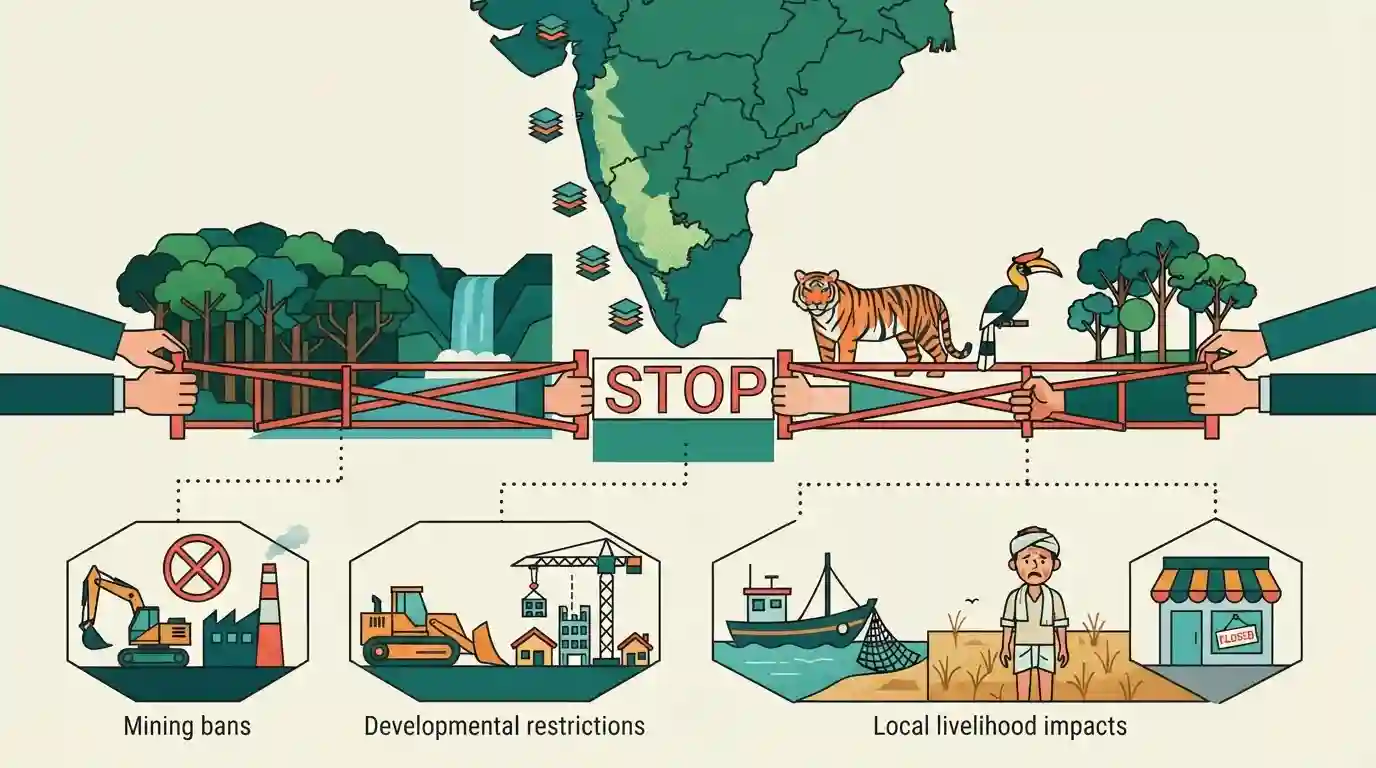
Why It Matters
Crucial for MPSC aspirants studying environmental governance, biodiversity hotspots, and federal friction regarding environmental notifications in India.
Summary
The seventh draft notification to declare portions of the Western Ghats as an Ecologically Sensitive Area (ESA) faces continuous resistance from six regional states—Maharashtra, Goa, Karnataka, Kerala, Tamil Nadu, and Gujarat—due to anxieties surrounding developmental restrictions, mining bans, and local livelihood impacts.
Key Points
- The seventh draft notification for the Western Ghats Ecologically Sensitive Area (ESA) has met with strong resistance from six stakeholder states: Maharashtra, Goa, Karnataka, Kerala, Tamil Nadu, and Gujarat.
- States are concerned that the restrictions on mining, quarrying, thermal power plants, and large construction projects within the designated ESA will hamper local livelihoods and developmental activities.
- The Gadgil and Kasturirangan committees form the background context for framing the Western Ghats conservation policies and identifying ecologically sensitive zones.
Important Terms
Western Ghats Ecologically Sensitive Area ESA notification

A draft notification issued under the Environment (Protection) Act, 1986, proposing to protect 56,825.7 sq. km of the Western Ghats by restricting mining, quarrying, and polluting industries.
UPSC context
MPSC General Studies Paper I (Geography) and Paper III (Environment & Ecology): Tests knowledge of biodiversity conservation, environmental laws, and federal friction.
Ministry of Environment, Forest and Climate Change
The central nodal ministry responsible for planning, promoting, and coordinating environmental and forestry policies and programs in India, including the declaration of ESAs.
UPSC context
MPSC General Studies Paper III (Environment & Ecology, Polity & Governance): Tests understanding of central executive bodies and environmental policy implementation.
Prelims Trap
The Kasturirangan committee recommended declaring the entire Western Ghats as an Ecologically Sensitive Area with zero developmental activities.
Aspirants often confuse Madhav Gadgil Committee's complete ban recommendations with Kasturirangan's 37% targeted ESA approach, or misattribute which states are covered.
Static Concepts Connected
What are the key differences between the Gadgil and Kasturirangan committees on Western Ghats?
- Gadgil Committee: WGEEP (2010) recommended declaring the entire Western Ghats as ESA across three zones with strict curbs on mining and thermal power.
- Kasturirangan Committee: HLWG (2013) recommended bringing only 37% of the Western Ghats under ESA, focusing primarily on cultural and natural landscapes.
- Core Objective: Both committees aimed to balance peninsular India's hydrological security with ecological fragility, but differed on developmental trade-offs.
Cross-Topic Patterns
Western Ghats ESA + Federalism and Scheduled Areas
Western Ghats conservation debates frequently intersect with Article 246 (legislative lists) and Schedule V/VI provisions regarding tribal rights in forested regions.

Gadgil vs Kasturirangan committee recommendations and state-wise ESA area shares are frequent multi-statement MPSC trap items.
Linked PYQs · 2
Linked PYQs · 2
- 2017MPSC_PRELIMSGS1
Which of the following mountains are considered as one of the top biodiversity hot spots ?
- 2024MPSC_PRELIMSGS1
Match the following pairs : | List-I | List-II | |---|---| | (a) Dr. Nitin Karmalkar Committee | (i) For implementation of National Education Policy - 2020 in Maharashtra | | (b) Nitin Karir Committee | (ii) To enquire the incident which happened during the distribution of Maharashtra Bhushan Award | | (c) Sunil Pawar Committee | (iii) To study why the rates of onion collapse. | | (d) Dr. K. Kasturirangan Committee | (iv) To make the syllabus for pre-primary to degree according to National Education Policy - 2020 | Code: (a) (b) (c) (d)
