Western Ghats Seventh Draft ESA Faces Opposition from States
Source:downtoearth-org ↗
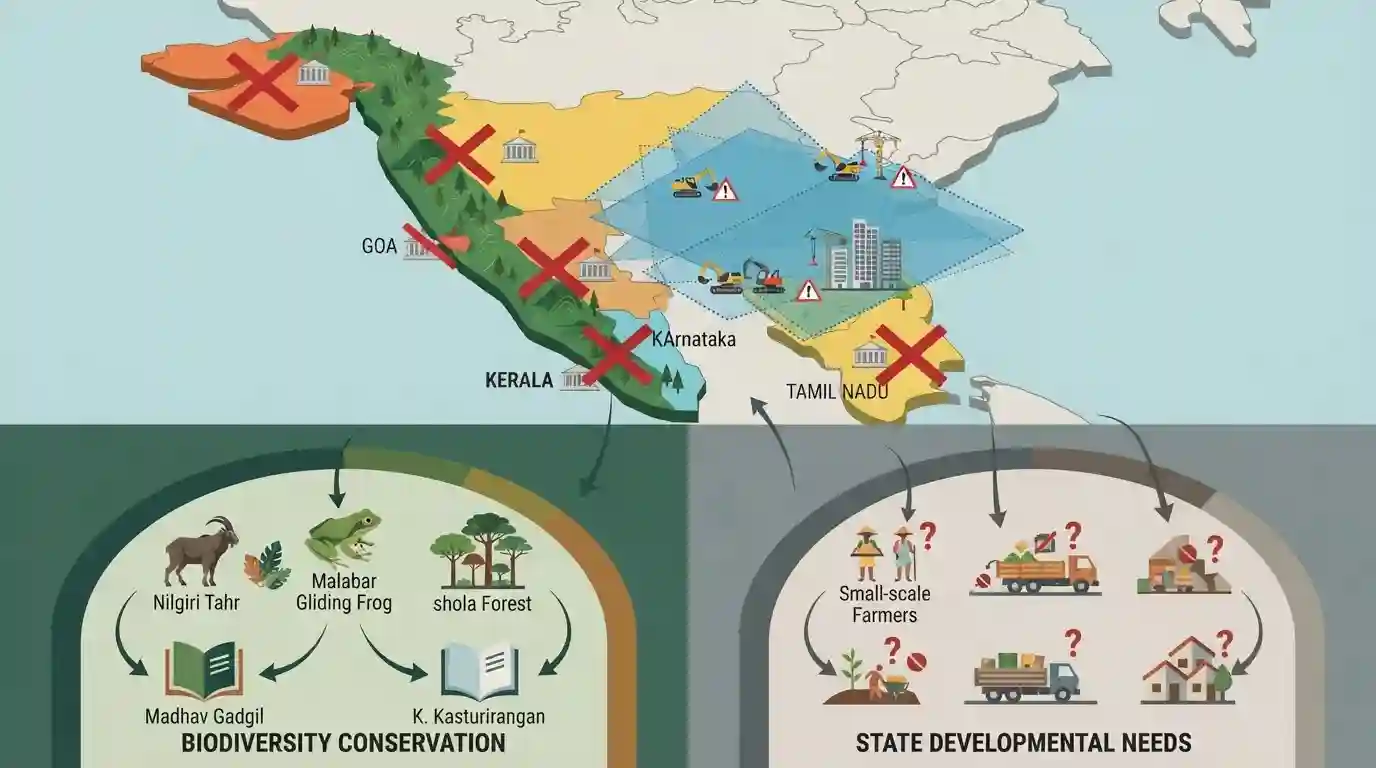
Why It Matters
Crucial for MPSC aspirants tracking environmental governance, ecological conservation policies, central-state conflicts over natural resource management, and committees related to the Western Ghats like the Gadgil and Kasturirangan reports.
Summary
The release of the seventh draft notification by the Union Ministry of Environment, Forest and Climate Change (MoEFCC) to designate Ecologically Sensitive Areas (ESAs) in the Western Ghats has met with widespread resistance from all six constituent states: Maharashtra, Goa, Gujarat, Karnataka, Kerala, and Tamil Nadu. The draft notification seeks to regulate developmental activities like mining, quarrying, and large-scale construction in specified eco-sensitive zones to protect the region's rich biodiversity, following recommendations from the Madhav Gadgil and K. Kasturirangan committees. However, state governments argue that the restrictions adversely impact local livelihoods and infrastructure development.
Key Points
- The Union Ministry of Environment, Forest and Climate Change (MoEFCC) has released the seventh draft notification to declare Ecologically Sensitive Areas (ESAs) in the Western Ghats.
- All six states spanning the Western Ghats—Maharashtra, Goa, Gujarat, Karnataka, Kerala, and Tamil Nadu—have expressed resistance against the draft notification over developmental concerns.
- The notification aims to protect biodiversity hotspots identified by panels led by Madhav Gadgil and K. Kasturirangan by restricting mining, large construction, and polluting industries.
- State objections center around livelihood impacts, restrictions on local infrastructure, and land-use regulations.
Important Terms
Environment Protection Act, 1986

India's umbrella environmental legislation enacted in 1986 following the Bhopal gas tragedy. It empowers the central government to protect environmental quality, regulate hazardous industries, and notify ecologically sensitive areas.
UPSC context
Crucial for UPSC CSE Prelims/Mains (GS Paper III: Environment). Tests statutory environmental governance, central powers, and pollution control frameworks.
Madhav Gadgil and K. Kasturirangan Committees
Expert panels appointed to formulate conservation strategies for the Western Ghats. Gadgil recommended total eco-sensitivity, while Kasturirangan restricted the ESA to 37 percent using satellite mapping.
UPSC context
Important for GS Paper III (Biodiversity, Environment). Tests the balance between developmental pressures and ecological preservation in ecologically fragile regions.
Ecologically Sensitive Areas (ESAs)
Specific geographical zones notified by the Union government to regulate developmental activities like mining, quarrying, and large construction to protect rich biodiversity and fragile ecosystems.
UPSC context
Key topic for GS Paper III (Environment & Ecology). Tests understanding of protected ecosystems, legal zoning, and federal resistance to environmental rules.
Prelims Trap
Both the Madhav Gadgil Committee and the K. Kasturirangan Committee recommended bringing approximately 37% of the Western Ghats under ESA.
Aspirants often confuse the two reports, assuming both recommended 37% coverage. In reality, Gadgil recommended 100% of the Western Ghats as ESA, whereas Kasturirangan recommended about 37%.
Static Concepts Connected
What are the key differences between the Gadgil and Kasturirangan committees on the Western Ghats?
- Gadgil Committee Report: WGEEP (2011) classified the entire Western Ghats into ESA 1, 2, and 3, advocating strict curbs on developmental activities across the whole region.
- Kasturirangan Report: HLWG (2013) recommended bringing only 37% of the Western Ghats (natural landscape) under ESA, adopting a more developmental-friendly approach.
- Common Restrictions: Both committees emphasized banning or strictly regulating mining, quarrying, thermal power plants, and large-scale construction in sensitive zones.
Cross-Topic Patterns
Western Ghats ESA vs Federalism
MPSC frequently combines Western Ghats ecology with constitutional division of powers (State List vs Concurrent List) regarding environmental legislations like the EPA, 1986.
Gadgil vs Kasturirangan Committee Reports
Gadgil and Kasturirangan committees form a core comparative study for GS Mains paper on developmental projects versus environmental sustainability.

Western Ghats ESA drafts (Gadgil vs Kasturirangan % recommendations, 6 states) will be tested via matching or statement-based MCQs.
Linked PYQs · 2
Linked PYQs · 2
- 2026MPSC_PRELIMSGS1
Which of the following statement/s is/are not correct ? (a) UN conference on Environment and Development was held at Montreal in 1992. (b) Bruntland Report, 1987 was related with UN second conference at Nairobi. (c) The aim of the Kyoto Protocol was to address the problems of anthropogenic climate change. Answer Options :
- 2025MPSC_PRELIMSGS1
The term sustainable development first came into prominence in the World Conservation Strategy presented in ______.
