Western Ghats ESA Draft Faces Opposition from Six States
Source:downtoearth-org ↗
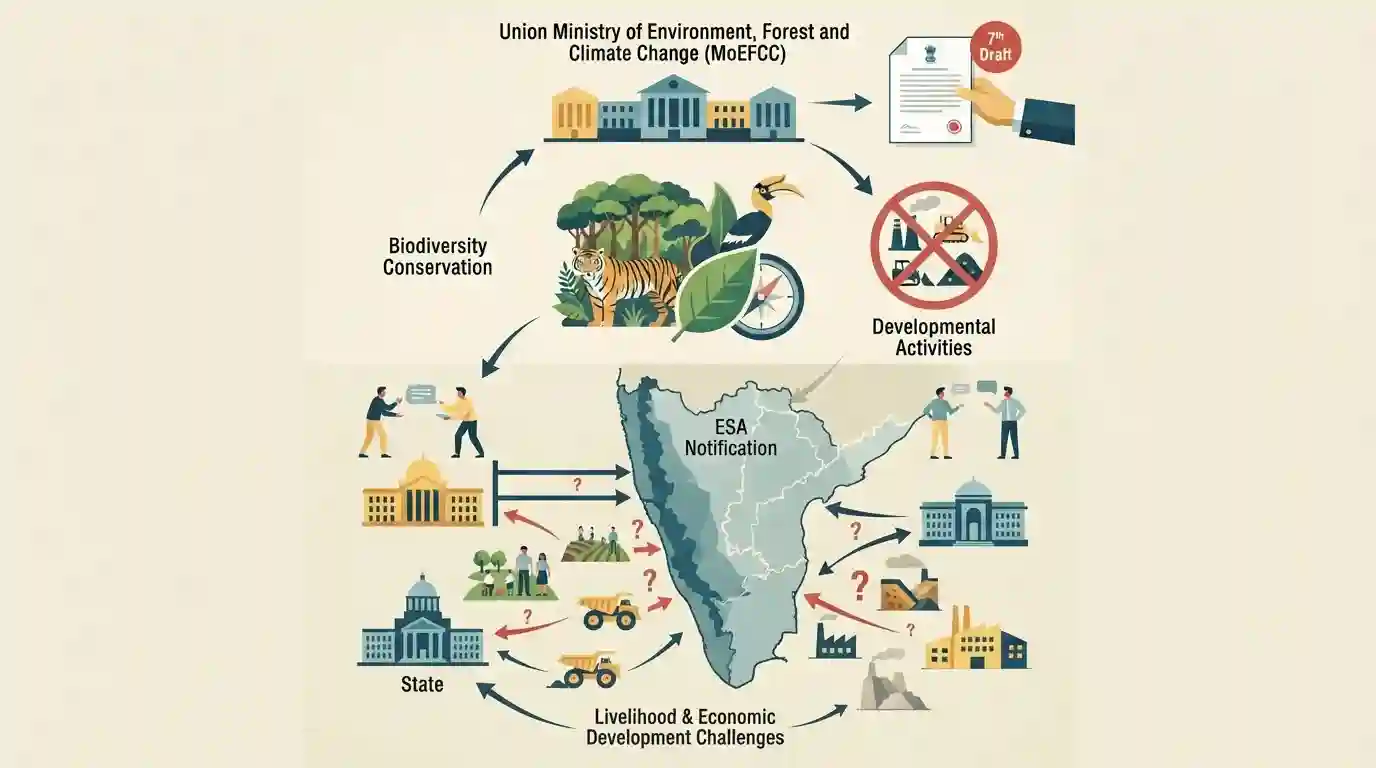
Why It Matters
The Western Ghats is a global biodiversity hotspot, and balancing ecological conservation with developmental pressures across multiple states is a key governance and environmental challenge in India.
Summary
The article discusses the resistance from six Western Ghats states against the seventh draft notification by the Union Ministry of Environment, Forest and Climate Change (MoEFCC) designating parts of the Western Ghats as an Ecologically Sensitive Area (ESA). The notification seeks to regulate developmental activities to conserve the region's rich biodiversity, while states cite livelihood and economic development challenges.
Key Points
- The Union Ministry of Environment, Forest and Climate Change (MoEFCC) has released the seventh draft notification to declare portions of the Western Ghats as an Ecologically Sensitive Area (ESA).
- Six Western Ghats states (Gujarat, Maharashtra, Goa, Karnataka, Kerala, and Tamil Nadu) have raised resistance and concerns over the draft notification.
- The ESA notification aims to restrict developmental activities such as large-scale mining, quarrying, thermal power plants, and large construction projects to protect the fragile biodiversity of the Western Ghats.
- States are concerned about the socioeconomic impacts on local communities, livelihood restrictions, and infrastructural bottlenecks.
Important Terms
Ecologically Sensitive Area (ESA) notification

Designation by the Ministry of Environment, Forest and Climate Change to protect fragile ecosystems from commercial exploitation and industrial expansion by restricting high-impact activities like mining and large construction.
UPSC context
MPSC & UPSC Environment and Ecology syllabus; tests policy measures for biodiversity conservation and sustainable development in fragile zones like the Western Ghats.
Gadgil Committee report
A 2011 expert panel chaired by Madhav Gadgil that recommended designating nearly 64 percent of the Western Ghats as an Ecologically Sensitive Area with strict environmental safeguards.
UPSC context
MPSC Paper I (Geography/Environment); tests understanding of landmark environmental committees, conservation governance, and developmental trade-offs in India.
Kasturirangan Committee report
A 2012 high-level working group report chaired by Kasturirangan that recommended designating about 37 percent of the Western Ghats as an ESA while safeguarding cultural landscapes.
UPSC context
MPSC Environment & Geography; tests balancing biodiversity preservation with economic aspirations, a recurring policy dilemma in hill regions.
Union Ministry of Environment, Forest and Climate Change (MoEFCC)
The central government ministry responsible for planning, promoting, and implementing environmental, forestry, and wildlife policies across India.
UPSC context
MPSC Polity & Governance; tests institutional framework for environmental legislation and administrative coordination among Union and State governments.
Prelims Trap
The Kasturirangan Committee recommended designating 100% of the Western Ghats as an Ecologically Sensitive Area (ESA).
Aspirants often confuse the Kasturirangan Committee (which recommended 37% coverage) with the Gadgil Committee (which recommended 100% coverage of the Western Ghats).
Static Concepts Connected
What are the key differences between the Gadgil and Kasturirangan committees on the Western Ghats?
- Gadgil Report Scope: Gadgil Committee (WGEEP) recommended designating the entire Western Ghats (100%) as an Ecologically Sensitive Area, dividing it into three zones.
- Kasturirangan Report Scope: Kasturirangan Committee (HLWG) recommended designating only about 37% of the Western Ghats as an Ecologically Sensitive Area (ESA).
- Methodology & Restrictions: Kasturirangan report adopted a remote-sensing-based approach and proposed banning only high-impact industries like mining and thermal power, unlike Gadgil's stricter bottom-up restrictions.
Cross-Topic Patterns
Western Ghats ESA and Cooperative Federalism
The Western Ghats ESA debate bridges environmental protection under the Environment Protection Act, 1986, with cooperative federalism challenges and state-level resistance against Union-mandated conservation frameworks.
Biodiversity Hotspots vs. Developmental Mineral Economics
Gadgil and Kasturirangan committee recommendations highlight the persistent trade-off between ecological security in biodiversity hotspots and mineral-led industrial development in peninsular India.

Kasturirangan vs Gadgil committee reports and ESA criteria under the EPA 1986 frequently feature in MPSC multi-statement questions.
Linked PYQs · 3
Linked PYQs · 3
- 2017MPSC_PRELIMSGS1
Which of the following mountains are considered as one of the top biodiversity hot spots ?
- 2024MPSC_PRELIMSGS1
Match the following pairs : | List-I | List-II | |---|---| | (a) Dr. Nitin Karmalkar Committee | (i) For implementation of National Education Policy - 2020 in Maharashtra | | (b) Nitin Karir Committee | (ii) To enquire the incident which happened during the distribution of Maharashtra Bhushan Award | | (c) Sunil Pawar Committee | (iii) To study why the rates of onion collapse. | | (d) Dr. K. Kasturirangan Committee | (iv) To make the syllabus for pre-primary to degree according to National Education Policy - 2020 | Code: (a) (b) (c) (d)
- 2022MPSC_PRELIMSGS1
Biosphere reserves are demarcated into ________.
