Western Ghats Ecologically Sensitive Area Draft Notification Framework
Source:drishtiias ↗
Why It Matters
The Western Ghats ESA notification is a recurring policy issue involving environmental conservation vs. developmental needs across six states, making it vital for MPSC questions on Indian geography, environment, and government policy panels (Gadgil and Kasturirangan committees).
Summary
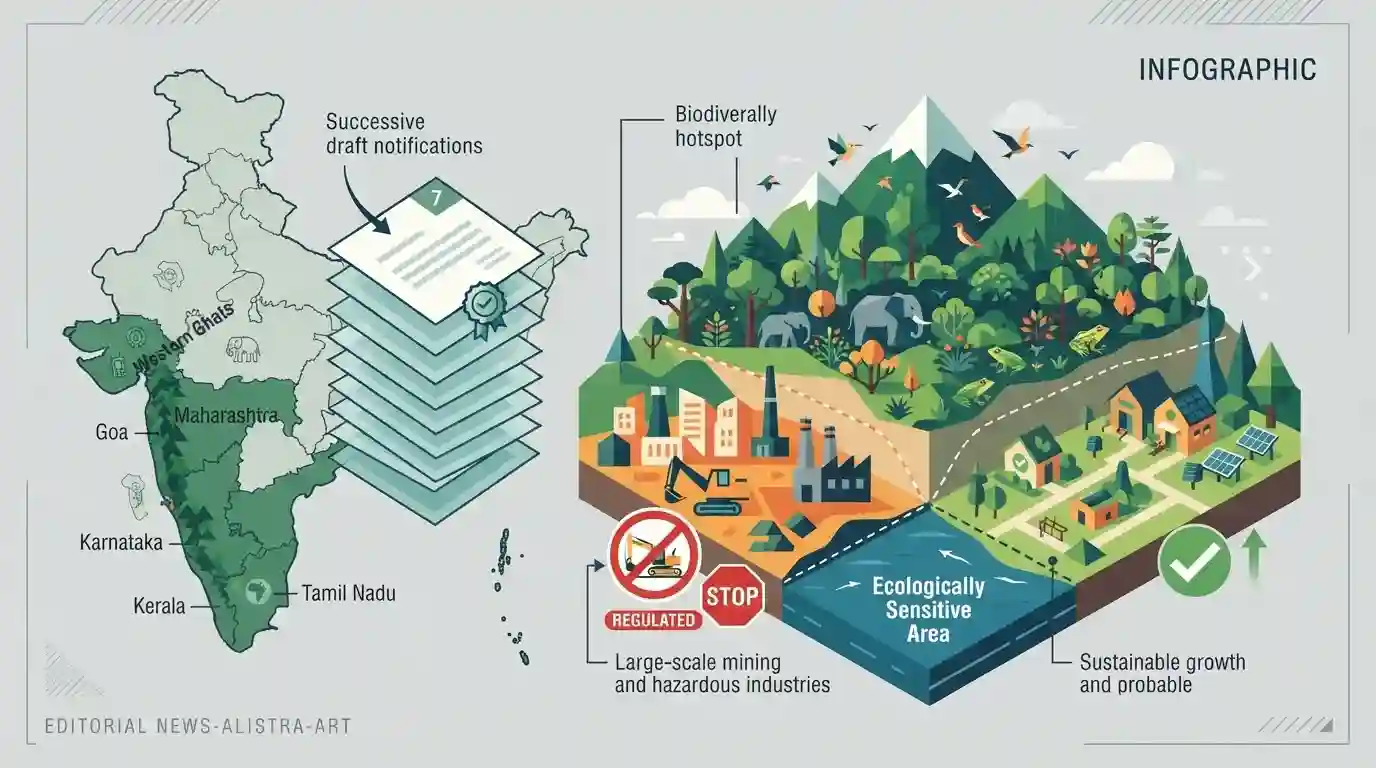
The article discusses the issuance of the 7th draft notification by the Union Ministry of Environment, Forest and Climate Change (MoEFCC) to designate parts of the Western Ghats as an Ecologically Sensitive Area (ESA). Spanning six states including Maharashtra, the notification seeks to regulate hazardous industrial, mining, and developmental activities to balance ecological preservation with sustainable growth in one of the world's preeminent biodiversity hotspots.
Key Points
- The Ministry of Environment, Forest and Climate Change (MoEFCC) has released the 7th draft notification to declare an Ecologically Sensitive Area (ESA) in the Western Ghats.
- The notification covers a total area of approximately 56,825 square kilometers across six states: Gujarat, Maharashtra, Goa, Karnataka, Kerala, and Tamil Nadu.
- It proposes to prohibit or severely restrict certain activities like mining, quarrying, thermal power plants, and large-scale construction to protect the region's fragile ecosystem and biodiversity.
- Recommendations are based on previous high-level panels, notably the Kasturirangan Committee report, which followed the broader foundational insights of the Madhav Gadgil Committee.
Important Terms
Western Ghats Ecologically Sensitive Area Notification

A periodic draft measure issued by the MoEFCC to legally protect ~56,825 sq km of the Western Ghats by restricting high-impact activities like mining and quarrying.
UPSC context
Mains GS-3: Environment and Ecology; tests regulatory frameworks, environmental governance, and sustainable development challenges in biodiversity hotspots.
Union Ministry of Environment, Forest and Climate Change (MoEFCC)
The central nodal ministry responsible for planning, promoting, and implementing environmental and forestry policies, including the notification of Ecologically Sensitive Areas in India.
UPSC context
Mains GS-3: Environment and Pollution; tests administrative mechanisms and statutory actions for environmental protection.
Madhav Gadgil Committee
The Western Ghats Ecology Expert Panel (2011) headed by Madhav Gadgil that recommended designating the entire Western Ghats as an Ecologically Sensitive Area with graded restriction zones.
UPSC context
Prelims/Mains: Environment and Ecology; tests understanding of landmark environmental committees, conservation strategies, and developmental conflicts.
Kasturirangan Committee
A High-Level Working Group (2013) led by K. Kasturirangan that recommended designating ~37% (natural landscape) of the Western Ghats as an Ecologically Sensitive Area.
UPSC context
Prelims/Mains: Biodiversity Conservation; tests committee recommendations balancing developmental needs with ecological preservation in fragile regions.
Prelims Trap
The 7th draft notification has finally enacted a permanent legal ban across the entire Western Ghats.
The notification is still a draft (7th iteration) and has not yet been enacted as a final permanent rule, though aspirants often confuse draft notifications with finalized statutes.
Static Concepts Connected
What are the key differences between the Gadgil Committee and Kasturirangan Committee reports on the Western Ghats?
- Gadgil Scope: Gadgil Committee (WGEEP) recommended designating the entire Western Ghats as an Ecologically Sensitive Area (ESA) with three zones and strict curbs on developmental projects.
- Kasturirangan Scope: Kasturirangan Committee recommended bringing only 37% of the Western Ghats under the ESA framework, adopting a more developmental-friendly approach.
- Common Thrust: Both panels highlighted mining, quarrying, and large-scale thermal plants as major ecological threats requiring prohibition or stringent regulation.
Cross-Topic Patterns
ESA Notification + Federalism & Local Governance
Western Ghats notifications directly impact local Gram Panchayats and state forest departments under the Fifth Schedule and Forest Conservation Act, linking environmental federalism with local governance.
Biodiversity Conservation vs. Developmental Economics
The Gadgil vs. Kasturirangan debate highlights the constant administrative tension between total ecological preservation and regional developmental aspirations in peninsular India.

Western Ghats ESA committees (Gadgil vs Kasturirangan) and state-wise area distribution will likely appear in MPSC environment statements.
Linked PYQs · 3
Linked PYQs · 3
- 2017MPSC_PRELIMSGS1
Which of the following mountains are considered as one of the top biodiversity hot spots ?
- 2022MPSC_PRELIMSGS1
In India, which of the following has become a hot-spot with reference to threats to biodiversity ?
- 2025MPSC_PRELIMSGS1
Match the following. | Biosphere Reserve | Establishment Year | |---|---| | a. Nilgiri | I. 2011 | | b. Sundarban | II. 2008 | | c. Kutch | III. 1989 | | d. Panna | IV. 1986 | Code: a b c d
