Western Ghats Eco Sensitive Area Notification Framework Explained
Source:kpiasacademy ↗
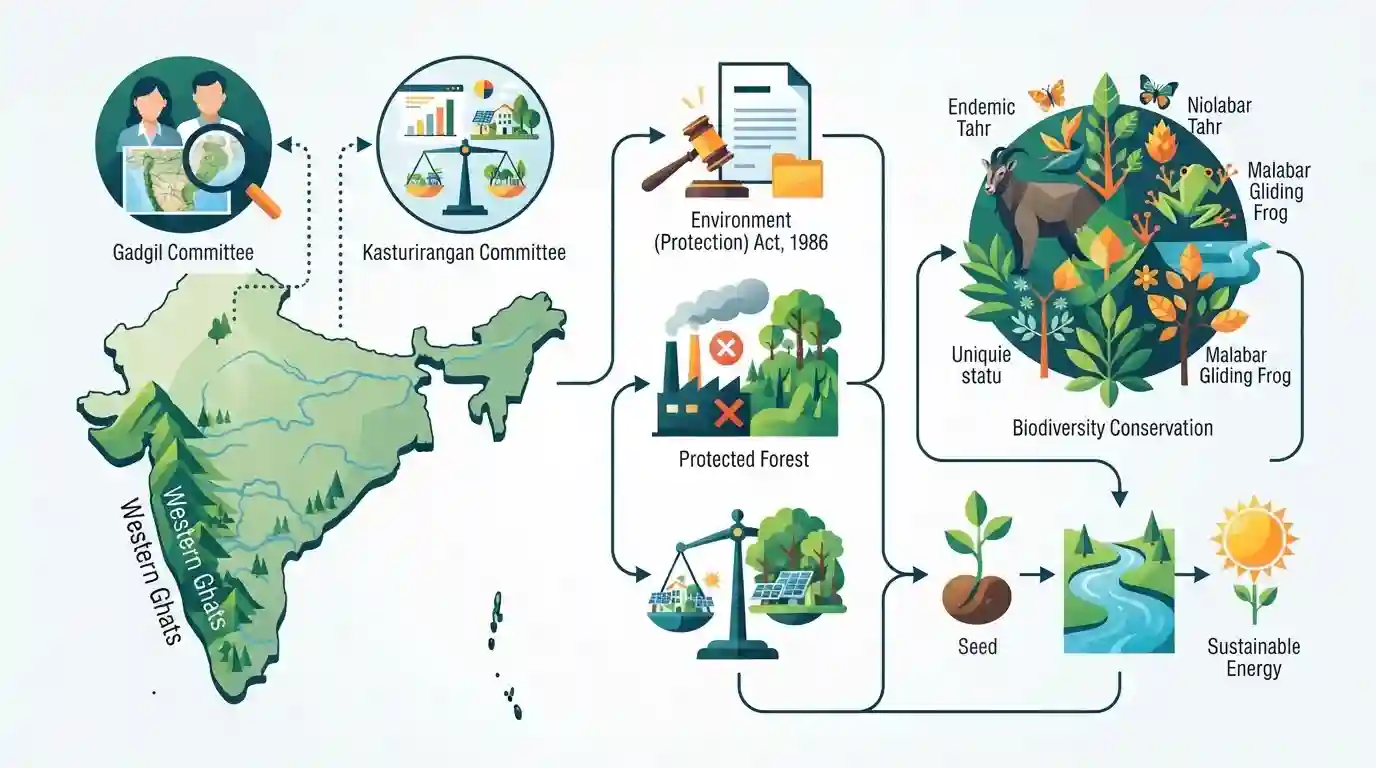
Why It Matters
The Western Ghats Eco-Sensitive Area is a recurrent topic in Indian environmental policy and geography, frequently tested in MPSC prelims regarding committee reports, geographical extent, and ecological conservation.
Summary
This article discusses the continuous deliberations and ecological significance surrounding the notification of the Western Ghats Eco-Sensitive Area (ESA). It covers the foundational recommendations of the Gadgil and Kasturirangan committees, the geographical spread of the Western Ghats biodiversity hotspot, and the regulatory framework under the Environment (Protection) Act, 1986 aimed at balancing developmental needs with environmental preservation.
Key Points
- The Western Ghats span across six states: Gujarat, Maharashtra, Goa, Karnataka, Kerala, and Tamil Nadu.
- Two major committees were formed to recommend conservation measures: the Western Ghats Ecology Expert Panel (Gadgil Committee) and the High-Level Working Group (Kasturirangan Committee).
- The Kasturirangan committee recommended that 37% of the total area of the Western Ghats should be declared as an Eco-Sensitive Area (ESA), restricting harmful activities like mining, quarrying, and large-scale construction.
- Eco-Sensitive Areas are notified under the Environment (Protection) Act, 1986 to act as shock absorbers for protected areas.
Important Terms
Eco-Sensitive Area (ESA) Notification

Zones designated around protected areas, national parks, and wildlife sanctuaries under the Environment (Protection) Act, 1986 to regulate development and prevent ecological degradation.
UPSC context
MPSC Paper I/III (Geography & Environment): Tests understanding of environmental legislation, biodiversity conservation, and sustainable development trade-offs.
Gadgil Committee
The Western Ghats Ecology Expert Panel (WGEEP) chaired by Madhav Gadgil (2011), which recommended declaring the entire Western Ghats region as ecologically sensitive with graded restrictions.
UPSC context
MPSC Paper I (Environment and Ecology): Frequently tested committee recommendations on Western Ghats conservation and ecological zoning.
Kasturirangan Committee
A High-Level Working Group chaired by K. Kasturirangan (2013) that proposed designating about 37% of the Western Ghats as an Eco-Sensitive Area to balance conservation and development.
UPSC context
MPSC Paper I (Ecology & Geography): Important for comparing developmental models versus strict ecological protection in biodiversity hotspots.
Ministry of Environment, Forest and Climate Change (MoEFCC)
The nodal ministry under the Government of India responsible for planning, promoting, and coordinating environmental and forestry policies and implementing wildlife protection laws.
UPSC context
MPSC Paper II/III (Governance & Environment): Tests institutional framework for environmental clearances, notifications, and statutory bodies in India.
Prelims Trap
Both Gadgil and Kasturirangan committees recommended declaring 37% of the Western Ghats as an Eco-Sensitive Area.
Aspirants frequently confuse the Gadgil Committee's recommendation (total restriction across the entire Ghats) with the Kasturirangan Committee's recommendation (37% area as ESA).
Static Concepts Connected
What are the key differences between the Gadgil and Kasturirangan committees on the Western Ghats?
- Gadgil Report: WGEEP Approach: Recommended the entire Western Ghats as an ecological sensitive area divided into zones with strict bottom-up regulatory controls.
- Kasturirangan Report: HLWG Approach: Recommended bringing only 37% of the total Western Ghats area under ESA, focusing on cultural landscapes and natural areas.
- Common Ground: Mining Ban: Both committees strongly recommended banning all new mining, quarrying, and thermal power plants in sensitive zones.
Cross-Topic Patterns
Western Ghats ESA + Landslide Disaster Management
Western Ghats ESA classifications link directly to state-specific landslide mitigation funds and disaster management plans under the NDMA Act.
Eco-Sensitive Zones vs. Forest Rights Act
The debate between developmental needs and biodiversity conservation mirrors Schedule V and VI forest rights conflicts in central and southern Indian hill tracts.

Western Ghats committee recommendations (Gadgil vs Kasturirangan), states covered, and ESA legal basis under EPA 1986 are prime MPSC match-the-following targets.
Linked PYQs · 2
Linked PYQs · 2
- 2017MPSC_PRELIMSGS1
Which of the following mountains are considered as one of the top biodiversity hot spots ?
- 2025MPSC_PRELIMSGS1
Match the following. | Biosphere Reserve | Establishment Year | |---|---| | a. Nilgiri | I. 2011 | | b. Sundarban | II. 2008 | | c. Kutch | III. 1989 | | d. Panna | IV. 1986 | Code: a b c d
