Policy Updates on Western Ghats Environmental Conservation
Source:shankariasparliament ↗
Why It Matters
Crucial for MPSC Combined Prelims candidates focusing on Indian and Maharashtra geography, environment, biodiversity hotspots, and state-specific environmental policies.
Summary
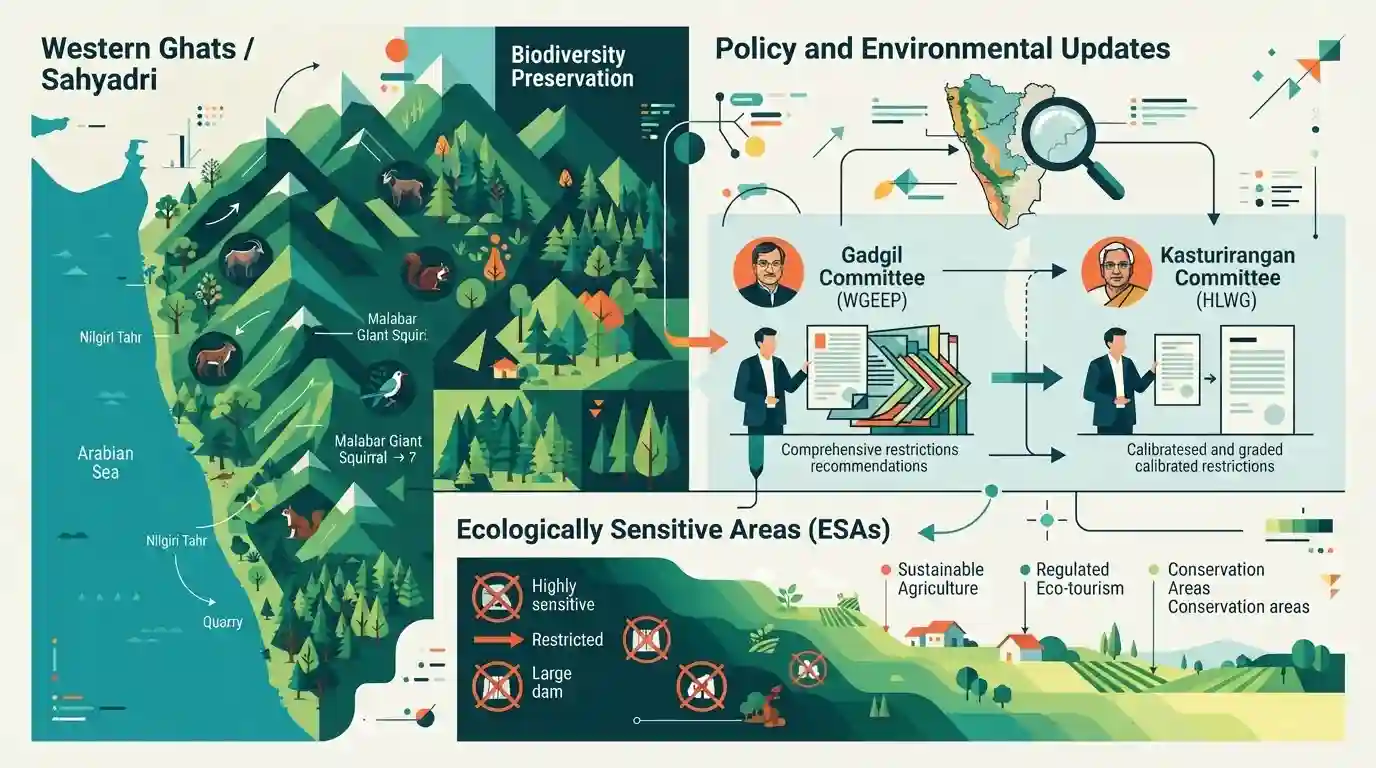
This article highlights ongoing policy and environmental updates regarding the conservation of the Western Ghats, emphasizing expert committees like Gadgil and Kasturirangan, Ecologically Sensitive Areas (ESAs), and biodiversity preservation.
Key Points
- The Western Ghats span six states across western India, renowned as a global biodiversity hotspot and UNESCO World Heritage site.
- Conservation panels like the Gadgil Committee (WGECE) and Kasturirangan Committee (HLWG) were formed to recommend protective frameworks for the region.
- Issues surrounding Ecologically Sensitive Areas (ESAs) involve balancing developmental needs with environmental protection, especially restricting mining, quarrying, and large-scale construction.
Important Terms
Ecologically Sensitive Area (ESA) notification

A designated zone where specific developmental activities, mining, and polluting industries are restricted or prohibited under the Environment (Protection) Act, 1986, to protect fragile ecosystems.
UPSC context
MPSC / Environment and Ecology: Tests understanding of biodiversity conservation policies, legal frameworks under EPA 1986, and geographical protection zones.
Ministry of Environment, Forest and Climate Change (MoEFCC)
The apex central government ministry in India responsible for planning, promoting, and coordinating environmental and forestry policies, including the notification of Ecologically Sensitive Areas.
UPSC context
MPSC / Polity and Governance: Tests institutional framework, administrative jurisdictions, and policy implementation mechanisms for environmental protection in India.
Prelims Trap
Both the Gadgil and Kasturirangan committees recommended a total ban on all developmental activities across 100% of the Western Ghats region.
Aspirants often confuse the two panels, assuming Kasturirangan recommended blanket ban on developmental activities across the entire Western Ghats, whereas it recommended restricting only 37% as ESA.
Static Concepts Connected
What are the key differences between the Gadgil and Kasturirangan Committees on Western Ghats?
- Gadgil Scope: Gadgil Committee (WGECE) recommended declaring the entire Western Ghats (100%) as an Ecologically Sensitive Area with graded zones and decentralised governance.
- Kasturirangan Scope: Kasturirangan Committee (HLWG) adopted a targeted approach, restricting ESA to about 37% of the total Western Ghats area, mostly covering natural vegetation.
- Common Bans: Both committees recommended a strict ban on mining, sand quarrying, and thermal power plants within identified sensitive zones.
Cross-Topic Patterns
Western Ghats + Centre-State Federalism Disputes
Western Ghats conservation panels connect directly to federalism debates, as states like Kerala and Karnataka oppose central ESA notifications citing livelihood concerns.

Gadgil vs Kasturirangan report recommendations + ESA percentage notifications likely to appear as a statement-based MPSC question.
Linked PYQs · 2
Linked PYQs · 2
- 2017MPSC_PRELIMSGS1
Which of the following mountains are considered as one of the top biodiversity hot spots ?
- 2023MPSC_PRELIMSGS1
The Sahyadri range is not straight but at many places it is curved, because
