Exercise Trishul and Tri-Service Multi-Domain Military Integration
Source:Indian Express ↗
Why It Matters
Multi-domain operations and theaterisation are key themes in current Indian defence reforms. Understanding joint military exercises like Ex Trishul helps candidates address GS-3 Security questions on border management, internal security, cyber warfare, and the role of the Chief of Defence Staff (CDS) in fostering jointness among the forces.
Summary
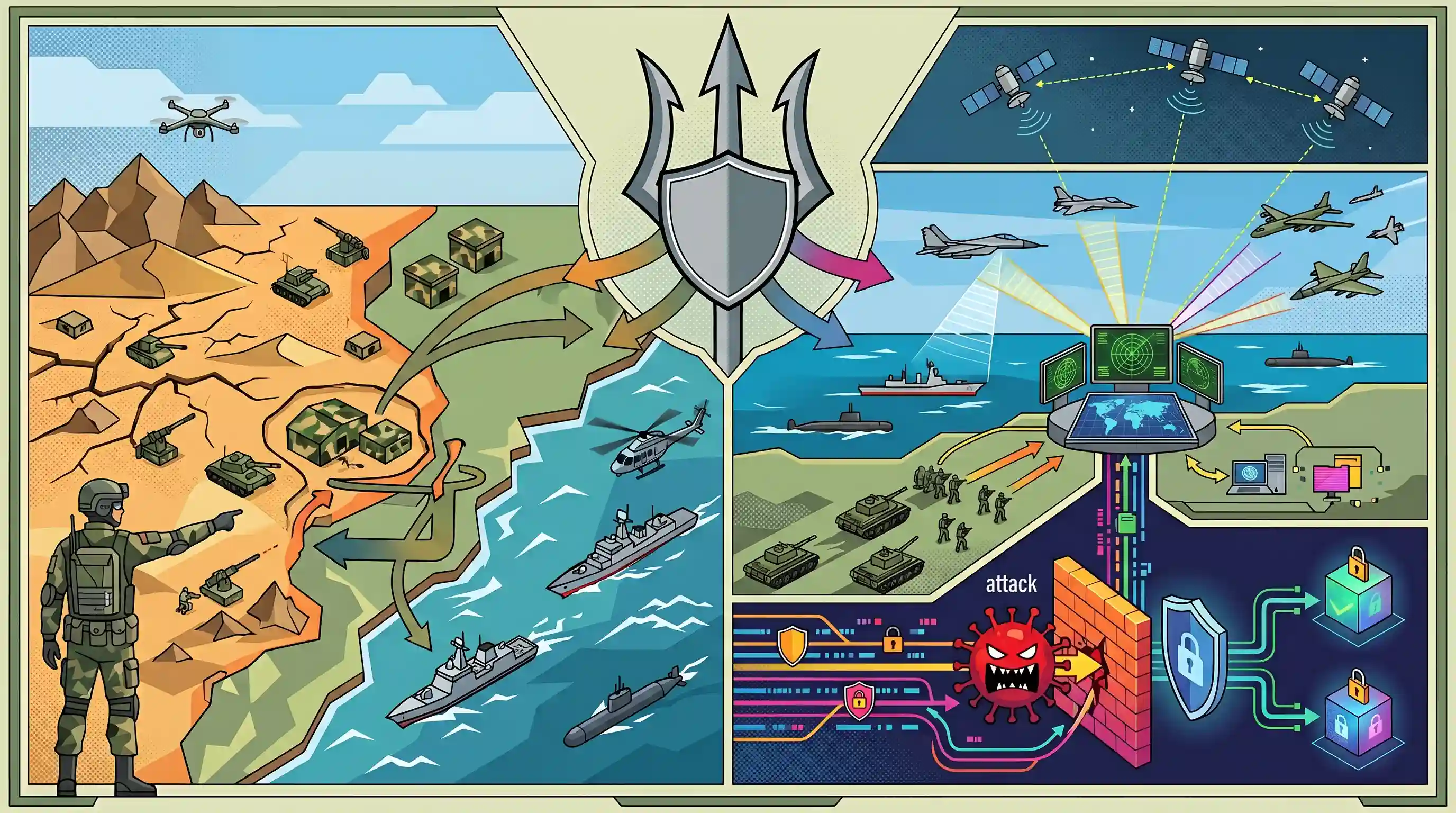
Exercise Trishul 2025 is a comprehensive tri-service military drill conducted by the Indian Army, Navy, and Air Force along the Western front, spanning from the Thar Desert to the coastal region of Kutch. The exercise focuses on land-sea-air integration to validate operational and tactical dominance across both physical and virtual warfare domains. It represents a significant step in the Indian Armed Forces' ongoing efforts toward 'jointness' and theaterisation, preparing them for complex, multi-domain contingencies in modern warfare.
Key Points
- Exercise Trishul 2025 is a major tri-service drill involving the Indian Army, Navy, and Air Force along India's Western front.
- The operational area spans from the inland Thar Desert down to the coastal and marshy terrain of Kutch.
- The exercise aims to validate combat dominance across both physical (land, sea, air) and virtual (cyber, space, electronic warfare) domains.
- It aligns with the broader strategic push for theaterisation and 'jointness' to enhance interoperability and resource optimization within the armed forces.
Important Terms
Exercise Trishul 2025

India's largest tri-service military exercise involving the Army, Navy, and Air Force along the Western Front. It validates joint operational procedures and integrates land, air, and sea capabilities for multi-domain contingencies.
UPSC context
GS III (Security) – Military exercises, tri-service integration, and border management strategies.
Theaterisation
A structural reform integrating the Army, Navy, and Air Force under a unified commander for specific geographical regions. It aims to eliminate service silos, optimize resources, and improve operational synergy.
UPSC context
GS III (Security) – Major defense reforms, Chief of Defence Staff (CDS), and modernization of command structures.
Multi-domain Warfare
Modern combat strategy synchronizing operations across land, sea, air, space, and cyberspace. It uses real-time intelligence and cross-domain synergy to overwhelm adversaries in both physical and virtual environments.
UPSC context
GS III (Security) – Emerging threats, hybrid warfare, and the evolution of modern military doctrines.
Jointness
The conceptual state of the three military services acting as a single, cohesive force through shared training, unified doctrine, and synchronized command. It is essential for successful tri-service operations.
UPSC context
GS III (Security) – Operational efficiency, inter-service cooperation, and the transformation of the Armed Forces.
Sir Creek
A 96-km long disputed marshy estuary between Gujarat (India) and Sindh (Pakistan). It is a strategically sensitive zone crucial for maritime boundary determination, coastal security, and naval surveillance.
UPSC context
GS III (Security) – Border management, maritime security, and territorial disputes on the western frontier.
Aatmanirbharta (Defence)
India’s strategic initiative for self-reliance in military technology by developing indigenous weapon systems. It aims to reduce foreign import dependency and strengthen the national defense-industrial base.
UPSC context
GS III (Security/Economy) – Indigenous technology and development of the domestic defense sector.
Prelims Trap
Exercise Trishul is a joint bilateral military drill between India and an allied nation to secure the Western borders.
It is a domestic tri-service exercise (Army, Navy, IAF) testing India's internal 'theaterisation', not an international bilateral or multilateral military drill.
Static Concepts Connected
What is Theaterisation and the mandate of the Chief of Defence Staff (CDS)?
- Unified Commands: Replaces individual service commands with Integrated Theatre Commands (ITCs) to ensure unified land, air, and sea operations during conflicts.
- CDS Mandate: Created post-Kargil Review Committee recommendations, the CDS acts as permanent Chairman of the Chiefs of Staff Committee to drive tri-service integration.
- Resource Optimization: Reduces duplication in logistics, communications, and procurement to maximize combat efficiency under a single theater commander.
Why is the Kutch and Sir Creek border geographically and strategically complex?
- Shifting Terrain: The Rann of Kutch is a vast seasonal salt marsh, severely complicating conventional physical fencing, troop movement, and border patrolling.
- Sir Creek Dispute: A 96-km tidal estuary where India and Pakistan contest the maritime boundary interpretation (Thalweg mid-channel principle vs. eastern bank).
- Multi-Agency Security: Securing this permeable zone requires complex synergy between the Border Security Force (BSF), Indian Coast Guard, Marine Police, and Armed Forces.
Cross-Topic Patterns
Grey-Zone Warfare & Border Smuggling
Electronic warfare and counter-drone drills in Ex Trishul directly connect to internal security threats like drone-dropped narcotics and weapons across the Punjab, Rajasthan, and Gujarat borders.
Military-Civil Fusion & CIBMS
Integrating military ops with the BSF and civil administration in Kutch reflects the broader push for a Comprehensive Integrated Border Management System (CIBMS) in hostile terrains.

A multi-statement question combining Theaterisation, the statutory role of the CDS, and Multi-Domain Operations is highly likely in 2026.
Linked PYQs · 4
Linked PYQs · 4
- 2016MainsGS3
Border management is a complex task due to difficult terrain and hostile relations with some countries. Elucidate the challenges and strategies for effective border management.
- 2021MainsGS3
Keeping in view India's internal security, analyse the impact of cross-border cyber attacks. Also discuss defensive measures against these sophisticated attacks.
- 2024PrelimsGS1
What are the duties of the Chief of Defence Staff (CDS) as Head of the Department of Military Affairs? 1. Permanent Chairman of Chiefs of Staff Committee 2. Exercise military command over the three Service Chiefs 3. Principal Military Advisor to Defence Minister on all tri-service matters Select the correct answer using the code given below:
- 2025MainsGS3
Why is maritime security vital to protect India's sea trade? Discuss maritime and coastal security challenges and the way forward.
