Western Disturbance Impact on North West India Weather Patterns
Source:Indian Express ↗
Why It Matters
Western Disturbances are a recurring topic in UPSC Geography. The intersection of unseasonal weather events with agricultural vulnerability (like Rabi crop harvesting) highlights the practical impacts of climatic phenomena on the economy and food security. Understanding IMD's warning systems (colour-coded alerts) is also highly relevant for disaster preparedness.
Summary
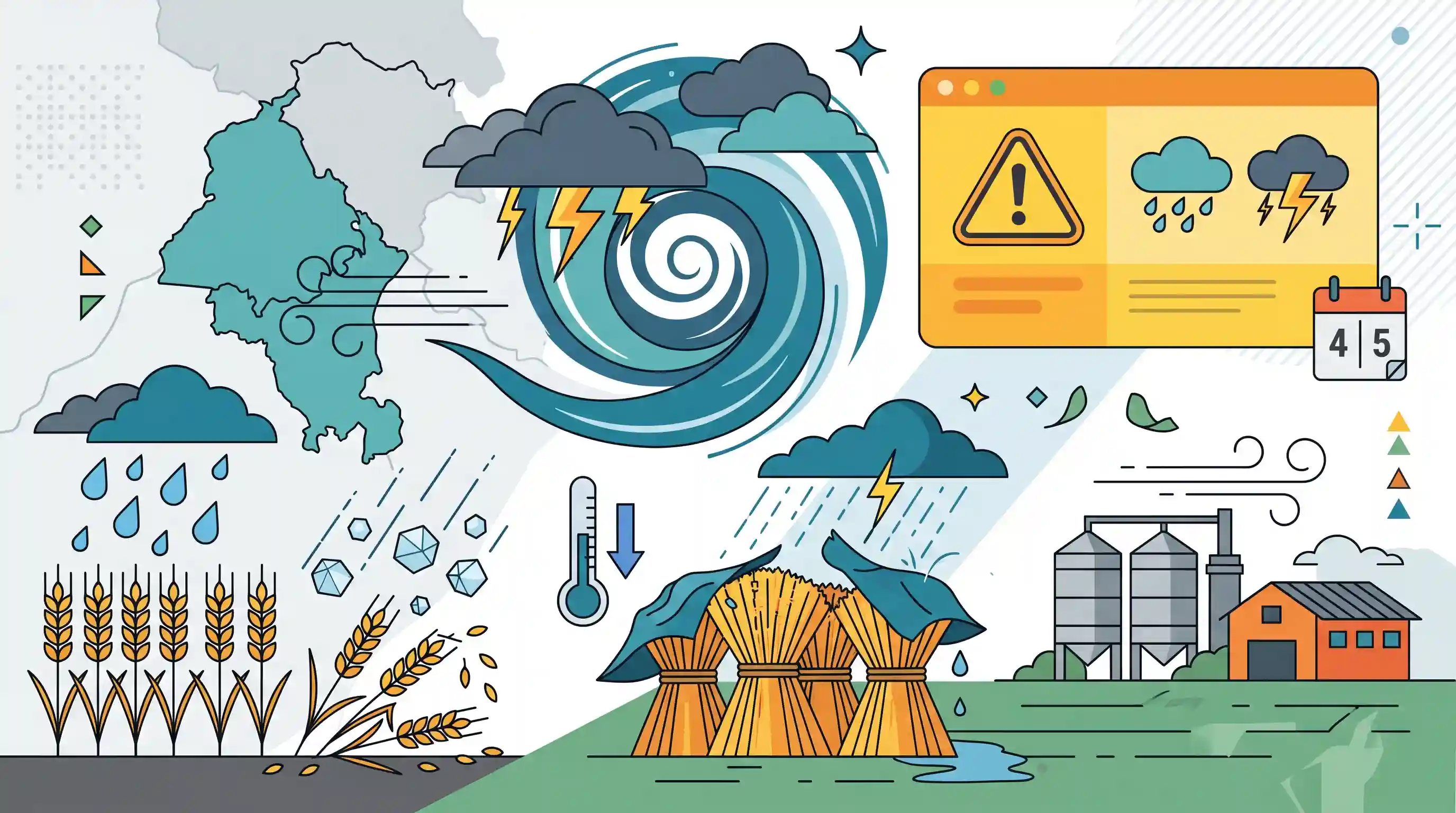
The India Meteorological Department (IMD) has issued a yellow alert for an approaching Western Disturbance expected to bring light to moderate rainfall, thunderstorms, and gusty winds to Punjab, Haryana, and Chandigarh on May 4-5. Maximum temperatures, currently near normal, are forecasted to drop slightly. The unseasonal precipitation and potential hailstorms pose a significant risk to standing and recently harvested Rabi crops, particularly wheat, threatening agricultural yield and rural infrastructure.
Key Points
- A Western Disturbance is forecasted to affect weather patterns in Punjab, Haryana, and Chandigarh from May 4-5.
- The IMD has issued a yellow alert, warning of thunderstorms, lightning, gusty winds (40-50 kmph), and isolated hailstorms.
- This unseasonal weather event poses a significant risk to harvested and standing Rabi crops, such as wheat, raising concerns for agricultural yield and rural infrastructure.
- Maximum temperatures, which are currently near normal, are expected to drop slightly due to the precipitation.
Important Terms
Western Disturbance

An extratropical storm originating in the Mediterranean region that travels eastward, bringing non-monsoonal winter and spring precipitation to northwest India and the Himalayas.
UPSC context
GS Paper 1 (Geography) and Paper 3 (Agriculture). Tests knowledge of non-monsoonal weather systems and their impact on India’s food security.
India Meteorological Department (IMD)
The principal government agency under the Ministry of Earth Sciences responsible for meteorological observations, weather forecasting, and providing warnings against severe weather phenomena.
UPSC context
GS Paper 1 (Geography) and GS Paper 2 (Government Agencies). Tests understanding of institutional frameworks for disaster management and climate monitoring.
Yellow Alert
A color-coded warning meaning "Be Aware," signifying that weather conditions may deteriorate and cause disruptions, requiring authorities and the public to stay updated.
UPSC context
GS Paper 3 (Disaster Management). Tests knowledge of early warning systems and protocols for mitigating the impact of hazardous weather events.
Rabi Crops
Winter crops sown between October and December and harvested in spring (March-April). Major examples include wheat, mustard, and barley, which are vital for food security.
UPSC context
GS Paper 1 (Geography-Agriculture) and Paper 3 (Economy). Tests understanding of cropping seasons, agricultural vulnerability, and rural economic stability.
Hailstorm
A severe weather event involving the precipitation of ice pellets, often occurring during thunderstorms, causing significant mechanical damage to standing crops and rural infrastructure.
UPSC context
GS Paper 3 (Agriculture and Disaster Management). Tests awareness of climate-related risks to crop yields and the necessity for disaster mitigation.
Prelims Trap
Western Disturbances are strictly winter phenomena and always beneficial for Rabi crops.
WDs can occur in spring/summer. While winter moisture aids wheat growth, April/May occurrences cause massive post-harvest losses and crop lodging.
Static Concepts Connected
What is the mechanism and origin of Western Disturbances?
- Origin: They originate over the Mediterranean Sea, Caspian Sea, and Black Sea as extratropical cyclones.
- Carrier: Driven eastward towards the Indian subcontinent by the upper-tropospheric Subtropical Westerly Jet Stream.
- Moisture source: The storms pick up critical moisture from the Mediterranean Sea and Persian Gulf before shedding it over the Himalayas and Northern plains.
What do the IMD's color-coded weather alerts signify?
- Yellow Alert: 'Watch' state. Advises authorities and the public to stay updated on potentially severe, worsening weather.
- Orange Alert: 'Alert' state. Authorities need to be prepared for power outages, road disruptions, or communication failures.
- Red Alert: 'Warning' state. Requires immediate action from agencies to protect life and property from extreme weather.
Cross-Topic Patterns
Climate change & WD seasonality
Shifting climate patterns are pushing WD occurrences into the pre-monsoon summer, where they interact with extreme surface heating to fuel intense convective thunderstorms rather than gentle winter rains.
Climatology meets Agrarian Distress
Unseasonal May rains expose India's deficient post-harvest storage infrastructure, linking climatological anomalies directly to agrarian distress, crop spoilage, and food inflation.

Expect a 2026 question linking the changing seasonality of Western Disturbances to jet stream shifts and specific post-harvest Rabi damage.
Linked PYQs · 2
Linked PYQs · 2
- 2015PrelimsGS1
Consider the following statements: 1. The winds which blow between 30° N and 60° S latitudes through-out the year are known as westerlies. 2. The moist air masses that cause winter rains in North-Western region of India are part of westerlies. Which of the statements given above is/are correct?
- 2022MainsGS1
Discuss the meaning of colour-coded weather warnings for cyclone prone areas given by India Meteorological Department.
