Geopolitical de-risking and economic engagement with China
Source:Indian Express ↗
Why It Matters
It provides a practical example of the 'de-risking vs decoupling' debate in contemporary international relations. Understanding how middle powers balance US security ties with Chinese economic interdependence is crucial for answering questions on global geopolitics, supply chains, and India's potential role as an alternative partner.
Summary
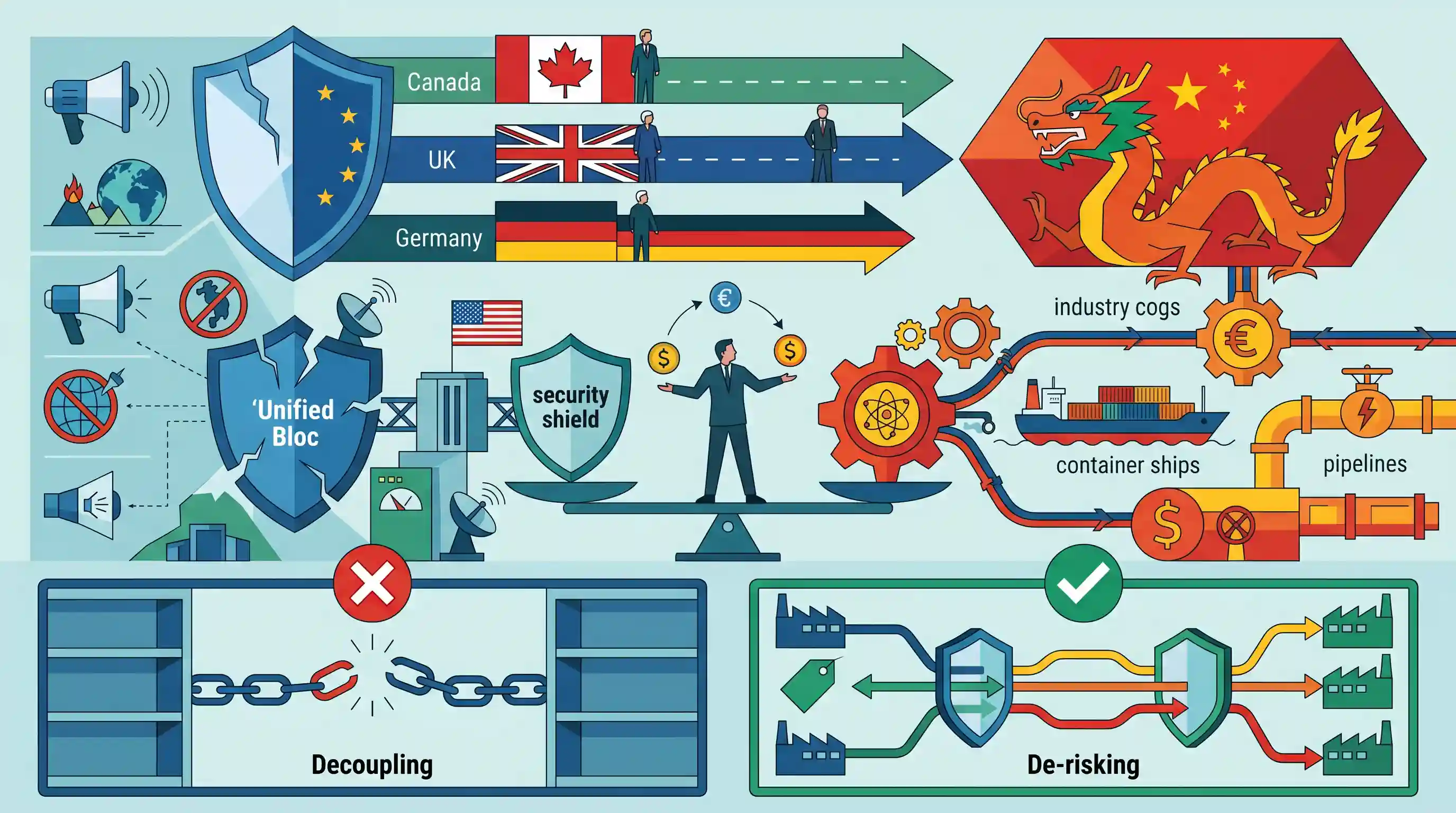
Recent diplomatic visits to China by leaders from Canada, the UK, and Germany’s Friedrich Merz illustrate a significant geopolitical trend: Western nations are prioritizing economic pragmatism over ideological confrontation. Despite shared criticisms regarding human rights and China's stance on global conflicts, these countries acknowledge that complete economic 'decoupling' is unfeasible. Instead, they are pursuing 'de-risking' strategies to protect their domestic industries and supply chains while managing security concerns. This pragmatic engagement reveals the limitations of a unified Western economic bloc against China and underscores the complex balancing act allies perform between US security alliances and indispensable economic ties with Beijing.
Key Points
- Leaders from Canada, the UK, and Germany (including prospective Chancellor Friedrich Merz) are undertaking visits to China, signaling a pragmatic diplomatic approach by Western nations.
- The visits reflect a strategic preference for 'de-risking' over complete 'decoupling' from the Chinese economy, safeguarding crucial export markets and supply chains.
- For export-driven economies like Germany, maintaining functional ties with China is essential to protect domestic industries, notably the automotive sector, from the fallout of broader geopolitical tensions.
- This trend highlights the complex balancing act US allies face, navigating their security alignment with Washington while resisting full alignment with US-led economic isolation of Beijing.
Important Terms
De-risking

A strategic approach to reduce economic dependencies and vulnerabilities in critical sectors (e.g., semiconductors, rare earths) without completely severing trade ties.
UPSC context
GS Paper 2 (International Relations); evaluates the shift from total isolation to targeted economic security.
Decoupling
The process of severing or significantly reducing deep economic, commercial, and technological interdependencies between two nations, primarily used regarding U.S.-China relations.
UPSC context
GS Paper 3 (Economy); concerns global trade fragmentation and domestic industrial 'hollowing out'.
NATO (North Atlantic Treaty Organization)
A military alliance of North American and European nations that identified China as a 'systemic challenge' in its 2022 Strategic Concept.
UPSC context
GS Paper 2 (Bilateral/Global Groupings); marks the expansion of the alliance's focus to the Indo-Pacific.
European Union (EU)
A political and economic union of 27 member states that classifies China as a partner, economic competitor, and systemic rival simultaneously.
UPSC context
GS Paper 2 (International Relations); essential for understanding multipolar diplomacy and collective bargaining.
Strategic Autonomy
The ability of a state or group (like the EU) to pursue its own foreign policy and security interests without being constrained by other powers.
UPSC context
GS Paper 2; central to EU’s balancing act between U.S. security and Chinese trade.
Economic Pragmatism
Prioritizing practical economic benefits and trade stability over ideological differences or political confrontations in international relations.
UPSC context
GS Paper 2; tests understanding of 'Realpolitik' in modern global trade and diplomacy.
Global Supply Chains
The worldwide system of organizations and activities involved in moving a product from supplier to customer, now being restructured for resilience.
UPSC context
GS Paper 3 (Economy); relevant for topics on logistics, self-reliance, and international trade disruptions.
Prelims Trap
The G7 and Western allies have adopted a unified policy of complete economic decoupling from China.
Western nations, especially in Europe, have explicitly shifted from 'decoupling' (severing all ties) to 'de-risking'—protecting critical supply chains while maintaining broad trade.
Static Concepts Connected
What is the difference between economic 'decoupling' and 'de-risking'?
- Decoupling: Aims to completely sever economic ties and eliminate bilateral trade or technological dependencies between two nations.
- De-risking: Focuses on reducing vulnerabilities in critical supply chains (like semiconductors or rare earths) without ending broader economic engagement.
- China Plus One: A corporate strategy to diversify manufacturing and investment outside of China to alternative developing nations to mitigate geopolitical risks.
How do Global Value Chains (GVCs) impact export-driven economies?
- Import-Export Linkage: Export-led economies rely on importing intermediate goods to manufacture high-value exports, creating deep cross-border interdependencies.
- Geopolitical Vulnerability: GVC disruptions caused by geopolitical tensions or protectionism severely impact domestic industries, forcing nations to balance security with trade pragmatism.
Cross-Topic Patterns
SCRI and Indo-Pacific Geoeconomics
Japan, India, and Australia launched SCRI to build resilient supply networks. Western 'de-risking' aligns directly with these Indo-Pacific geoeconomic shifts, providing opportunities for India.
Critical Minerals & Green Tech Diplomacy
European nations depend heavily on China's dominance in rare earth elements and solar tech. Their pragmatic diplomacy is essentially a survival tactic for their domestic green transitions.

Expect a Prelims statement contrasting 'de-risking' vs 'decoupling', or a Mains question on India leveraging the 'China Plus One' shift.
Linked PYQs · 3
Linked PYQs · 3
- 2024MainsGS2
‘The West is fostering India as an alternative to reduce dependence on China's supply chain and as a strategic ally to counter China's political and economic dominance.’ Explain this statement with examples.
- 2025MainsGS3
What are the challenges before the Indian economy when the world is moving away from free trade and multilateralism to protectionism and bilateralism? How can these challenges be met?
- 2021MainsGS2
“The USA is facing an existential threat in the form of a China, that is much more challenging than the erstwhile Soviet Union.” Explain.
