West Bengal Teacher Recruitment Scam and Governance Failures
Source:Indian Express ↗
Why It Matters
The scam provides a potent case study for civil services aspirants on the consequences of governance failure in critical social sectors like education. It is directly relevant for GS Paper 2 (transparency, accountability, institutional mechanisms) and GS Paper 4 (probity, ethics in administration, and public trust).
Summary
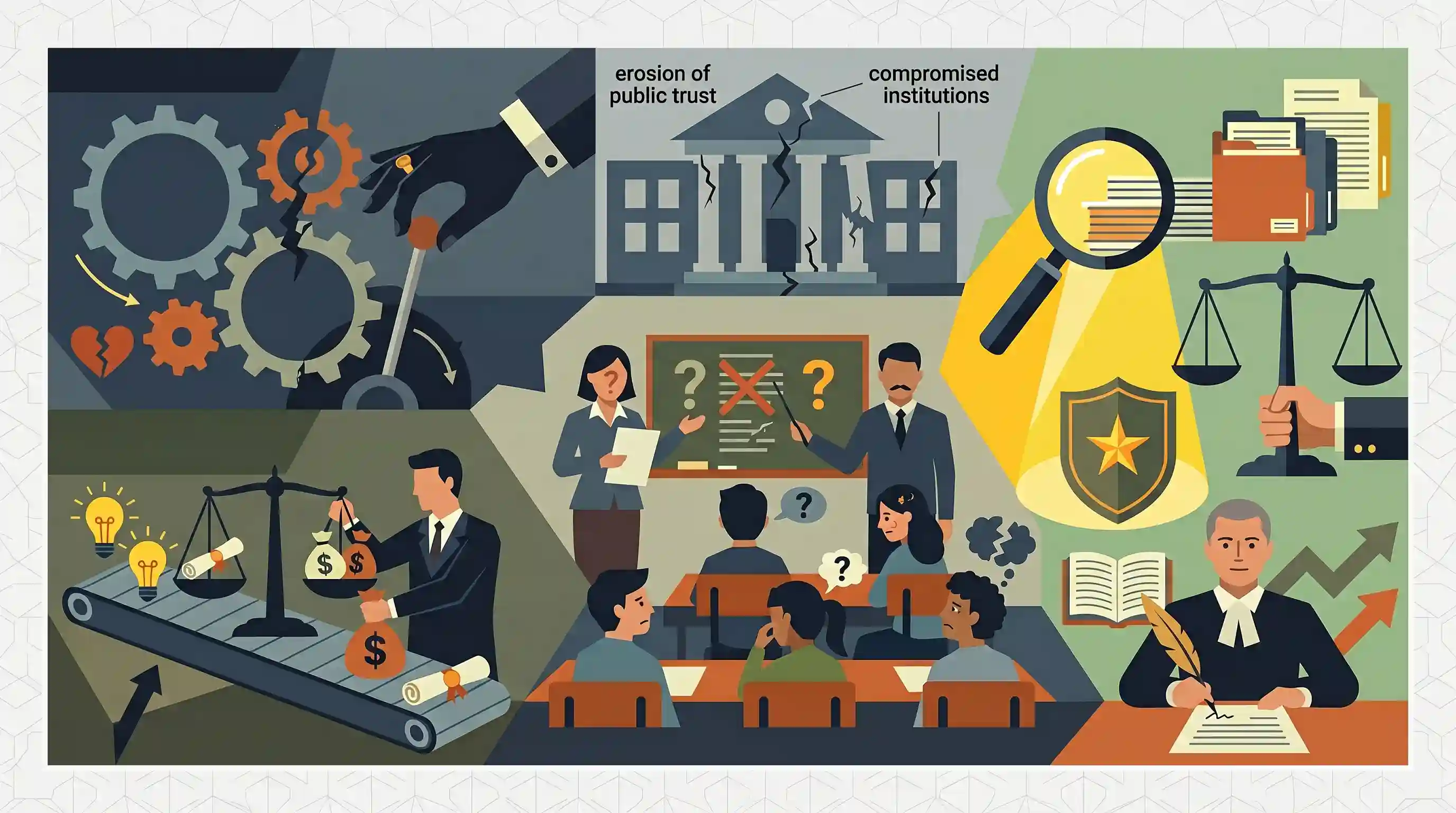
The article examines the ongoing West Bengal teacher hiring scam, framing it as the culmination of long-standing systemic failures in the state's educational governance and public recruitment processes. By detailing how political interference and deep-rooted corruption compromised the School Service Commission (SSC), the piece highlights the erosion of meritocracy. Beyond the immediate legal and political fallout, the scam severely impacts the education sector by introducing unqualified teachers into classrooms, ultimately hurting students. The crisis serves as a stark reminder of the critical need for transparency, accountability, and probity in government institutions to maintain public trust.
Key Points
- The West Bengal teacher recruitment scam highlights systemic corruption and lack of transparency within state recruitment bodies like the School Service Commission (SSC).
- Political interference in bureaucratic functioning has severely compromised merit-based hiring processes, eroding public trust in government institutions.
- The appointment of unqualified individuals to teaching positions poses a severe, long-term threat to the quality of education and human resource development in the state.
- The crisis underscores the urgent need for robust institutional reforms to enforce accountability, transparency, and ethical conduct in public administration.
Important Terms
School Service Commission (SSC)

A statutory body in West Bengal responsible for the recruitment of teachers and non-teaching staff in state-run and state-aided schools.
UPSC context
GS Paper 2: Statutory bodies; tests understanding of public recruitment transparency and administrative probity.
Central Bureau of Investigation (CBI)
India's premier central investigative agency, operating under the DSPE Act, 1946, tasked with probing high-profile corruption and criminal cases.
UPSC context
GS Paper 2: Investigative agencies; relevant for central-state relations and judicial activism in governance.
Enforcement Directorate (ED)
A specialized financial investigation agency under the Ministry of Finance, mandated to enforce the Prevention of Money Laundering Act (PMLA).
UPSC context
GS Paper 3: Economic crimes; critical for studying PMLA and the financial aspects of institutional corruption.
West Bengal Board of Secondary Education (WBBSE)
The state authority in West Bengal overseeing secondary education, responsible for curriculum management and issuing final appointment letters to school staff.
UPSC context
GS Paper 2: Governance and Education; illustrates systemic oversight challenges in state-level educational administration.
Prelims Trap
"The State School Service Commission is a constitutional body established under Article 315."
Aspirants confuse State Public Service Commissions (Constitutional, Art 315) with State School Service Commissions, which are merely statutory bodies created by specific state legislature Acts.
Static Concepts Connected
How does systemic corruption in public employment violate Fundamental Rights?
- Article 14: Arbitrary manipulation of merit lists denies the fundamental right to equality before the law and equal protection of laws.
- Article 16: Guarantees equal opportunity in matters of public employment; bypassed when bribes replace merit, stripping genuine candidates of fair competition.
What is the difference between a Code of Ethics and a Code of Conduct?
- Code of Ethics: Broad, values-based principles (like integrity, objectivity, and impartiality) that guide a civil servant's decision-making and moral judgment.
- Code of Conduct: Specific, enforceable rules dictating acceptable and unacceptable behaviors, such as the Central Civil Services (Conduct) Rules prohibiting certain financial transactions.
Cross-Topic Patterns
E-Governance vs. Systemic Corruption
Manipulation of physical OMR sheets links GS2 Governance to GS4 Probity. UPSC often evaluates end-to-end digital portals as a structural fix for reducing arbitrary human discretion.
RTE and Demographic Dividend
Hiring unqualified teachers directly undermines the Right to Education Act (2009) and degrades human capital, linking GS2 social justice outcomes with GS3 demographic dividend concerns.

GS2/GS4 Mains 2026 will likely test how public recruitment scams violate constitutional morality (Arts 14/16) and demand e-governance fixes.
Linked PYQs · 3
Linked PYQs · 3
- 2024MainsGS4
“The 'Code of Conduct' and 'Code of Ethics' are the sources of guidance in public administration. There is code of conduct already in operation, whereas code of ethics is not yet put in place. Suggest a suitable model for code of ethics to maintain integrity, probity and transparency in governance.”
- 2024MainsGS2
The Doctrine of Democratic Governance makes it necessary that the public perception of the integrity and commitment of civil servants becomes absolutely positive. Discuss.
- 2023MainsGS2
e-governance, as a critical tool of governance, has ushered in effectiveness, transparency and accountability in governments. What inadequacies hamper the enhancement of these features ?
