West Bengal One State One Education Bill Provisions
Source:plutusias ↗
Why It Matters
Important for understanding state-level legislative initiatives in education and center-state or state-university governance dynamics in West Bengal.
Summary
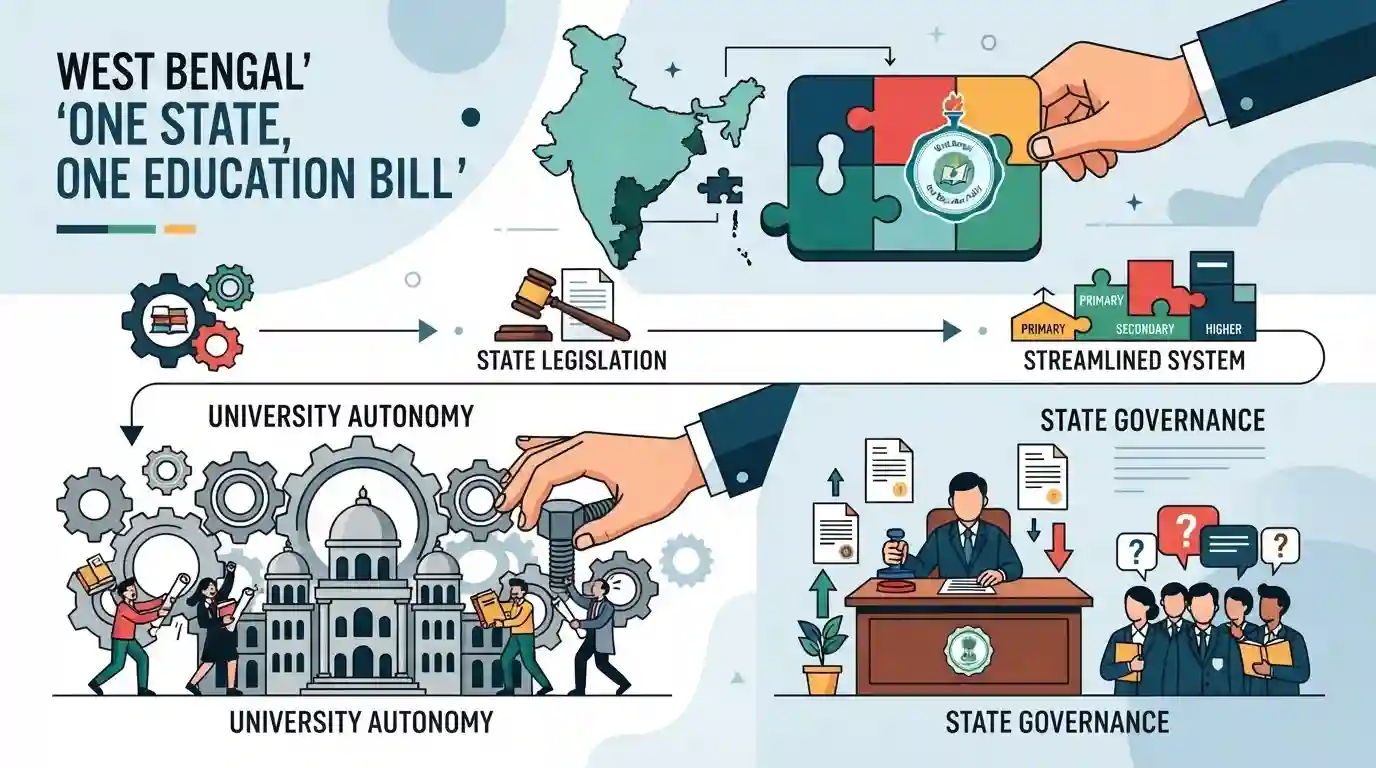
The article discusses West Bengal's 'One State, One Education Bill', detailing its key provisions aimed at streamlining the state's education system and the controversies surrounding university autonomy and state governance.
Key Points
- West Bengal introduced the 'One State, One Education Bill' to overhaul and streamline the educational framework across the state.
- The bill seeks to centralize certain aspects of educational administration and curriculum governance.
- It has sparked debates surrounding state university autonomy, federalism, and the division of administrative powers between state bodies and universities.
Important Terms
One State One Education Bill

A state legislative measure aimed at streamlining higher education by introducing uniform administrative frameworks and personnel transfer mechanisms across state-run universities.
UPSC context
WBCS Paper V (Polity and Governance): Tests federalism, state legislative powers, and university autonomy.
West Bengal Education Bill
Legislative amendments and administrative policies in West Bengal designed to restructure higher education governance, faculty deployment, and departmental oversight of state universities.
UPSC context
WBCS Paper V (Education Policy): Important for questions on regional educational reforms, state-university dynamics, and administrative control.
West Bengal Legislative Assembly
The unicameral state legislature of West Bengal vested with the power to enact laws on state subjects, including education under the State List.
UPSC context
WBCS Paper V (Indian Polity): Tests the legislative process, law-making powers, and Centre-State legislative relations.
Prelims Trap
Education is exclusively a State subject under the Indian Constitution, leaving no legislative power to the Parliament.
Aspirants might assume education is exclusively a state subject, but it was moved to the Concurrent List by the 42nd Constitutional Amendment Act, 1976.
Static Concepts Connected
What are the constitutional provisions regarding the administration and legislative competence of education in India?
- State List origin: Original placement: Education was originally a State subject under Entry 11 of the State List in the Seventh Schedule.
- 42nd Amendment: Constitutional shift: Transferred to the Concurrent List (Entry 25) via the 42nd Amendment Act of 1976.
- Parliamentary competence: Union role: Parliament retains legislative competence, enabling national frameworks like the National Education Policy (NEP).
Cross-Topic Patterns
Education Policy + Federalism & State Lists
State legislation on university governance intersects directly with Union List vs State List dynamics under the Seventh Schedule, particularly Entry 25 of the Concurrent List.
Minority Educational Rights + State Regulation
Administrative rationalization of minority-serving institutions like Aliah University tests Article 30 minority educational rights against state regulatory oversight.

University autonomy vs state centralization in West Bengal education bills will likely appear in polity or state-specific descriptive questions.
Linked PYQs · 2
Linked PYQs · 2
- 2019WBCS_PRELIMSGS1
Which Schedule of the Constitution of India distributes power between the Union and the States?
- 2023WBCS_PRELIMSGS1
Socio-economic planning is a part of
