West Bengal Higher Education Administrative Reform Bill
Source:plutusias ↗
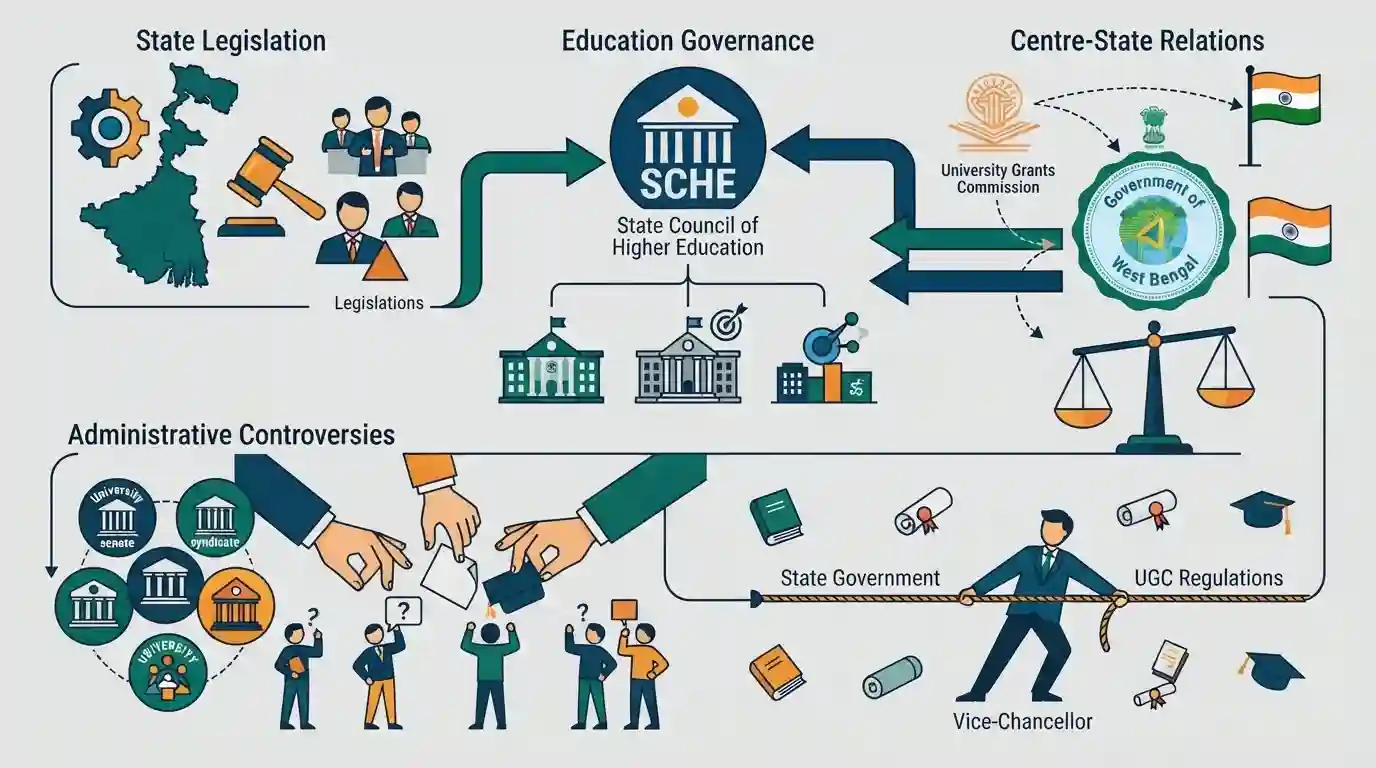
Why It Matters
This article explores state-level educational legislative reforms and concurrent list dynamics, making it vital for understanding state administrative structures and governance controversies in West Bengal.
Summary
An analysis of West Bengal's 'One State One Education Bill', its primary provisions, institutional mechanics, and administrative controversies concerning higher education governance in the state.
Key Points
- West Bengal introduced the One State One Education Bill to streamline higher education administration and governance across state universities.
- The bill outlines key structural reforms, provisions, and central-state administrative debates typical of concurrent-list subjects like education.
- Education falls under the Concurrent List of the Indian Constitution, allowing both state and central legislative frameworks to influence academic policies.
- State university governance and the role of the Chancellor have historically been major areas of institutional friction in West Bengal.
Important Terms
One State One Education Bill

A legislative measure enabling inter-university transfers of teaching and non-teaching personnel across state-run institutions in West Bengal, aimed at redistributing academic human resources.
UPSC context
Important for WBCS Paper V (Polity and Governance, Centre-State Relations, and State Legislation). Tests knowledge of contemporary state-level educational reforms and institutional autonomy.
West Bengal Legislative Assembly
The unicameral law-making body of West Bengal comprising 294 directly elected members, responsible for enacting state legislation and holding the executive accountable.
UPSC context
Crucial for WBCS Polity (State Legislature, Article 168). Tests understanding of legislative procedures, law-making, and state-level constitutional bodies.
West Bengal Land Reforms Act
A landmark 1955 statute designed to reform agrarian relations, protect sharecroppers (bargadars), and impose land ownership ceilings in West Bengal.
UPSC context
Essential for WBCS Economy and West Bengal History/Geography (Land Reforms). Tests knowledge of post-independence agrarian restructuring and tenancy laws.
Prelims Trap
Education has always been listed exclusively under the Concurrent List of the Constitution since 1950.
Education was originally a purely State subject before the 42nd Amendment Act of 1976 transferred it to the Concurrent List, a frequent point of confusion in polity questions.
Static Concepts Connected
Which constitutional amendment transferred 'Education' from the State List to the Concurrent List?
- Constitutional Shift: The 42nd Constitutional Amendment Act of 1976 shifted education, forests, weights and measures, protection of wild animals, and administration of justice to the Concurrent List.
- Seventh Schedule: Entry 25 of the Concurrent List deals with education, including technical education, medical education, and universities.
Cross-Topic Patterns
Education Reforms and Concurrent List Federalism
West Bengal's inter-university transfer reforms mirror recurring debates on cooperative federalism and legislative competence under the Concurrent List of the Seventh Schedule.
Minority Institutions vs. State Administrative Control
Shifting institutional administrative purview, such as Aliah University's move, highlights tensions between minority welfare mandates and centralized higher education governance.

Expect a statement-based question combining Seventh Schedule Concurrent List entries and state university Chancellor/governance disputes.
Linked PYQs · 2
Linked PYQs · 2
- 2020WBCS_PRELIMSGS1
'Chancellor' of the State-run Universities in West Bengal is
- 2022WBCS_PRELIMSGS1
For the purpose of legislation, education is enlisted in the
