West Bengal public safety legislation and preventive detention
Source:lawstreet ↗
কেন এটি গুরুত্বপূর্ণ
The article is essential for understanding the practical applications and limitations of Fundamental Rights (Articles 14, 21, 22), the constitutional nuances of Preventive Detention, the Right to Property (Article 300A), and the division of legislative powers between the Union and the States (7th Schedule, Article 254).
সারসংক্ষেপ
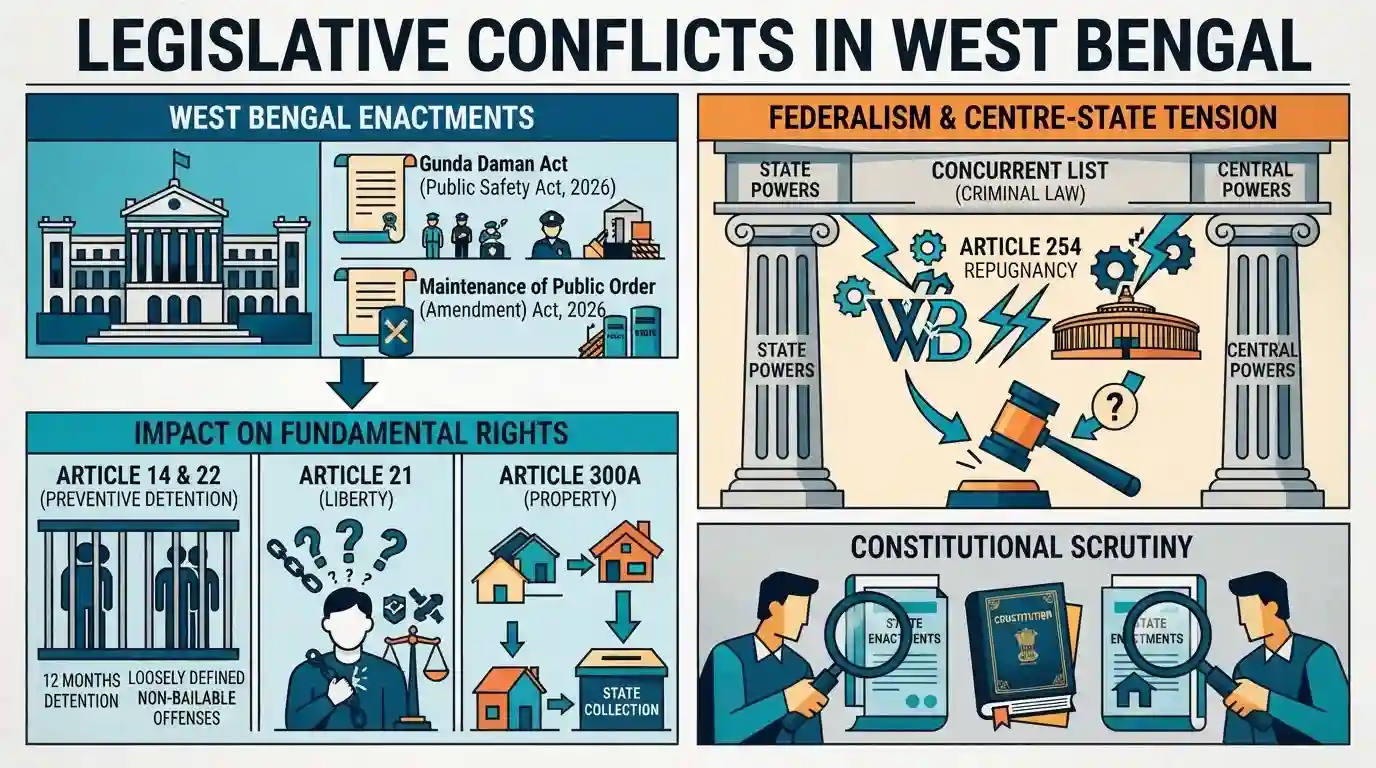
The West Bengal legislature has enacted the 'Gunda Daman Act' (West Bengal Public Safety and Control of Anti-Social Activities Act, 2026) along with the West Bengal Maintenance of Public Order (Amendment) Act, 2026, aimed at curbing organized crime and recovering damages caused during riots. The legislation grants law enforcement broad powers, including preventive detention for up to 12 months, non-bailable classifications for loosely defined 'anti-social activities', and the confiscation of private property prior to conviction. These stringent public safety measures have ignited constitutional debates regarding their potential infringement on Fundamental Rights, particularly Articles 14, 21, and 22, as well as the Right to Property under Article 300A. Furthermore, the laws raise crucial federalism issues concerning state versus concurrent legislative powers and potential repugnancy with existing central laws under Article 254.
মূল বিষয়
- The new West Bengal laws allow for preventive detention of individuals for up to 12 months without trial, triggering the constitutional oversight mechanisms of an Advisory Board under Article 22(4).
- Broad definitions of 'anti-social activities' have sparked legal concerns over potential arbitrariness and violation of Article 14 (Equality before Law).
- The non-bailable classification for various offenses and sweeping enforcement powers raise critical questions regarding the Right to Life and Personal Liberty (Article 21).
- The legislation introduces provisions for property confiscation to recover protest damages without prior conviction, creating friction with the constitutional Right to Property (Article 300A).
- The acts highlight federalism debates, as overlaps with central criminal laws (BNS and BNSS) may cause repugnancy under Article 254, even though 'Public Order' falls under the State List (Entry 1, List II).
গুরুত্বপূর্ণ শব্দ
West Bengal Public Safety and Control of Anti-Social Activities Act, 2026

A 2026 state law allowing preventive detention up to 12 months without trial, non-bailable arrests, externment, and property confiscation for individuals broadly classified as "anti-social" or habitual offenders.
UPSC context
GS Paper 2 (Polity). Tests the constitutional validity of state policing powers and potential infringement of Articles 14 and 21.
West Bengal Maintenance of Public Order (Amendment) Act, 2026
A 2026 amendment empowering the state to recover up to three times the value of damaged property during riots by attaching and auctioning the accused's assets pre-conviction.
UPSC context
GS Paper 2 & 3 (Internal Security). Tests the balance between maintaining public order and protecting the Right to Property (Article 300A).
Gunda Daman Act
The popular moniker for West Bengal's 2026 anti-organized crime law. Modeled after similar state statutes, it introduces stringent public safety frameworks to aggressively curb syndicate operations and riots.
UPSC context
GS Paper 2 (State Legislature). Illustrates the growing trend of tough state-level anti-crime frameworks and their friction with central laws (Article 254).
Advisory Board
A constitutional safeguard body, typically led by a High Court judge, mandated to review and approve preventive detention orders within a specified timeframe to prevent arbitrary executive detention.
UPSC context
GS Paper 2 (Fundamental Rights). Crucial for questions on Article 22(4) and the procedural checks on the state's preventive detention powers.
প্রিলিমস ফাঁদ
The 44th Constitutional Amendment successfully reduced the maximum period of preventive detention without Advisory Board approval to two months.
Though the 44th Amendment Act (1978) sought to reduce the maximum detention period without Advisory Board approval to 2 months, this specific provision was never officially notified. The constitutional limit remains 3 months.
সংযুক্ত স্থির ধারণা
How is legislative jurisdiction over preventive detention divided in the Seventh Schedule?
- Exclusive Union Power: Parliament has exclusive authority under List I (Entry 9) for reasons of defence, foreign affairs, or the security of India.
- Concurrent Jurisdiction: Both Parliament and State Legislatures share concurrent powers under List III (Entry 3) for reasons of state security, public order, or essential services.
What is the Doctrine of Repugnancy under Article 254?
- Concurrent List Conflict: Repugnancy arises when a State law directly conflicts with a Central law on a subject enumerated in the Concurrent List.
- General Rule: The Central law prevails, and the State law is void to the extent of the repugnancy under Article 254(1).
- Presidential Assent Exception: A repugnant State law can still prevail in that State if it receives the assent of the President under Article 254(2).
আন্তঃবিষয় প্যাটার্ন
Executive asset seizure vs Judicial process
Executive-led property confiscations for protest damages clash with Supreme Court mandates requiring independent judicial commissions, testing the separation of powers and Article 300A.
State safety laws vs Central criminal codes
State-level organized crime and public safety laws create deep procedural overlaps with the new central criminal codes (BNS and BNSS), triggering complex Article 254 constitutional questions.

Article 22 limits, the un-notified 44th Amendment, and concurrent jurisdiction over preventive detention are prime for Prelims 2026.
সংযুক্ত PYQ · 3
সংযুক্ত PYQ · 3
- 2021WBCS_PRELIMSGS1
Article 21 of the Indian Constitution ensues
- 2024WBCS_PRELIMSGS1
Which Fundamental Rights cannot be suspended during a National Emergency under Article 359?
- 2017WBCS_PRELIMSGS1
'Law and Order' is included in the
