Kolkata Police Withdraws Suo Motu FIR Against Student Protesters
Source:The Hindu ↗
Why It Matters
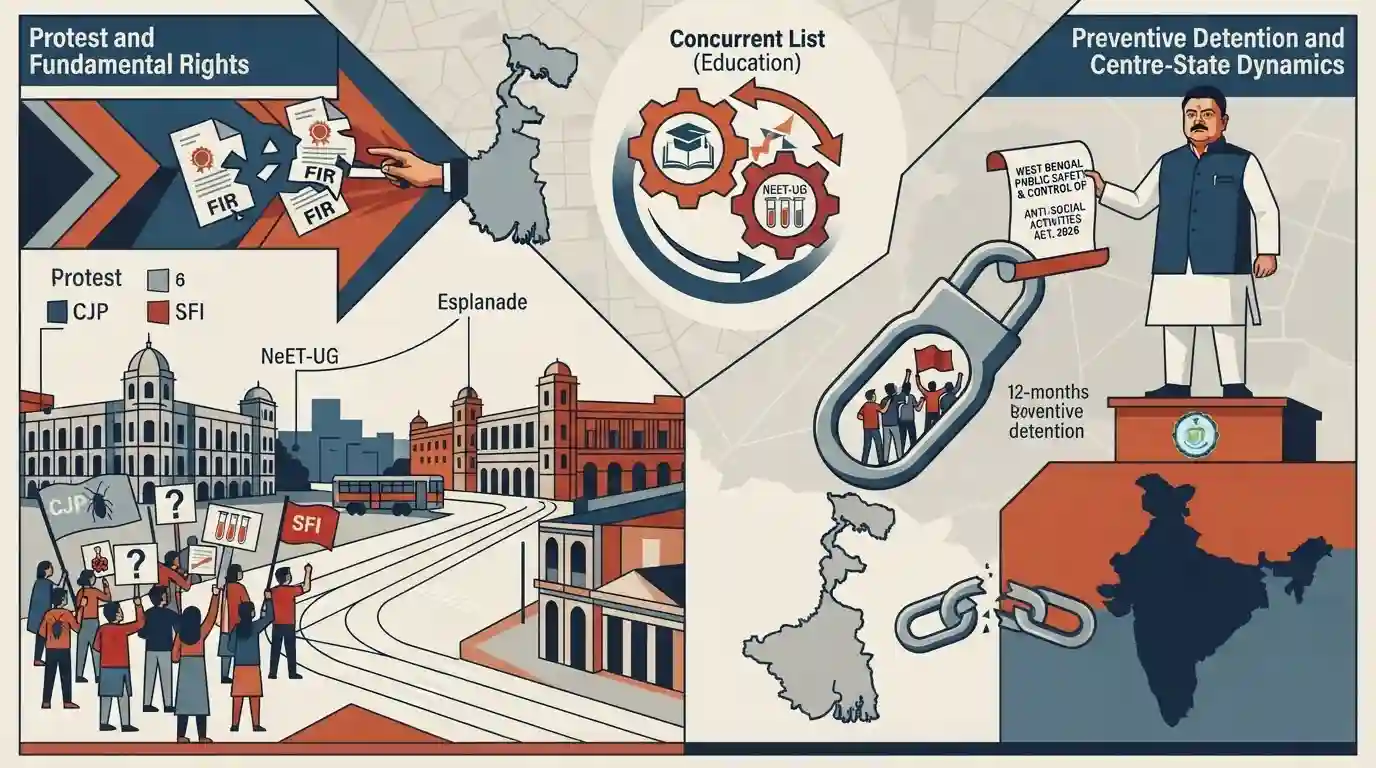
The threat of using a stringent new state law for preventive detention against student protesters highlights the tension between public order and constitutional protections of personal liberty (Articles 21 & 22). Additionally, the context of the protest reflects the ongoing debate surrounding centralized national exams (NEET) in subjects like Education, which is on the Concurrent List.
Summary
The West Bengal government directed the Kolkata Police to withdraw a suo motu FIR filed against members of the Cockroach Janata Party (CJP) and Students Federation of India (SFI) for their protests at Esplanade against alleged NEET-UG irregularities. The withdrawal comes after significant political tension, during which Chief Minister Suvendu Adhikari threatened to invoke the newly enacted West Bengal Public Safety and Control of Anti-Social Activities Act, 2026, which allows up to 12 months of preventive detention.
Key Points
- Kolkata Police withdrew a suo motu FIR against CJP and SFI protesters demanding the resignation of the Union Education Minister over NEET irregularities.
- West Bengal Chief Minister Suvendu Adhikari had threatened to book protesters under the newly enacted West Bengal Public Safety and Control of Anti-Social Activities Act, 2026 (Goonda Act).
- The 'Goonda Act' contains provisions for preventive detention of individuals for up to 12 months.
- While the FIR concerning unlawful assembly was withdrawn, cases against those who allegedly assaulted journalists will proceed.
Important Terms
West Bengal Public Safety and Control of Anti-Social Activities Act, 2026

A state law enacted in July 2026 empowering West Bengal authorities to order preventive detention for up to 12 months to curb organized crime and "anti-social" actions.
UPSC context
GS Paper II: Fundamental Rights (Articles 21, 22), preventive detention, and executive powers vs. civil liberties.
Cockroach Janata Party (CJP)
A youth-led satirical political movement in India founded in May 2026 to protest national entrance exam irregularities and reclaim a derogatory court remark demeaning the unemployed youth.
UPSC context
GS Paper II: Pressure groups, informal associations, and the role of digital mobilization in Indian polity.
National Testing Agency (NTA)
An autonomous premier testing organization established by India's Ministry of Education to conduct highly competitive, standardized entrance examinations for admissions to higher educational institutions.
UPSC context
GS Paper II: Statutory, regulatory and quasi-judicial bodies; issues relating to development and management of Education.
NEET (UG)
The National Eligibility cum Entrance Test (Undergraduate), a single-window national level entrance exam conducted for admissions to medical and dental undergraduate courses in India.
UPSC context
GS Paper II: Social sector issues, federal conflicts in education policy, and examination reforms.
Students Federation of India (SFI)
A prominent, left-wing student organization in India that mobilizes students for educational reforms, social justice, and democratic rights.
UPSC context
GS Paper II: Pressure groups and formal associations and their impact on public policy and student mobilization.
Prelims Trap
"Only Parliament has the authority to enact laws providing for preventive detention."
Preventive detention for public order or state security falls under the Concurrent List (Entry 3), empowering State Legislatures to pass such laws.
Static Concepts Connected
What are the constitutional limitations on preventive detention under Article 22?
- Maximum duration: Detention cannot exceed three months unless an Advisory Board reports sufficient cause for extension.
- Advisory Board composition: Must consist of persons who are, or are qualified to be, High Court judges.
- Right to information: The authority must communicate the grounds of detention as soon as possible, unless against public interest.
- Right to representation: The detenu must be afforded the earliest opportunity to make a representation against the detention order.
How does the Supreme Court distinguish 'Public Order' from 'Law and Order'?
- Law and Order: Routine infractions affecting only specific individuals or small groups. This alone cannot justify preventive detention.
- Public Order: Actions that disrupt the community's general functioning or the "even tempo" of life. Justifies extraordinary preventive detention.
- Concentric circles doctrine: Courts view 'public order' as a much narrower concept nested entirely within the broader sphere of 'law and order'.
Cross-Topic Patterns
Concurrent List friction via Education
NEET irregularities trigger state-led protests against central bodies (NTA), highlighting federal friction over Education, which was moved to the Concurrent List by the 42nd Amendment.
State detention laws vs Article 22
The weaponization of state-level public safety Acts for protests frequently invites judicial scrutiny over arbitrary use of preventive detention without proving a breakdown of public order.

Expect a multi-statement Prelims question on Article 22, distinguishing Parliamentary vs State powers to enact preventive detention laws.
Linked PYQs · 3
Linked PYQs · 3
- 2021WBCS_PRELIMSGS1
In the Constitution of India, ‘Protection of Life and Personal Liberty’ is guaranteed under Article No.
- 2022WBCS_PRELIMSGS1
For the purpose of legislation, education is enlisted in the
- 2018WBCS_PRELIMSGS1
In the classification of power in the Constitution of India, education falls under
