Rising Women Voter Turnout Trends In West Bengal Assembly Elections
Source:Indian Express ↗
Why It Matters
The increasing electoral participation of women and their emergence as a decisive voting bloc shifts political focus towards women-centric welfare schemes and governance. The interplay of welfare schemes, political empowerment, and migration patterns provides critical insights into changing electoral dynamics in India.
Summary
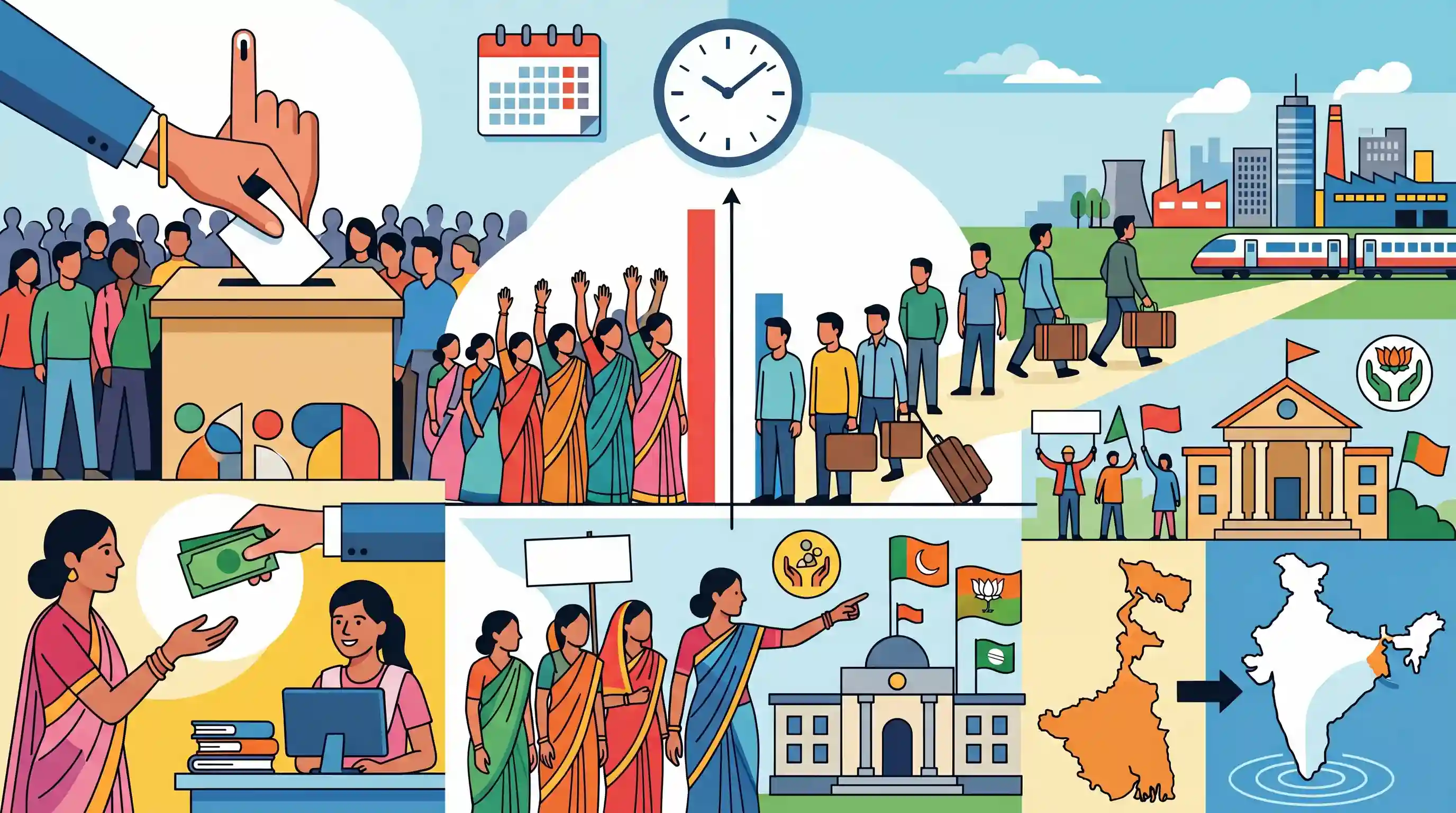
West Bengal recorded its highest-ever voter turnout of 92.47% in the 2026 Assembly elections, with women outvoting men (93.24% vs 91.74%). This trend highlights the growing political empowerment and consciousness of women in the state. The TMC's targeted welfare schemes (Kanyashree, Lakshmir Bhandar) and the legacy of panchayat reservations during the Left Front era are viewed as key factors driving this mobilization. The higher participation of women is also partly attributed to the migration of men to other states for employment. The phenomenon reflects a broader pan-India trend of rising female electoral participation.
Key Points
- West Bengal recorded a historic overall voter turnout of 92.47% in the 2026 Assembly elections.
- Female voter turnout (93.24%) significantly outpaced male voter turnout (91.74%), continuing a trend observed in the state since 2011.
- The ruling TMC attributes the high participation to its women-centric welfare schemes like Lakshmir Bhandar, Kanyashree, and Rupashree, which have empowered women politically and economically.
- The CPI(M) suggests that women's political consciousness stems from the 33% reservation for women in panchayats introduced during the Left regime.
- Out-migration of men for employment to other states has also structurally contributed to the higher ratio of women voters casting ballots.
Important Terms
Lakshmir Bhandar

A West Bengal welfare scheme providing monthly financial assistance (₹1,000–₹1,200) to female heads of households aged 25–60 to promote financial independence.
UPSC context
GS Paper II: Welfare schemes for vulnerable sections; tests understanding of gender-budgeting and social security.
Kanyashree Prakalpa
An award-winning conditional cash transfer scheme in West Bengal designed to improve girl children's status by incentivizing education and preventing child marriage.
UPSC context
GS Paper II: Social Justice; tests knowledge of internationally-recognized models for women’s empowerment and education.
Election Commission of India (ECI)
The autonomous constitutional authority (Article 324) responsible for administering election processes in India, ensuring free, fair, and inclusive voting.
UPSC context
GS Paper II: Polity; core topic regarding constitutional bodies, electoral reforms, and democratic accountability.
Left Front
A coalition of left-wing parties, led by CPI(M), that ruled West Bengal (1977–2011), implementing significant land reforms and panchayat decentralization.
UPSC context
GS Paper II: Decentralization; relevant for the history of Panchayati Raj and political mobilization in India.
Rupashree Prakalpa
A West Bengal scheme providing a one-time ₹25,000 grant to economically stressed families for the marriage of daughters aged 18 or above.
UPSC context
GS Paper II: Governance; tests knowledge of state-specific social security and its impact on social indicators like child marriage.
Direct Benefit Transfer (DBT)
A governance mechanism where subsidies or benefits are transferred directly into beneficiaries' bank accounts, minimizing intermediaries and leakages.
UPSC context
GS Paper III: Indian Economy/E-governance; tests understanding of fiscal efficiency and digital infrastructure in welfare delivery.
Prelims Trap
Higher female voter turnout in state elections ensures proportional or parity representation of women in State Legislative Assemblies.
Despite women reaching voter turnout parity or outvoting men, their legislative representation remains severely disproportionate (averaging ~9% across State Assemblies). Turnout parity does not equal representation parity.
Static Concepts Connected
What are the constitutional provisions for women's representation in PRIs?
- Article 243D: Mandates that not less than one-third of total seats in Panchayats be reserved for women, including quotas within SC/ST reservations.
- Chairperson positions: One-third of the total number of offices of Chairpersons in the Panchayats at each level must be reserved for women.
- State discretion: State legislatures can enhance this baseline reservation. Several states have voluntarily raised women's reservation in Panchayati Raj Institutions to 50%.
How is the Election Commission addressing internal migrant disenfranchisement?
- Current limitations: Internal migrants cannot vote from their worksite. Postal ballots are restricted to service voters, election duty staff, and specific essential services, excluding general migrant laborers.
- RVM Proposal: The ECI has proposed a Multi-Constituency Remote Electronic Voting Machine (RVM) to allow domestic migrants to vote for their home constituencies remotely.
Cross-Topic Patterns
Feminization of the electorate via welfare
Targeted cash transfers are shifting women from passive participants to a distinct, independent voting bloc, heavily influencing state fiscal strategies and electoral outcomes.
Migration's impact on electoral demographics
Male out-migration for work inflates female voter ratios in origin states, simultaneously highlighting the severe, systemic disenfranchisement of India's internal migrant workforce.

Expect a GS2 Mains question contrasting the rise of women as an independent voting bloc with their chronically low legislative representation.
Linked PYQs · 3
Linked PYQs · 3
- 2025MainsGS2
Women's social capital complements in advancing empowerment and gender equity. Explain.
- 2023MainsGS2
Discuss the contribution of civil society groups for women's effective and meaningful participation and representation in state legislatures in India.
- 2021MainsGS2
“Though women in post-Independent India have excelled in various fields, the social attitude towards women and feminist movement has been patriarchal." Apart from women education and women empowerment schemes, what interventions can help change this milieu?
