West Bengal Demands State Safeguards in Ganga Water Agreement
Source:news-on-air ↗
Why It Matters
The Ganga Water Treaty of 1996 is a crucial cornerstone of India-Bangladesh ties. The active involvement of the West Bengal government highlights the critical federal aspect of transboundary water diplomacy in South Asia. Additionally, the Farakka Barrage's role in reviving the lower Ganges (Hooghly) to sustain the Kolkata Port is a recurring core topic in the WBCS geography and environmental syllabus.
Summary
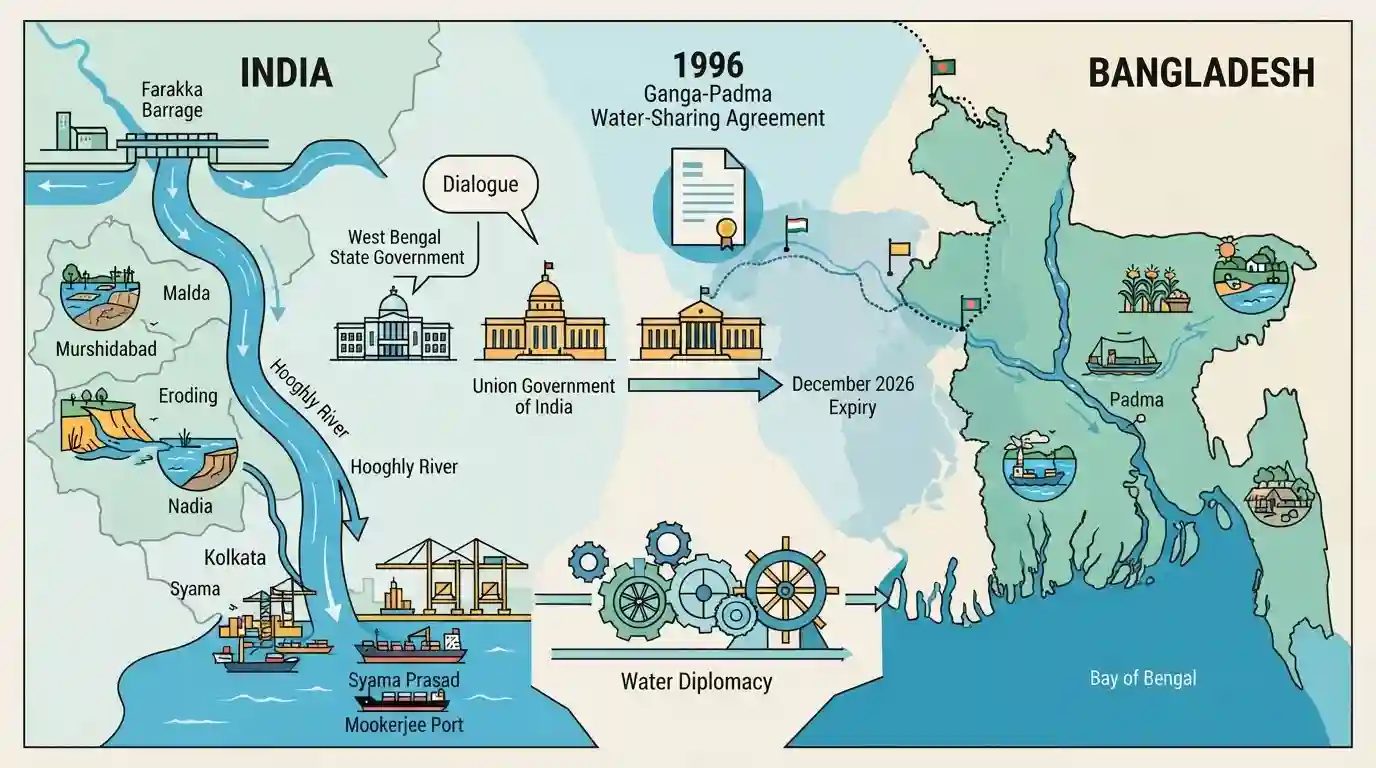
The West Bengal government has formally requested the Union government to protect the state's environmental and economic interests prior to the renewal of the landmark 1996 Ganga-Padma water-sharing agreement with Bangladesh, which expires in December 2026. West Bengal has emphasized the need for a sustained water discharge from the Farakka Barrage during the dry season to prevent siltation and maintain the navigability of the Hooghly river channel, which is essential for Kolkata's Syama Prasad Mookerjee Port. It has also raised concerns regarding flooding and riverbank erosion in Malda, Murshidabad, and Nadia.
Key Points
- The 30-year Ganga Water Sharing Treaty, signed in December 1996 between India and Bangladesh, is set to expire in December 2026.
- The West Bengal government has urged the Central government to prioritize state interests and local ecological concerns before finalizing any treaty renewal.
- Maintaining adequate dry-season water flow through the Farakka Barrage is crucial to keeping the Bhagirathi-Hooghly river system navigable and protecting the shipping operations of Kolkata's Syama Prasad Mookerjee Port.
- The state highlighted serious issues of riverbank erosion, heavy siltation, and seasonal flooding affecting the riparian districts of Malda, Murshidabad, and Nadia.
- Technical teams from both countries have already started gathering river flow data at Farakka in India and the Hardinge Bridge in Bangladesh under the aegis of the Joint Rivers Commission.
Important Terms
Ganga Water Sharing Treaty (1996)

A landmark 30-year bilateral treaty signed in 1996 between India and Bangladesh regulating dry-season flow allocation of the Ganga River at the Farakka Barrage, expiring in December 2026.
UPSC context
WBCS Mains Paper III (Geography) & Paper IV (Current Affairs); tests transboundary river basins, regional hydrology, and international water-sharing.
Farakka Barrage
A 2.24-kilometer-long barrage on the Ganga River in Murshidabad, West Bengal, commissioned in 1975 to divert water into the Bhagirathi-Hooghly system to flush silt from Kolkata Port.
UPSC context
WBCS Mains Paper III (Geography of Bengal); tests major irrigation projects, drainage networks, and regional port-navigability challenges.
Syama Prasad Mookerjee Port Trust
India’s oldest operating major riverine port, located in Kolkata, West Bengal. Renamed from Kolkata Port Trust in 2020, it requires sustained Farakka water discharge to remain navigable.
UPSC context
WBCS Mains Paper III (Geography: Transport & Economy); tests major Indian ports, riverine maritime operations, and economic infrastructure of Bengal.
India-Bangladesh Joint Rivers Commission
A bilateral body established in June 1972 to facilitate technical cooperation, information exchange, and management of the 54 transboundary rivers shared by India and Bangladesh.
UPSC context
WBCS Mains Paper IV (Current Affairs/IR); tests bilateral institutional diplomacy, cross-border water governance, and international joint bodies.
Union Ministry of Jal Shakti
An apex union-level ministry formed in 2019 to streamline national water policies, drinking water access, and coordinate transboundary and inter-state river management.
UPSC context
WBCS Mains Paper V (Polity/Governance) and Paper IV; tests union-state relations, federal resource allocation, and major welfare schemes.
Prelims Trap
The formal consent of affected State Governments is constitutionally mandatory for the Union to sign or renew transboundary water treaties.
Under Article 253, Parliament can legislate on State List subjects (like water) to implement international treaties without needing the state's formal consent, though political consultation is customary.
Static Concepts Connected
How does the Constitution distribute power over transboundary river water treaties?
- Union List Entry 14: Deals with entering into treaties and agreements with foreign countries and implementing them.
- State List Entry 17: Water is a state subject (irrigation, canals, water storage) but is subject to Union List Entry 56.
- Article 253: Empowers Parliament to make laws for implementing any treaty or agreement, overriding any State List subject.
What is the geographical and historical significance of the Farakka Barrage?
- Location & Timeline: Commissioned in 1975 on the Ganga River in Murshidabad and Malda districts to divert water into the Hooghly system.
- Primary Objective: To flush out silt and maintain the draft/navigability of the Bhagirathi-Hooghly river channel for Kolkata Port.
- Joint Rivers Commission: Established in June 1972 to manage water resources and technical cooperation across 54 shared transboundary rivers.
Cross-Topic Patterns
Paradiplomacy in Federal Water Sharing
The Teesta and Ganga disputes highlight paradiplomacy, where subnational states like West Bengal directly shape and constrain India's bilateral foreign policy negotiations with neighboring Bangladesh.
Siltation and Riverine Port Economics
Upstream Ganga siltation directly threatens Kolkata Port's viability, showing how geomorphic changes in the Bhagirathi-Hooghly system dictate maritime trade economics and expensive dredging requirements.

Ganga Treaty renewal (2026) likely to be asked as a multi-statement question combining Article 253, Farakka history, and JRC-1972.
Linked PYQs · 4
Linked PYQs · 4
- 2011WBCS_PRELIMSGS1
Farakka Barrage has been constructed
- 2009WBCS_PRELIMSGS1
Farakka Barrage has been constructed
- 2015WBCS_PRELIMSGS1
The most important reason for the construction of the Farakka Barrage was
- 2018WBCS_PRELIMSGS1
Geomorphologists opine that change of the course of the Kosi river resulted in
