West Bengal Plans Three New Thermal Power Units to Boost Energy
Source:powerline ↗
কেন এটি গুরুত্বপূর্ণ
The locations of thermal power stations (Santaldih, Bakreshwar, Sagardighi) are frequently asked in the West Bengal Geography section of WBCS Prelims. Furthermore, upgrades to supercritical technology indicate significant infrastructural developments in the state's energy sector.
সারসংক্ষেপ
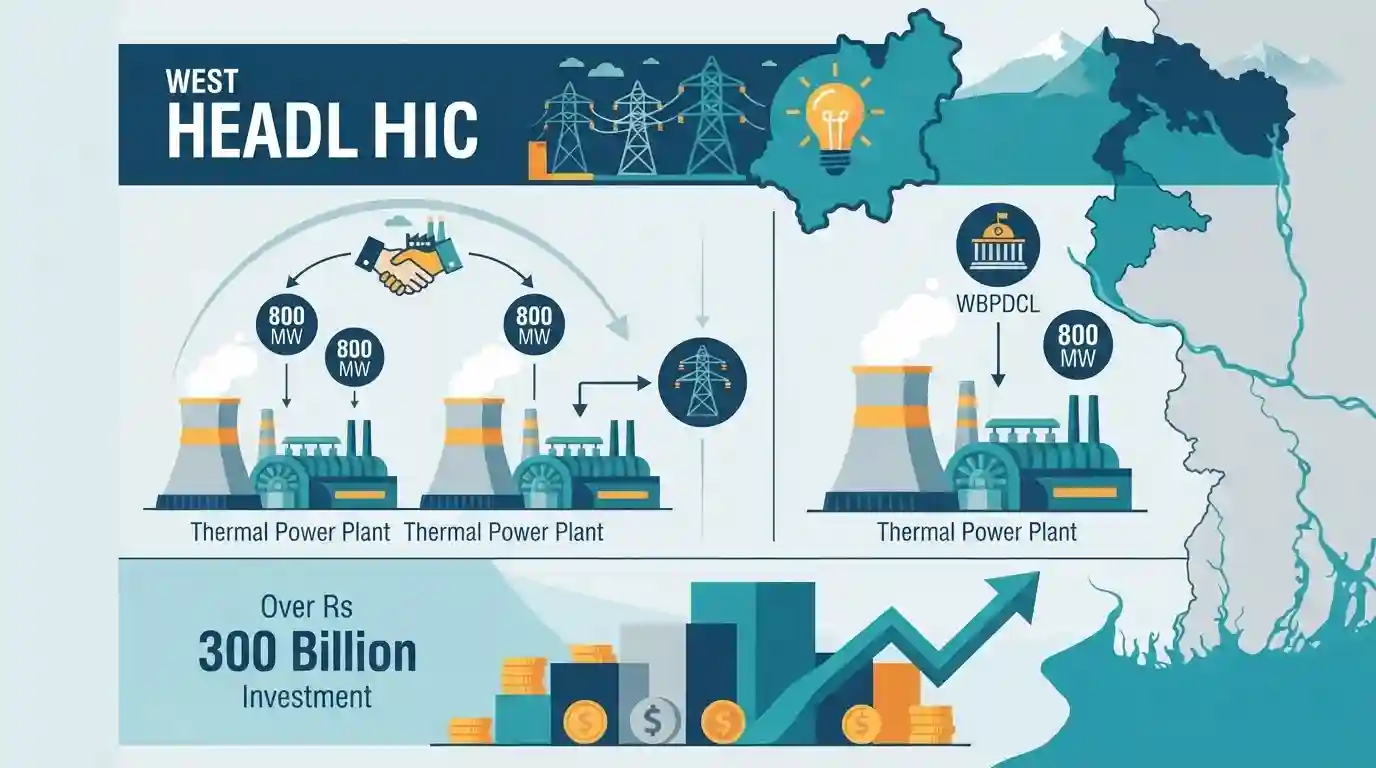
The West Bengal government has announced plans to establish three new 800 MW supercritical and ultra-supercritical coal-based thermal power units, aiming to enhance the state's power generation capacity. With a total investment of over Rs 300 billion, two of the units will be constructed at Santaldih via a public-private partnership (PPP), while the third will be developed at Bakreshwar by the West Bengal Power Development Corporation Limited (WBPDCL).
মূল বিষয়
- The West Bengal government plans to set up three 800 MW supercritical or ultra-supercritical coal-based thermal power units.
- The total investment for the new units will exceed Rs 300 billion.
- Two units will be established at Santaldih under the public-private partnership (PPP) model.
- One unit will be set up at Bakreshwar by WBPDCL, costing Rs 100.7 billion, making it WBPDCL's first supercritical thermal power unit.
- This capacity addition follows the recent commissioning of the fifth unit at the Sagardighi Thermal Power Station.
গুরুত্বপূর্ণ শব্দ
West Bengal Power Development Corporation Limited (WBPDCL)

A wholly-owned enterprise of the West Bengal government responsible for thermal power generation. It operates major stations like Kolaghat and Bakreshwar, playing a nodal role in meeting the state's electricity demand through capacity expansion.
UPSC context
Relevant for GS Paper 3 (Energy Infrastructure). Highlights the role of state-owned utilities in ensuring regional energy security.
Santaldih Thermal Power Station
A coal-fired power plant in Purulia district, West Bengal. It is slated for a major expansion with two new 800 MW supercritical units developed under a Public-Private Partnership (PPP) to boost the state's energy capacity.
UPSC context
Relevant for GS Paper 1 (Geography) and GS Paper 3 (Infrastructure). Important for mapping regional energy resources and capacity augmentation.
Bakreshwar Thermal Power Station
A major coal-based thermal power plant in Birbhum district, West Bengal, operated by WBPDCL. It is expanding its capacity by adding an 800 MW supercritical unit to address the state's peak electricity demand.
UPSC context
Useful for GS Paper 1 (Geography) and GS Paper 3 (Energy). Tests knowledge of key regional power infrastructure locations.
Supercritical thermal power units
Coal-based power plants that operate above the critical point of water pressure and temperature. They offer higher thermal efficiency, consume less coal per megawatt, and emit fewer greenhouse gases compared to conventional subcritical plants.
UPSC context
Important for GS Paper 3 (Environment & Energy). Focuses on technological advancements for cleaner coal energy and emission reduction.
SHAKTI Policy
The Scheme for Harnessing and Allocating Koyala (Coal) Transparently in India allocates coal to thermal power plants. It aims to resolve fuel supply constraints and reduce dependence on imported coal for power generation.
UPSC context
Crucial for GS Paper 3 (Infrastructure & Resources). Tests government interventions for coal linkage and energy security.
প্রিলিমস ফাঁদ
Supercritical thermal power plants operate immediately below the thermodynamic critical point of water to utilize the latent heat of vaporization.
Supercritical plants operate *above* the thermodynamic critical point (22.11 MPa, 374°C), meaning water transitions directly from liquid to gas without boiling, avoiding latent heat loss.
সংযুক্ত স্থির ধারণা
What is Supercritical and Ultra-supercritical (USC) thermal power technology?
- Operating threshold: Works above the thermodynamic critical point of water (22.11 MPa and 374°C), where distinct liquid-vapor states do not exist.
- Efficiency gains: Raises thermal efficiency to over 40-45%, compared to ~33-35% in older, traditional subcritical coal plants.
- Environmental benefit: Significantly lowers coal consumption and carbon dioxide emissions per megawatt-hour of electricity generated.
How do the major river systems of West Bengal support thermal infrastructure?
- Bhagirathi-Hooghly system: Feeds vital cooling systems for major regional power plants, including the Sagardighi plant in Murshidabad.
- Western plateau tributaries: Originate in the Chota Nagpur plateau, feeding reservoirs like Neel Nirjan on the Bakreshwar (Mayurakshi tributary) and Santaldih (Damodar).
আন্তঃবিষয় প্যাটার্ন
Thermal expansion vs. Net-Zero commitments
Reconciling new supercritical coal units with India's international climate pledges of achieving net-zero emissions by 2070.
PPP financing in heavy infrastructure
Evaluating the shift towards public-private partnerships (PPP) to mobilize capital for high-cost ultra-supercritical infrastructure projects in cash-strapped states.

Supercritical steam parameters and river-basin locations of major thermal plants are highly probable for direct UPSC prelims mapping.
সংযুক্ত PYQ · 2
সংযুক্ত PYQ · 2
- 2015WBCS_PRELIMSGS1
The most superior industrial coal of West Bengal is of
- 2024WBCS_PRELIMSGS1
Wind Energy Project was set up in West Bengal at:
