Asansol Teachers Pioneer Urban Tree Transplantation Initiative
Source:etvbharat ↗
Why It Matters
This article highlights community-led ecological restoration and urban forestry in the highly industrialized Rarh region of West Bengal. It illustrates the practical application of tree translocation technology, the reclamation of native biodiversity (the Asan tree), and local action against invasive weeds like water hyacinth ('Terror of Bengal'). These topics are highly relevant to WBCS Prelims and Mains (Environment & Geography sections).
Summary
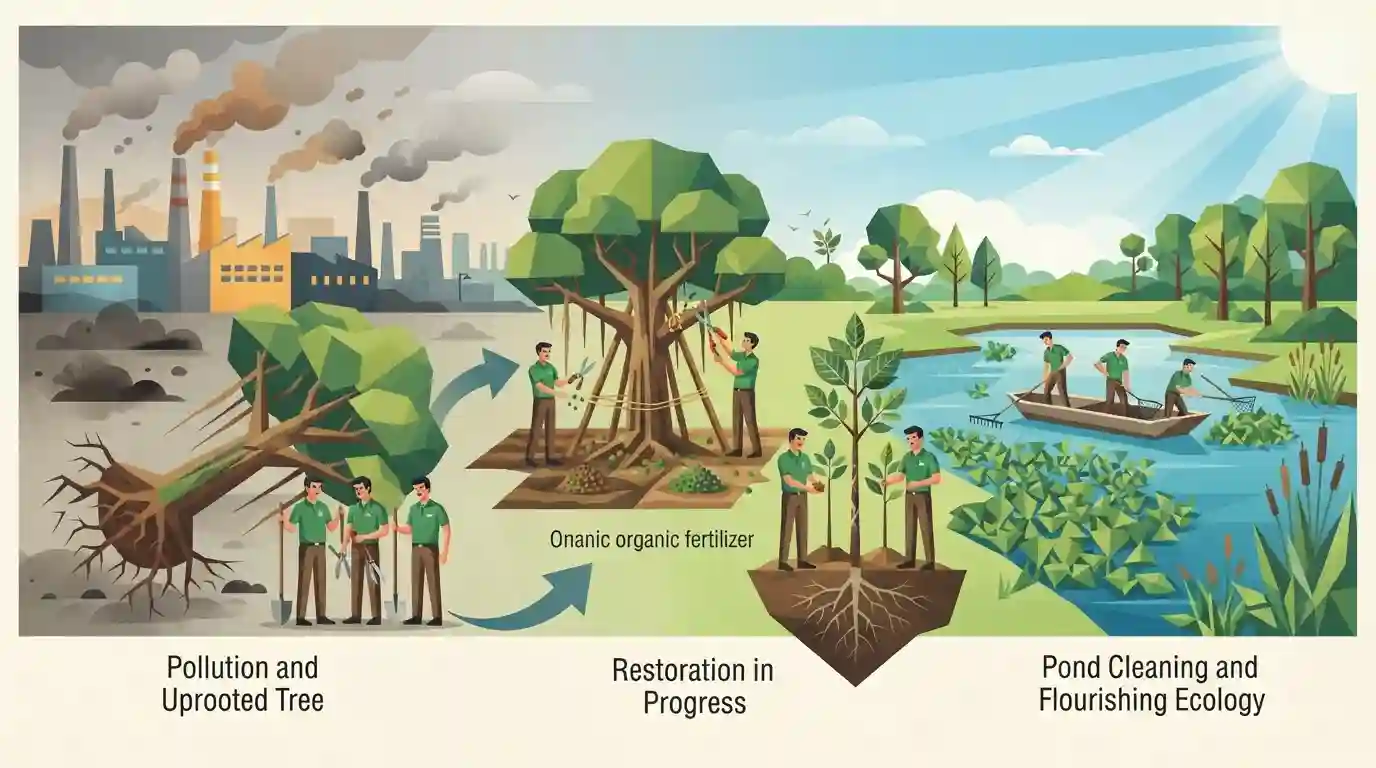
In the industrial hub of Asansol, West Bengal, a volunteer group of school teachers called 'Green Heaven' is restoring the local ecology through tree transplantation, native afforestation, and pond cleaning. They successfully revived a 20-to-25-year-old uprooted Banyan tree using pruning and organic fertilizer techniques, a method they have replicated elsewhere. Additionally, the group is reintroducing the native 'Asan' tree (after which Asansol is named) and clearing water hyacinths from local water bodies to combat aquatic degradation.
Key Points
- A citizen-led volunteer group named 'Green Heaven', primarily formed by school teachers during the COVID-19 pandemic, is actively greening the industrial city of Asansol in the West Bardhaman district of West Bengal.
- The group successfully pioneered local tree translocation by reviving a 20-to-25-year-old uprooted Banyan tree (Ficus benghalensis) inside the Asansol District Hospital. The scientific process involved pruning heavy branches to reduce nutrient and water load on damaged roots, digging a massive pit using a JCB, applying organic fertilizers, and conducting intensive regular watering via municipal tankers.
- Following the success at the hospital, the group saved several other storm-uprooted trees using similar techniques in Mahishila (Battala Bazar) and Barabani (Panchgachia).
- To restore the city's ecological heritage, 'Green Heaven' is planting native 'Asan' trees (Terminalia tomentosa/alata) across the city. The industrial town of Asansol derives its name from this tree species ('Asan' + 'Sol', meaning land/forest of Asan), which had nearly vanished due to industrialization.
- The group also restores local aquatic ecosystems by cleaning polluted ponds choked with water hyacinths (Eichhornia crassipes), a notorious invasive weed historically dubbed the 'Terror of Bengal'.
Important Terms
Asan Tree

A native tree species (Terminalia elliptica) historically abundant in West Bengal's Damodar River valley, from which the industrial city of Asansol derives its name.
UPSC context
Paper III: Geography of West Bengal. Tests knowledge of regional forest flora, forest types, and state-specific environmental history.
Tree Transplantation
An ecological conservation process of carefully uprooting a mature, fully grown tree and replanting it in another location to preserve green cover during development.
UPSC context
Paper IV: Science and Technology (Environment). Tests understanding of environmental mitigation, ecology, and urban forest conservation techniques.
Water Hyacinth
An invasive free-floating aquatic plant (Eichhornia crassipes), dubbed 'Terror of Bengal', that rapidly chokes freshwater bodies, blockading sunlight and depleting oxygen.
UPSC context
Paper IV: Environment & Ecology. Tests concepts of invasive alien species, eutrophication, and aquatic ecosystem degradation in West Bengal.
Green Heaven
A volunteer ecological organization of school teachers in Asansol, West Bengal, executing urban afforestation, mature tree transplantation, and pond cleaning.
UPSC context
Paper IV: Environment. Tests awareness of community-led environmental conservation initiatives and ecological restoration movements in West Bengal.
Asansol Municipal Corporation (AMC)
The urban local self-government body responsible for the civic administration, public services, and infrastructure development of West Bengal's second-largest city.
UPSC context
Paper V: Indian Polity and Constitution. Tests knowledge of urban local bodies, 74th Amendment Act, and local governance in West Bengal.
Prelims Trap
The Asan tree is the official State Tree of West Bengal due to its historical association with Asansol.
The State Tree of West Bengal is the Chatim Tree (Alstonia scholaris). Asan is ecologically and economically crucial locally, but holds no state-level official symbol status.
Static Concepts Connected
Why is Water Hyacinth termed the 'Terror of Bengal'?
- Invasive Origin: Introduced from South America for its ornamental flowers, it quickly choked Bengal's inland waterways.
- Oxygen Depletion: It multiplies rapidly, blocking sunlight and causing severe eutrophication by drastically reducing dissolved oxygen.
- Ecological Damage: Destroys local aquatic biodiversity and severely impacts inland fisheries across rural West Bengal.
What is the economic role of the Asan Tree?
- Tasar Silk Host: It serves as a primary host plant for rearing wild tropical Tasar silkworms (Antheraea mylitta).
- Dry-tract Forestry: Thrives in the dry, red-soil lateral tracts of Purulia, Bankura, and Paschim Bardhaman.
- Cottage Economy Support: Crucial for tribal livelihoods engaged in non-mulberry sericulture in western West Bengal.
Cross-Topic Patterns
Sericulture + Red Soil Geography
The distribution of the Asan tree directly dictates the geographical concentration of non-mulberry Tasar silk cultivation in West Bengal’s dry western lateral districts.
Industrialization + Wetland Eutrophication
Industrial growth post-2017 bifurcation of Paschim Bardhaman has intensified wetland eutrophication, shifting local restoration responsibilities to citizen-led initiatives.

Statement-based questions linking the state tree of WB, the 'Terror of Bengal', and regional silkworm host plants are highly probable.
Linked PYQs · 2
Linked PYQs · 2
- 2006WBCS_PRELIMSGS1
Oldest coalfield of Damodar Valley region is
- 2017WBCS_PRELIMSGS1
In West Bengal 'Rarh' is a physiographic region, part of which can be found in the district of
