West Bengal to provide officials for electoral roll revision
Source:The Hindu ↗
Why It Matters
The deployment of state administrative staff for election duties is a constitutional mandate under Article 324, but it frequently becomes a point of friction between the Election Commission and State governments. The Supreme Court's active oversight of the electoral roll revision highlights the judiciary's role in ensuring free and fair elections, ensuring accountability, and protecting voting rights from arbitrary deletions.
Summary
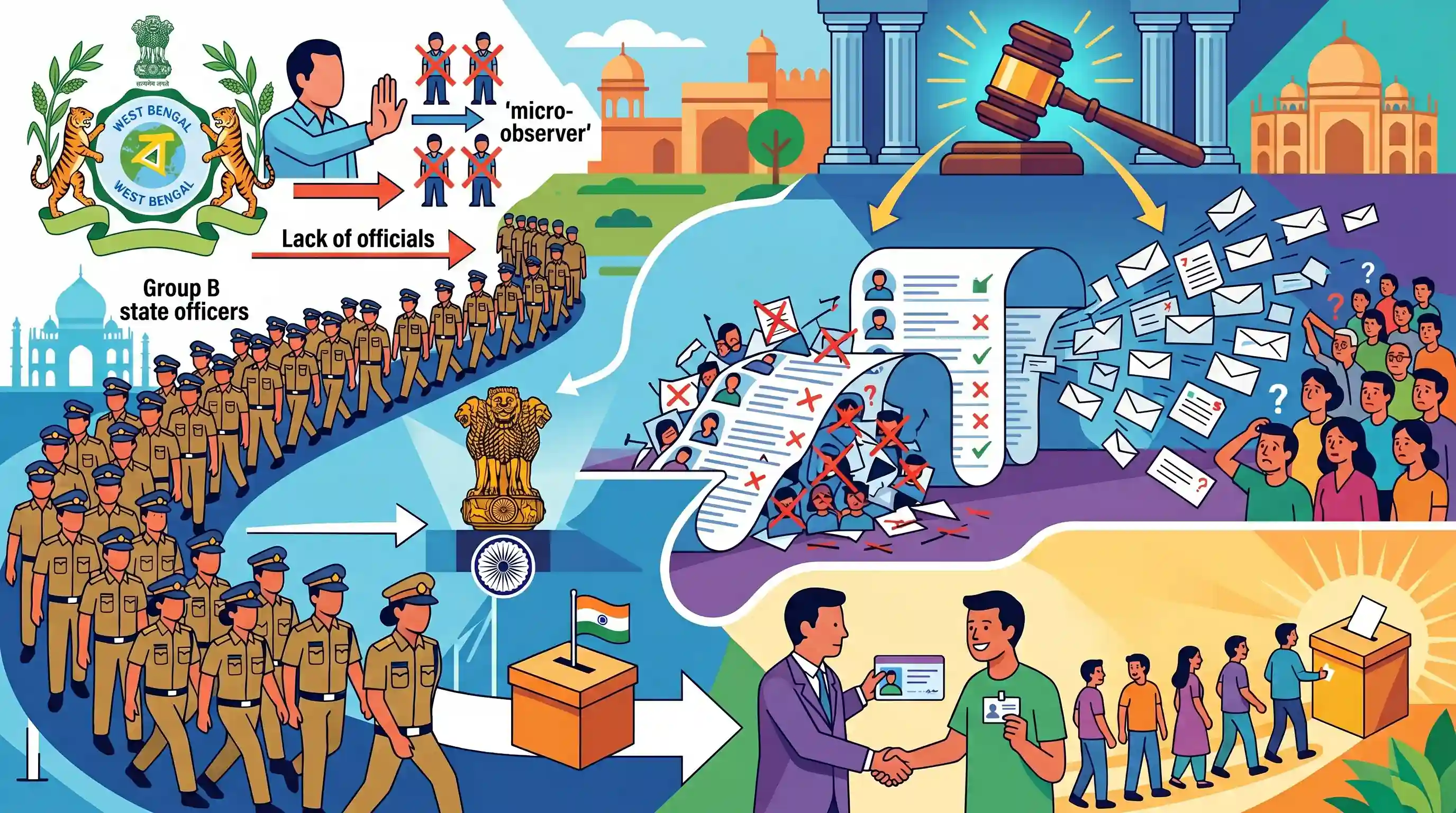
Ahead of a Supreme Court hearing regarding the Special Intensive Revision (SIR) of electoral rolls, the West Bengal government has agreed to provide 8,505 Group B officers to the Election Commission. The State’s Chief Minister, Mamata Banerjee, had earlier objected to the appointment of micro-observers by the EC. The EC explained to the apex court that micro-observers were deployed because the State had initially failed to provide adequate administrative staff. The SIR process has seen around 58 lakh voters deleted and over 1.36 crore issued notices for 'logical discrepancies', prompting the Supreme Court to order the EC to conduct verifications transparently and without harassing citizens.
Key Points
- The West Bengal government agreed to provide 8,505 Group B officers to the Election Commission for the Special Intensive Revision (SIR) of electoral rolls.
- The Election Commission informed the Supreme Court that it appointed micro-observers in the state because the government had initially provided only 80 Group B officers.
- Around 58 lakh voters were deleted from draft rolls, and over 1.36 crore were marked under 'logical discrepancy', leading to SC interventions.
- The Supreme Court directed the Election Commission to verify minor discrepancies transparently and without causing stress to voters.
- The Chief Electoral Officer of West Bengal sought a one-week extension to complete the SIR process ahead of the assembly elections.
Important Terms
Special Intensive Revision (SIR)

A large-scale, door-to-door verification drive by the Election Commission to update electoral rolls. It aims to remove duplicates, deceased persons, and ineligible entries through fresh enumeration and document verification.
UPSC context
GS Paper II: Electoral Reforms. Tests understanding of administrative mechanisms ensuring the integrity of the voter base and 'one person, one vote' principle.
Election Commission of India (ECI)
A permanent constitutional body (Article 324) responsible for the superintendence, direction, and control of elections to Parliament, State Legislatures, and the offices of President and Vice-President.
UPSC context
GS Paper II: Constitutional Bodies. Core topic regarding the independence and functioning of India's democratic machinery.
Micro-observers
Central government or PSU officials deployed at sensitive polling stations to monitor the voting process. They work under ECI Observers and report directly on any procedural vitiation or irregularities.
UPSC context
GS Paper II: Election Machinery. Tests knowledge of the technical safeguards used by the EC to ensure free and fair polling in vulnerable areas.
Article 324
The foundational constitutional provision vesting the Election Commission with plenary powers to manage elections and revise electoral rolls, acting as a reservoir of power when laws are silent.
UPSC context
GS Paper II: Indian Constitution. Fundamental for questions on the "plenary power" of the ECI and the separation of powers during elections.
Electoral Rolls
The official list of citizens eligible to vote in a constituency. Its preparation, revision, and maintenance are statutory requirements under the Representation of the People Act, 1950.
UPSC context
GS Paper II: Representation of People Act. Essential for understanding the legal criteria for citizenship-based voting rights and exclusion grievances.
Prelims Trap
"Micro-observers have the statutory authority to delete names from the draft electoral roll during revisions."
Micro-observers only monitor the process. The statutory authority to accept, reject, or delete names rests exclusively with the Electoral Registration Officer (ERO) under RPA 1950.
Static Concepts Connected
How is RPA 1950 different from RPA 1951 regarding elections?
- RPA 1950: Deals with the preparation and revision of electoral rolls, delimitation of constituencies, and the qualifications of voters.
- RPA 1951: Governs the actual conduct of elections, qualifications and disqualifications for candidates, election petitions, and corrupt practices.
What is the constitutional mandate for providing administrative staff to the ECI?
- Article 324(6): Mandates the President or State Governor to make available to the Election Commission such staff as may be necessary to conduct elections.
- Deemed Deputation: State officials deployed for election duty are considered to be on deputation to the ECI, falling under its direct control, superintendence, and discipline.
Cross-Topic Patterns
ECI mandates and administrative federalism
State delays in providing staff for ECI functions parallel recent issues with CBI general consent, highlighting structural stress points in Indian administrative federalism.
Article 329 vs Judicial Review
The SC's intervention to ensure electoral roll transparency tests the boundaries of Article 329, which generally bars courts from interfering in election processes once initiated.

Expect a multi-statement Prelims question testing the exact statutory powers under RPA 1950 vs 1951 and Art 324(6) staff deputation.
Linked PYQs · 4
Linked PYQs · 4
- 2022MainsGS2
Discuss the role of the Election Commission of India in the light of the evolution of the Model Code of Conduct.
- 2024MainsGS2
Examine the need for electoral reforms as suggested by various committees with particular reference to "one nation one election" principle.
- 2016MainsGS2
What was held in the Coelho case? In this context, can you say that judicial review is of key importance amongst the basic features of the Constitution?
- 2017PrelimsGS1
Consider the following statements: 1. The Election Commission of India is a five-member body. 2. Union Ministry of Home Affairs decides the election schedule for the conduct of both general elections and bye-elections. 3. Election Commission resolves the disputes relating to splits/mergers of recognised political parties. Which of the statements given above is/are correct?
