Supreme Court Directs ECI on West Bengal Electoral Revision
Source:The Hindu ↗
Why It Matters
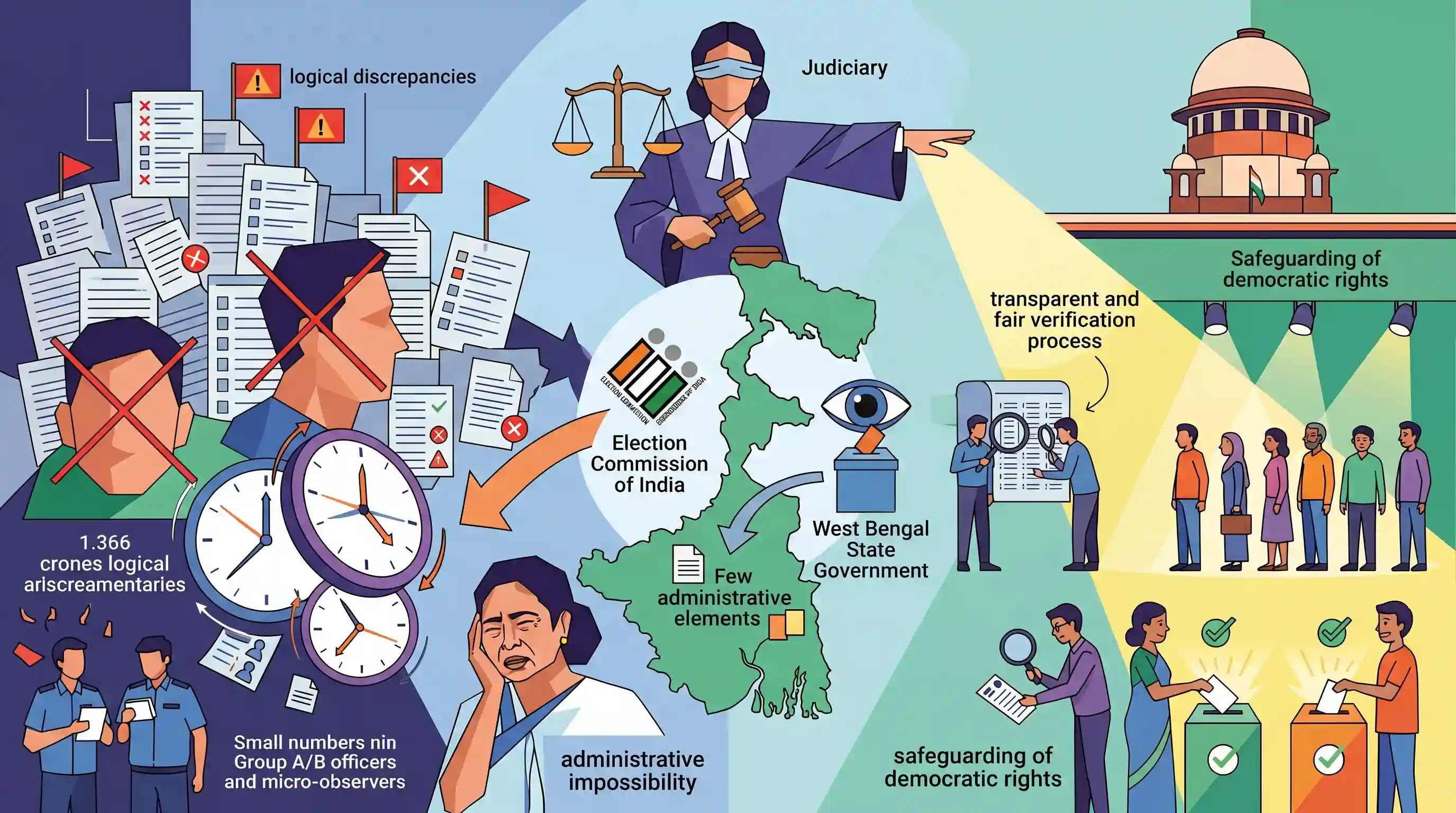
This issue underscores the complexities and friction involved in maintaining accurate electoral rolls, demonstrating the interplay between the Election Commission's constitutional mandate to ensure free and fair elections, the logistical constraints of state administrations, and the judiciary's oversight role in preventing disenfranchisement.
Summary
The Election Commission of India's Special Intensive Revision (SIR) of electoral rolls in West Bengal has sparked logistical and political challenges, leading to the deletion of around 58 lakh voters and flagging 1.36 crore for "logical discrepancies". The state government, led by Chief Minister Mamata Banerjee, highlighted the administrative impossibility of completing the required verification hearings on time due to a shortage of designated Group A/B officers and micro-observers. The Supreme Court has stepped in, directing the ECI to ensure a transparent and fair verification process, thereby highlighting the delicate interplay between state administration, the constitutional mandate of the ECI, and the judiciary's role in safeguarding democratic rights.
Key Points
- The Election Commission of India (ECI) initiated a Special Intensive Revision (SIR) of electoral rolls in West Bengal, resulting in the deletion of around 58 lakh voters.
- Over 1.36 crore voters were flagged for 'logical discrepancies,' requiring mandatory verification hearings and placing an immense burden on the state's administrative machinery.
- The state government requested deadline extensions due to a severe shortage of Group A and B officers, as well as micro-observers, necessary to conduct impartial hearings.
- The Supreme Court intervened, directing the ECI to ensure transparency in the revision exercise to prevent the unjust disenfranchisement of legitimate voters.
Important Terms
Election Commission of India (ECI)

An autonomous constitutional body established under Article 324 to manage and supervise free and fair elections to Parliament, State Legislatures, and the offices of President and Vice-President.
UPSC context
GS Paper II: Constitutional Bodies. Crucial for understanding electoral governance, independence of institutions, and the conduct of democratic processes.
Special Intensive Revision (SIR)
A comprehensive, house-to-house verification drive conducted by the ECI under Section 21(3) of the RPA 1950 to purify electoral rolls by removing duplicate, deceased, or shifted voters.
UPSC context
GS Paper II: Electoral Reforms. Tests knowledge of mechanisms ensuring the integrity of voter lists and preventing disenfranchisement or electoral fraud.
Article 324
The constitutional provision vesting the 'superintendence, direction, and control' of elections and the preparation of electoral rolls in the Election Commission of India.
UPSC context
GS Paper II: Constitution. A core article regarding the powers and independence of the ECI, often cited in judicial review cases.
Supreme Court of India
The highest judicial authority and guardian of the Constitution, empowered to ensure that administrative actions, such as voter deletions by the ECI, follow the principles of natural justice.
UPSC context
GS Paper II: Judiciary. Relevant for its role in safeguarding democratic rights through oversight of executive and constitutional bodies.
Judicial Review
The power of the judiciary to examine the legality and constitutionality of executive or constitutional bodies' actions, ensuring they do not violate fundamental rights or statutory laws.
UPSC context
GS Paper II: Separation of Powers. Essential for understanding the checks and balances between the ECI, state governments, and the courts.
Electoral Rolls
A legally compiled list of all citizens in a constituency eligible to vote; its maintenance is a core statutory duty of the ECI under the Representation of the People Act.
UPSC context
GS Paper II: Salient features of the Representation of the People Act. Fundamental to the 'one person, one vote' principle.
Group B Officers
The administrative cadre of state government employees often deployed by the ECI as Booth Level Officers or micro-observers to facilitate ground-level verification and election monitoring.
UPSC context
GS Paper II: Statutory, regulatory and various quasi-judicial bodies. Highlights the administrative logistics and human resource challenges in conducting large-scale electoral exercises.
Prelims Trap
"The preparation, revision, and deletion of electoral rolls are governed by the Representation of the People Act, 1951."
RPA 1950 deals with preparation of rolls, delimitation, and voter qualifications. RPA 1951 governs the actual conduct of elections, offenses, and disputes. Aspirants frequently confuse them.
Static Concepts Connected
What is the constitutional mechanism for staffing the Election Commission?
- Article 324(6): Obligates the President or State Governor to provide necessary staff to the ECI upon request for discharging its constitutional duties.
- Deemed Deputation: State administrative machinery drafted for election or roll-revision duties is deemed to be on deputation to the ECI, falling under its direct disciplinary control.
How does judicial review apply to electoral matters in India?
- Article 329(b) Bar: Courts are constitutionally barred from interfering in electoral matters or halting the process once the formal election notification has been issued.
- Pre-election Review: Preparatory steps, such as electoral roll revisions, remain open to limited judicial review to prevent unjust disenfranchisement before the election schedule begins.
Cross-Topic Patterns
Federalism in Election Machinery
The ECI's reliance on state civil servants (Group A/B) for executing its mandate creates unique federal friction when state governments cite administrative inability or political bias during electoral revisions.
Right to Vote (Art 326) vs Disenfranchisement
Mass deletion controversies link directly to the Constitutional right to vote (Art 326) and statutory safeguards under the RPA 1950, highlighting the tension between procedural purity and disenfranchisement.

Expect a 2026 Prelims question testing the boundary between RPA 1950 (electoral rolls) and RPA 1951 alongside Art 324(6) staffing mandates.
Linked PYQs · 3
Linked PYQs · 3
- 2022MainsGS2
Discuss the role of the Election Commission of India in the light of the evolution of the Model Code of Conduct.
- 2017MainsGS2
To enhance the quality of democracy in India the Election Commission of India has proposed electoral reforms in 2016. What are the suggested reforms and how far are they significant to make democracy successful?
- 2017PrelimsGS1
Right to vote and to be elected in India is a
