West Bengal signs MoU for PM SHRI schools scheme implementation
Source:eletsonline ↗
কেন এটি গুরুত্বপূর্ণ
WBCS Prelims frequently features questions related to significant central and state government schemes (e.g., Sabooj Sathi). Knowledge of the PM SHRI scheme and West Bengal's participation is crucial for the current affairs and polity sections.
সারসংক্ষেপ
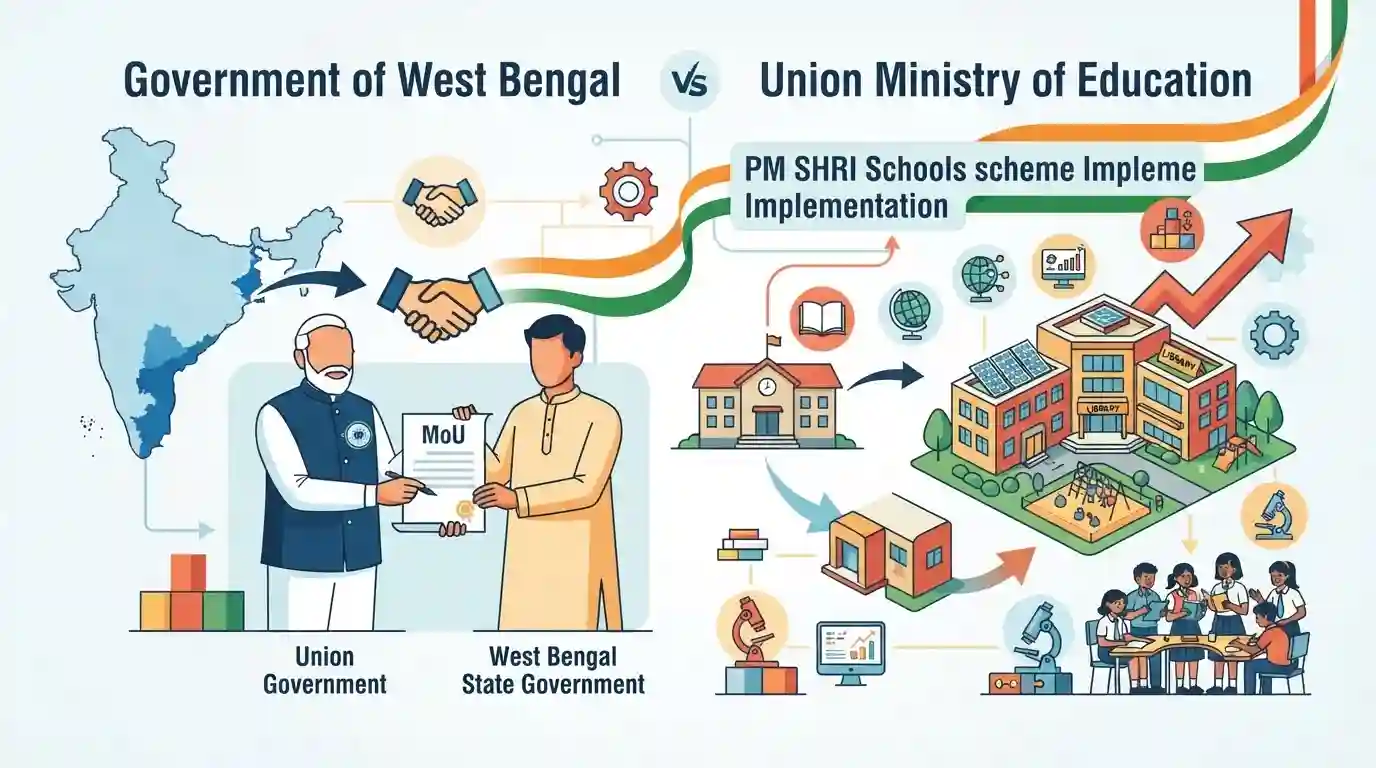
West Bengal has signed a Memorandum of Understanding (MoU) with the Union Ministry of Education to implement the centrally sponsored PM SHRI Schools scheme. The initiative will focus on upgrading state government schools into exemplary institutions that showcase the principles and holistic learning approaches outlined in the National Education Policy (NEP) 2020. This marks a positive step in Centre-State coordination for educational advancement and infrastructural development in the state.
মূল বিষয়
- The Government of West Bengal has signed a Memorandum of Understanding (MoU) with the Union Ministry of Education to implement the PM SHRI (PM Schools for Rising India) scheme.
- The PM SHRI scheme aims to upgrade and develop existing government schools into model institutions that embody the vision of the National Education Policy (NEP) 2020.
- The implementation of the scheme is expected to enhance the quality of education and provide modern educational infrastructure to students in West Bengal.
- The move signifies increased Centre-State cooperation in advancing educational reforms and infrastructure within the state.
গুরুত্বপূর্ণ শব্দ
PM SHRI Schools Scheme

A Centrally Sponsored Scheme to upgrade 14,500+ existing government schools into model institutions showcasing National Education Policy (NEP) 2020 components, featuring green infrastructure, smart classrooms, and holistic pedagogy.
UPSC context
GS-2 (Welfare Schemes/Education). Tests knowledge of government education initiatives, Centre-State cost-sharing, and NEP 2020 implementation.
National Education Policy (NEP) 2020
India's comprehensive education framework replacing the 1986 policy. It introduces a 5+3+3+4 school structure, emphasizes foundational literacy, multidisciplinary learning, vocational training, and targets spending 6% of GDP on education.
UPSC context
GS-2 (Social Justice). Evaluates understanding of human resource development, educational reforms, and pedagogical restructuring in India.
Centrally Sponsored Scheme
Development initiatives funded jointly by the Union and State governments but implemented by State authorities. They typically target state or concurrent list subjects like health and education.
UPSC context
GS-2 (Polity/Centre-State Relations) & GS-3 (Economy). Highly tested regarding fiscal federalism and Centre-State funding patterns.
প্রিলিমস ফাঁদ
"PM SHRI is a Central Sector Scheme to establish new model schools across India."
PM SHRI is a Centrally Sponsored Scheme (60:40 funding for major states) that upgrades existing schools. It does NOT build new schools from scratch.
সংযুক্ত স্থির ধারণা
How did 'Education' evolve under the 7th Schedule of the Constitution?
- Original Status: Originally, Education was purely a State subject under Entry 11 of the State List.
- 42nd Amendment: The 42nd Amendment Act (1976) moved Education to the Concurrent List (Entry 25), enabling Parliament to legislate on it.
- Executive Dynamic: While both can legislate, the Centre primarily steers educational policy via Centrally Sponsored Schemes (CSS) using financial leverage over states.
What are the core differences between Centrally Sponsored and Central Sector Schemes?
- Funding: CSS are co-funded by Centre and States (e.g., 60:40 or 90:10). Central Sector Schemes are 100% funded by the Union government.
- Implementation: CSS are implemented by State/UT governments. Central Sector Schemes are implemented directly by Central Ministries/agencies.
- Subject List: CSS generally address State or Concurrent List subjects (like Health, Education). Central Sector focuses on Union List subjects.
আন্তঃবিষয় প্যাটার্ন
Fiscal Federalism + CSS conditionality
The Centre withholding Samagra Shiksha funds until States sign the PM SHRI MoU highlights the use of conditional grants to enforce national policies on Concurrent List subjects.
Digital Governance + Competitive Federalism
PM SHRI's 'Challenge Mode' relies on the UDISE+ portal for baseline assessment, reflecting a broader governance shift toward data-driven competitive federalism for scheme allocations.

PM SHRI's 'Challenge Mode' selection, focus on existing school upgrades, and CSS funding ratios likely to form a 2026 prelims question.
সংযুক্ত PYQ · 2
সংযুক্ত PYQ · 2
- 2021WBCS_PRELIMSGS1
Sabooj-Sathi is a scheme for distribution of Bicycles to students of Government/Government Aided Schools/Madrasahs reading in
- 2020WBCS_PRELIMSGS1
Arundhoti Swarna Yojana by Assam Govt. starting from 1st January 2020 aims to
