West Bengal MSME sector growth and trade expo showcase
Source:theprint ↗
Why It Matters
The MSME sector is a vital engine for economic growth, employment generation, and balanced regional development. State-level policies on industrial parks, credit facilities (like Udyam Credit Card), and artisan welfare (PM Vishwakarma Yojana) are crucial topics for understanding India's industrial ecosystem and are directly relevant for the Economy section of the WBCS syllabus.
Summary
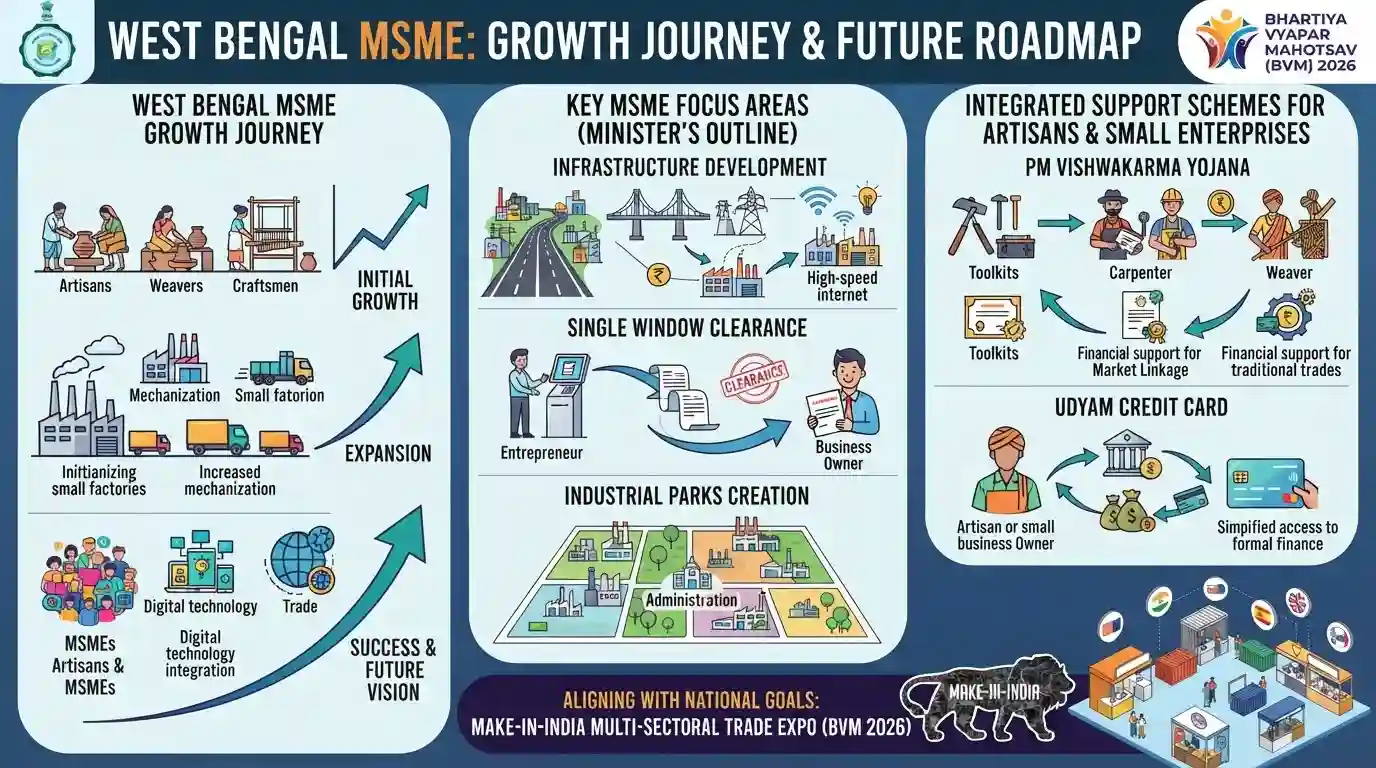
West Bengal presented its success journey and future roadmap for the Micro, Small and Medium Enterprises (MSME) sector at the Bhartiya Vyapar Mahotsav (BVM) 2026. The state's MSME Minister outlined key focus areas including infrastructure development, single window clearance for businesses, and the creation of industrial parks. To support local artisans and small enterprises, the state highlighted the integration of schemes like the PM Vishwakarma Yojana and the Udyam Credit Card. BVM 2026 serves as India's largest Make-In-India multi-sectoral trade expo, aligning state efforts with national manufacturing and trade goals.
Key Points
- West Bengal highlighted its achievements and future roadmap for the MSME sector at the Bhartiya Vyapar Mahotsav (BVM) 2026.
- The MSME roadmap focuses on infrastructure development, single window clearance, and establishing industrial parks.
- Key welfare and credit schemes emphasized include the PM Vishwakarma Yojana and the Udyam Credit Card facility to boost small businesses and artisans.
- Bhartiya Vyapar Mahotsav 2026 is promoted as India's largest Make-In-India multi-sectoral trade expo.
Important Terms
PM Vishwakarma Yojana

A Central Sector Scheme that empowers traditional artisans and craftspeople by providing formal recognition, modern skill training, toolkit incentives, and collateral-free concessional credit.
UPSC context
Highly relevant for GS-2 and GS-3. Tests informal sector formalization, financial inclusion, and rural economic resilience.
Make-In-India
A flagship national initiative aiming to transform India into a global design and manufacturing hub. It targets increasing the manufacturing sector’s GDP share to 25% and generating 100 million additional jobs.
UPSC context
Core GS-3 topic. Tests understanding of industrial policy, foreign direct investment, and domestic supply chain resilience.
Udyam Credit Card
A scheme providing Udyam-registered micro and small enterprises with quick, collateral-free digital credit (typically up to ₹5 lakh) to meet short-term working capital and day-to-day operational needs.
UPSC context
Important for GS-3 (Economy). Focuses on MSME financial inclusion, digital credit delivery, and working capital support.
Single Window Clearance
A unified digital governance platform that integrates various central and state approval processes, allowing businesses and investors to obtain all required regulatory clearances from a single access point.
UPSC context
Crucial for GS-2 (Governance) and GS-3 (Investment). Tests ease of doing business, transparency, and regulatory bottleneck reduction.
Bhartiya Vyapar Mahotsav 2026
India's largest multi-sectoral trade exhibition, jointly organized by ITPO and CAIT in August 2026, aimed at connecting domestic MSMEs, artisans, and startups with national and global markets.
UPSC context
Relevant for Prelims (Current Affairs) and GS-3. Highlights MSME promotion, Atmanirbhar Bharat, and local-to-global trade strategies.
Prelims Trap
"PM Vishwakarma provides collateral-free credit to all members of artisan families engaged in the 18 specified trades."
The scheme strictly restricts eligibility to only one member per family, and it is a Central Sector Scheme (100% Union funded), not Centrally Sponsored.
Static Concepts Connected
What are the revised composite criteria for MSME classification in India?
- Micro Enterprises: Investment up to ₹1 Cr and annual turnover up to ₹5 Cr.
- Small Enterprises: Investment up to ₹10 Cr and annual turnover up to ₹50 Cr.
- Medium Enterprises: Investment up to ₹50 Cr and annual turnover up to ₹250 Cr.
- Uniformity: The traditional distinction between manufacturing and services sectors has been entirely eliminated.
What are the core provisions of the PM Vishwakarma Scheme?
- Funding Structure: It is a 100% centrally funded Central Sector Scheme under the Ministry of MSME.
- Credit Support: Provides collateral-free credit up to ₹3 lakh at a concessional 5% interest rate.
- Eligibility Limits: Covers 18 traditional trades but is strictly limited to one beneficiary per family.
Cross-Topic Patterns
Formalization via Udyam Assist Platform
The Udyam Assist Platform integrates informal enterprises lacking PAN/GST into the formal economy, linking Digital Public Infrastructure (DPI) with Priority Sector Lending.
Cooperative Federalism in Industrial Policy
State-led credit schemes layered over national initiatives like Make-In-India showcase concurrent jurisdiction (Entry 20, List III) driving grassroots industrial growth.

Expect a multi-statement Prelims question testing the subtle eligibility limits of PM Vishwakarma alongside the 2020 MSME classification.
Linked PYQs · 3
Linked PYQs · 3
- 2015WBCS_PRELIMSGS1
Industrial credit is available from
- 2021WBCS_PRELIMSGS1
When was the First Industrial Policy resolution taken?
- 2023WBCS_PRELIMSGS1
In India the main textile fibre crop is
