PM Surya Ghar scheme rooftop solar targets and state subsidies
Source:energetica-india ↗
Why It Matters
WBCS Prelims frequently tests candidates on specific state government schemes, renewable energy projects (e.g., Frazerganj wind project), and exact subsidy amounts (e.g., Gatidhara scheme). West Bengal's augmentation of the PM Surya Ghar scheme with state funds and specific SC/ST grants makes it a high-probability current affairs topic.
Summary
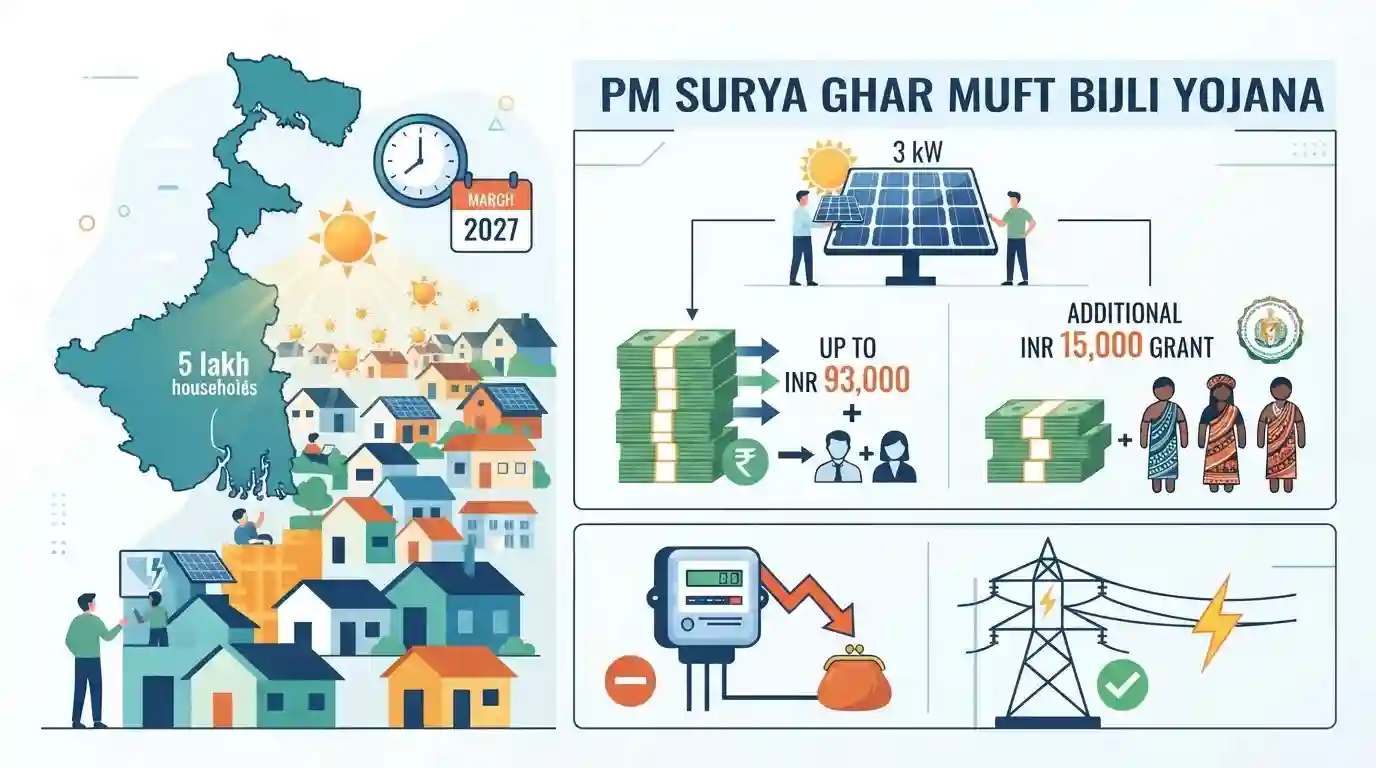
The West Bengal government has significantly expanded its rooftop solar ambitions under the central PM Surya Ghar Muft Bijli Yojana, setting a new target to equip 5 lakh households by March 2027—five times its original allocation. To incentivize adoption, the state is augmenting central subsidies with its own grants. Beneficiaries will receive a combined subsidy of up to INR 93,000 for a 3 kW system, alongside a special additional grant of INR 15,000 reserved for SC/ST applicants. This initiative aims to accelerate the transition to renewable energy, lower utility bills for citizens, and reduce power distribution losses.
Key Points
- West Bengal has set an ambitious target of installing rooftop solar systems in 5 lakh households by March 2027, scaling up its initial central allocation of 1 lakh.
- The state government is providing additional subsidies on top of the central PM Surya Ghar scheme, granting INR 35,000 for a 1 kW system (INR 30,000 Center + INR 5,000 State).
- For a 3 kW setup, the total combined subsidy reaches INR 93,000 (INR 78,000 Center + INR 15,000 State).
- An extra state grant of INR 15,000 is explicitly provided to beneficiaries belonging to Scheduled Castes (SC) and Scheduled Tribes (ST).
- The move aims to boost decentralized clean energy generation, reduce transmission losses, and lower electricity bills, with plans to expand installations to government offices.
Important Terms
PM Surya Ghar Muft Bijli Yojana

A central scheme launched in February 2024 providing up to 300 units of free monthly electricity to one crore Indian households through subsidized residential rooftop solar installations.
UPSC context
GS Paper III (Government Schemes, Energy); tests understanding of decentralized solar adoption, fiscal incentives, and India’s renewable energy transition targets.
Rooftop Solar
The installation of solar photovoltaic panels on building roofs to generate decentralized electricity directly at the point of consumption, reducing reliance on conventional thermal grids.
UPSC context
GS Paper III (Infrastructure, Renewable Energy); tests concepts of decentralized green power generation, net-zero commitments, and grid integration challenges.
Net Metering
A bidirectional billing mechanism that credits solar energy system owners for excess electricity fed back into the grid, offsetting their overall consumption bills.
UPSC context
GS Paper III (Infrastructure, Environment); tested in Prelims (2016) to evaluate knowledge of grid integration policies and consumer-level green energy incentives.
DISCOMs (Power Distribution Companies)
State-owned or private utility companies responsible for the last-mile transmission, delivery, and billing of electricity to residential, commercial, and industrial end-consumers.
UPSC context
GS Paper III (Energy, Infrastructure); tests understanding of structural reforms, state-level fiscal health, and renewable energy integration capacity.
AT&C (Aggregate Technical and Commercial) Losses
The sum of technical transmission losses, commercial billing inefficiencies, power theft, and revenue collection failures within an electricity distribution network.
UPSC context
GS Paper III (Infrastructure, Energy); tests understanding of power sector efficiency, utility performance parameters, and the financial viability of distribution networks.
Prelims Trap
"PM Surya Ghar Muft Bijli Yojana provides a 100% upfront central subsidy for residential rooftop solar installations."
The Centre offers partial, capacity-linked subsidies (e.g., INR 78,000 for a 3 kW system). Beneficiaries, loans, or state top-ups must cover the remaining installation costs.
Static Concepts Connected
What is Net Metering in rooftop solar systems?
- Mechanism: A billing system where a bidirectional meter records both the energy imported from the grid and the surplus solar energy exported back to it.
- Financial Benefit: Consumers are billed only for their 'net' energy usage, effectively offsetting their grid electricity costs with the solar power they generate.
What comprises Aggregate Technical & Commercial (AT&C) losses?
- Technical Losses: Energy dissipated as heat during transmission and distribution due to inherent grid infrastructure inefficiencies (I2R losses).
- Commercial Losses: Revenue lost to electricity theft, unmetered usage, billing errors, and payment defaults by consumers.
- Solar Mitigation: Decentralized rooftop generation creates power at the point of consumption, entirely bypassing long transmission lines and mitigating technical losses.
Cross-Topic Patterns
Climate Action + Affirmative Action
Targeted state grants for SC/ST households in rooftop solar highlight the intersection of environmental justice and inclusive economic growth, ensuring marginalized communities access clean energy.
Cooperative Federalism in NDCs
State top-ups on central renewable schemes demonstrate how sub-national financial commitments and cooperative federalism are crucial for India to meet its 2030 Panchamrit capacity targets.

Expect a 2026 Prelims question linking PM Surya Ghar's subsidy tiers with AT&C loss reduction and the core mechanics of Net Metering.
Linked PYQs · 3
Linked PYQs · 3
- 2024WBCS_PRELIMSGS1
What is the efficiency of currently available commercial solar cells?
- 2021WBCS_PRELIMSGS1
What is the maximum Government Subsidy that can be availed by a beneficiary under the Gatidhara Scheme?
- 2024WBCS_PRELIMSGS1
Wind Energy Project was set up in West Bengal at:
