West Bengal Ayushman Bharat health scheme rollout and federal impact
Source:boldnewsonline ↗
Why It Matters
The rollout of a flagship central healthcare scheme in a state that traditionally prioritized its own standalone health insurance programs (like Swasthya Sathi) is a key development in cooperative federalism and public health service delivery, making it highly relevant for governance and policy questions in WBCS Prelims.
Summary
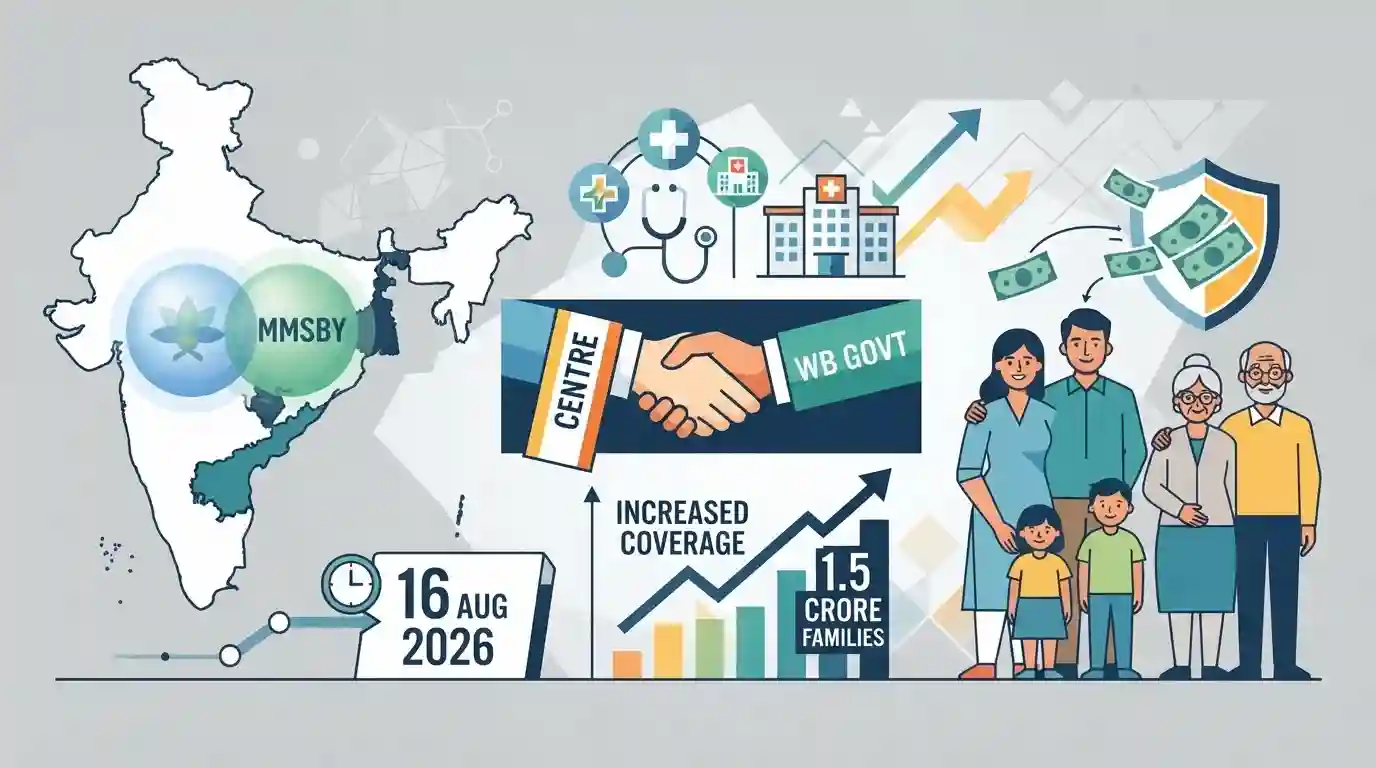
West Bengal is set to implement the Centre's flagship Ayushman Bharat health insurance scheme starting August 16, 2026, targeting coverage for around 1.5 crore families. The concurrent operation of Ayushman Bharat and the state's existing Mukhya Mantri Swasthya Bima Yojana aims to significantly expand healthcare access and financial protection, reflecting improved Centre-State coordination in public health administration.
Key Points
- West Bengal will officially roll out the central Ayushman Bharat health insurance scheme starting August 16, 2026.
- The central health scheme aims to benefit approximately 1.5 crore families across the state.
- Already 3.4 crore people in West Bengal have enrolled for Ayushman Bharat.
- The scheme will co-exist with the state's Mukhya Mantri Swasthya Bima Yojana, which has around 80 lakh registered beneficiaries, widening the safety net.
Important Terms
Ayushman Bharat (PM-JAY)

A centrally-sponsored flagship health assurance scheme providing cashless coverage of up to ₹5 lakh per family per year for secondary and tertiary hospitalization to India's poorest families, launched in West Bengal on August 16, 2026.
UPSC context
GS Paper III (Indian Economy); tests knowledge of national welfare programs, healthcare administration, and fiscal federalism.
Mukhyamantri Swasthya Bima Yojana (MMSBY)
A state-funded health insurance scheme launched by West Bengal in August 2026, offering ₹5 lakh cashless coverage to Swasthya Sathi beneficiaries ineligible for the Central Ayushman Bharat scheme.
UPSC context
GS Paper III (Indian Economy); evaluates familiarity with state-specific social security schemes, healthcare reforms, and public administration.
Swasthya Sathi
A universal cashless health insurance scheme launched by West Bengal in December 2016, offering up to ₹5 lakh annual coverage per family, now being transitioned into Ayushman Bharat and MMSBY.
UPSC context
GS Paper III (Economic Development); tests awareness of West Bengal's landmark health policies and transitional public welfare initiatives.
Centrally Sponsored Schemes (CSS)
Welfare programs formulated by the Central Government but implemented by State Governments, funded through a defined cost-sharing ratio (such as 60:40 for Ayushman Bharat in West Bengal).
UPSC context
GS Paper V (Constitution & Polity); tests concepts of fiscal federalism, Centre-State financial relations, and public finance.
Prelims Trap
Ayushman Bharat in West Bengal is a 100% centrally-funded scheme that entirely replaces the state's 100% state-funded Swasthya Sathi scheme.
PM-JAY is a Centrally Sponsored Scheme with a 60:40 Centre-State funding split in WB. It co-exists with, rather than replaces, the state-funded Swasthya Sathi.
Static Concepts Connected
Constitutional status of Public Health in India
- State List: Public health, sanitation, and hospitals fall under Entry 6 of List II (State List) of the Seventh Schedule.
- Concurrent List: Social security, insurance, and social planning fall under Entries 20 and 23 of List III, enabling joint legislation.
- Article 282: Allows the Centre to make discretionary grants for public purposes, under which Centrally Sponsored Schemes are funded.
Centrally Sponsored vs Central Sector Schemes
- Funding Split: Centrally Sponsored Schemes (CSS) are jointly funded (e.g., 60:40), whereas Central Sector Schemes are 100% funded by the Centre.
- Implementation: CSS are implemented by State governments, while Central Sector Schemes are directly executed by Central ministries.
Cross-Topic Patterns
Fiscal Federalism and CSS
The shift showcases how Centre-State financial bargaining and CSS matching-grant requirements influence state budgetary allocations and policy alignment.
Universal Health Coverage and SDGs
Co-existence of dual health covers addresses the SDG 3.8 target of financial risk protection, bridging gaps in socio-economic registry exclusions.

WBCS Mains is highly likely to contrast WB's Swasthya Sathi with PM-JAY on funding ratios, eligibility criteria, and Seventh Schedule lists.
Linked PYQs · 3
Linked PYQs · 3
- 2021WBCS_PRELIMSGS1
What proportion of the Insurance Premium payable for Swasthya-Sathi Scheme is borne by the State Government?
- 2021WBCS_PRELIMSGS1
How many new Government Medical Colleges have become functional in West Bengal during the last ten years?
- 2024WBCS_PRELIMSGS1
Which of the following correctly describes the relationship between the Union and the States under the Constitution of India?
