Jute Packaging Materials Act and state agricultural industry support
Source:chinimandi ↗
Why It Matters
West Bengal is India's leading producer of jute. Regulatory policies, mandatory packaging guidelines, and central-state consultations directly impact millions of local farm families and the state's historic jute mill sector, which are frequently asked in WBCS economic geography and agriculture sections.
Summary
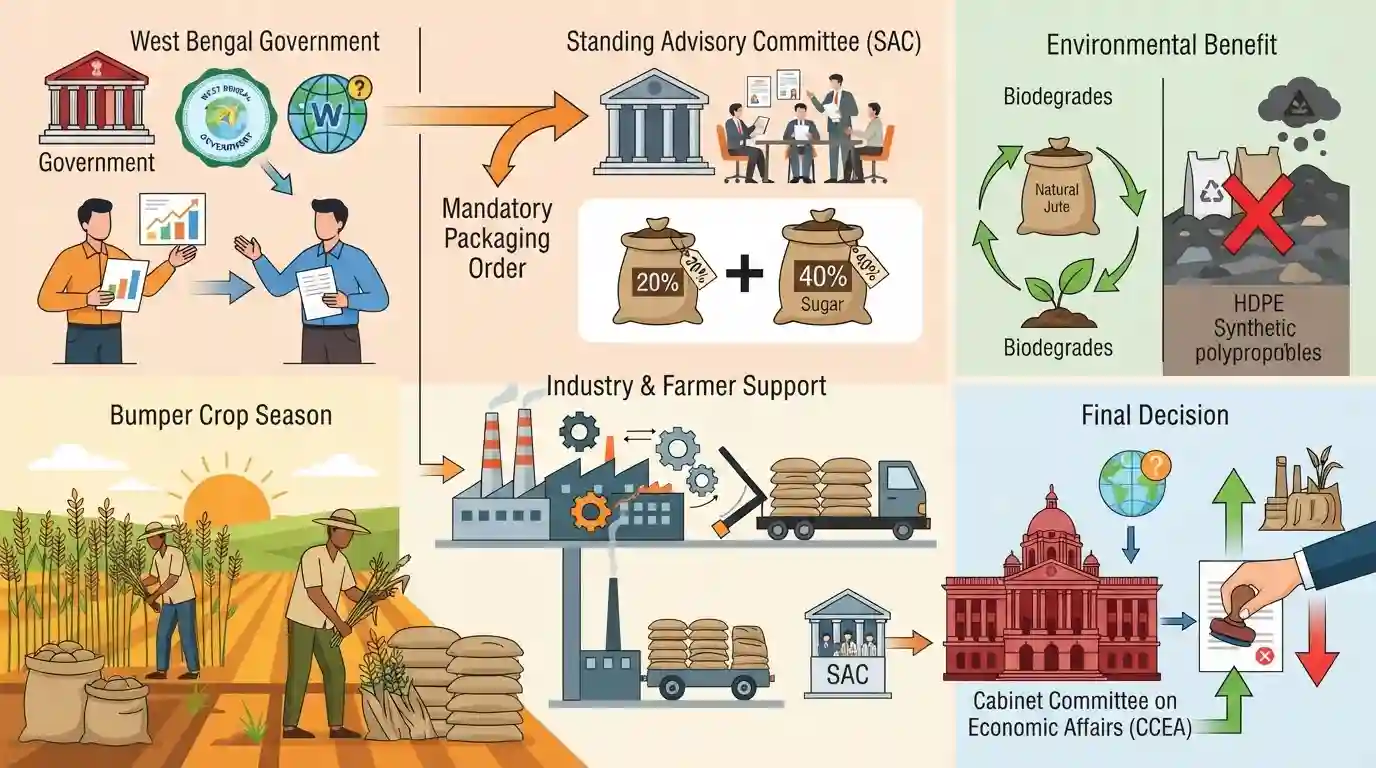
The West Bengal government has urged the Union Ministry of Textiles' Standing Advisory Committee (SAC) to increase the mandatory reservation for sugar packaging in jute bags from 20% to 40% for the 2026-27 jute year. Presenting a joint case via its Labour and MSME & Textiles departments, the state highlighted the need to support jute farmers during a bumper crop season and keep mills operational. The state also emphasized jute's biodegradable benefits over synthetic alternatives like HDPE and polypropylene sacks. The final decision rests with the Cabinet Committee on Economic Affairs (CCEA).
Key Points
- The West Bengal government has proposed increasing the reservation of sugar packaging in jute bags from 20% to 40% for the 2026-27 jute year.
- The proposal was presented during the 34th meeting of the Standing Advisory Committee (SAC) under the Jute Packaging Materials Act, 1987.
- This is the first time West Bengal was represented jointly by its Labour Department (led by Labour Minister Arjun Singh) and MSME & Textiles Department before the SAC.
- The recommendation aims to counter surplus supply from a bumper jute crop, ensure stable prices for farmers, and support continuous operation of jute mills, which employ over 250,000 workers.
- West Bengal argued that jute is an eco-friendly, biodegradable alternative to synthetic materials like High-Density Polyethylene (HDPE) and polypropylene (PP) woven sacks.
- The SAC's recommendations will be forwarded to the Cabinet Committee on Economic Affairs (CCEA) for the final decision.
Important Terms
Jute Packaging Materials Act, 1987

A 1987 federal law mandating the use of jute bags for packing specific commodities, designed to protect jute farmers and workers in India from the influx of synthetic packaging materials.
UPSC context
Important for Indian Economy and Governance; highlights state protectionism vs. free-market policies and environmental sustainability.
Standing Advisory Committee (SAC)
A committee under the Jute Packaging Materials Act, 1987, composed of government secretaries. It advises the central government on the extent and commodities for mandatory jute packaging based on availability and industry protection.
UPSC context
Relevant for Indian Polity and Administration; illustrates the advisory mechanisms guiding economic regulation and statutory policies.
Cabinet Committee on Economic Affairs (CCEA)
A high-level committee chaired by the Prime Minister of India, responsible for reviewing and approving economic policies, including the mandatory reservation norms for packaging commodities in jute.
UPSC context
Crucial for Polity and Governance; demonstrates executive decision-making bodies overseeing vital economic interventions.
Ministry of Textiles
The central government body responsible for the policy formulation, planning, and development of the textile and jute sectors, encompassing the administration of the Jute Packaging Materials Act.
UPSC context
Tests knowledge of the Union executive's structure and the administration of key industrial sectors in the Indian Economy.
Prelims Trap
The Ministry of Textiles finalizes the mandatory jute packaging reservation quotas.
While the Standing Advisory Committee (SAC) under the Ministry of Textiles recommends the quotas, the final binding approval is strictly given by the Cabinet Committee on Economic Affairs (CCEA).
Static Concepts Connected
What are the key geographical and historical features of the Hooghly Jute Belt?
- First Mill: Established at Rishra in 1855 by George Acland, marking the birth of India's modernized jute industry.
- Location Factors: Driven by river water for retting, Raniganj coal for power, cheap migrant labour, and Kolkata port access.
- Production Share: West Bengal dominates the sector, contributing over 70% of India's total raw jute production.
How is raw jute procured and supported under India's MSP regime?
- Nodal Agency: The Jute Corporation of India (JCI), headquartered in Kolkata, acts as the central nodal agency for procurement.
- MSP Authority: Recommended by the CACP and approved by the CCEA to ensure remunerative prices for farmers.
- Grade Standard: MSP for raw jute is officially announced based on the TD-3 grade (equivalent to the older TD-5).
Cross-Topic Patterns
Jute Packaging & Plastic Waste Rules
The push for biodegradable jute packaging directly aligns with India's Plastic Waste Management Rules and the mandate for Extended Producer Responsibility (EPR) on synthetic materials like HDPE.
Hooghly Belt Labour Demographics
The economic survival of 250,000 jute mill workers heavily impacts the demographic and socio-economic stability of the Hooghly industrial belt, a classic WBCS geography theme on inter-state migration.

Expect a multi-statement question combining JPMA 1987 provisions, CCEA's final authority, and West Bengal's >70% production.
Linked PYQs · 2
Linked PYQs · 2
- 2013WBCS_PRELIMSGS1
Jute is mainly grown in
- 2023WBCS_PRELIMSGS1
In India the main textile fibre crop is
