West Bengal school curriculum overhaul aligned with NEP
Source:careers360 ↗
কেন এটি গুরুত্বপূর্ণ
WBCS Prelims frequently tests candidates on West Bengal's state-specific governance schemes and major national policies affecting the state. The alignment of West Bengal's curriculum with NEP 2020 is a significant policy shift, and knowledge of its funding mechanism (Samagra Shiksha Abhiyan) and goals is highly relevant for policy and governance sections.
সারসংক্ষেপ
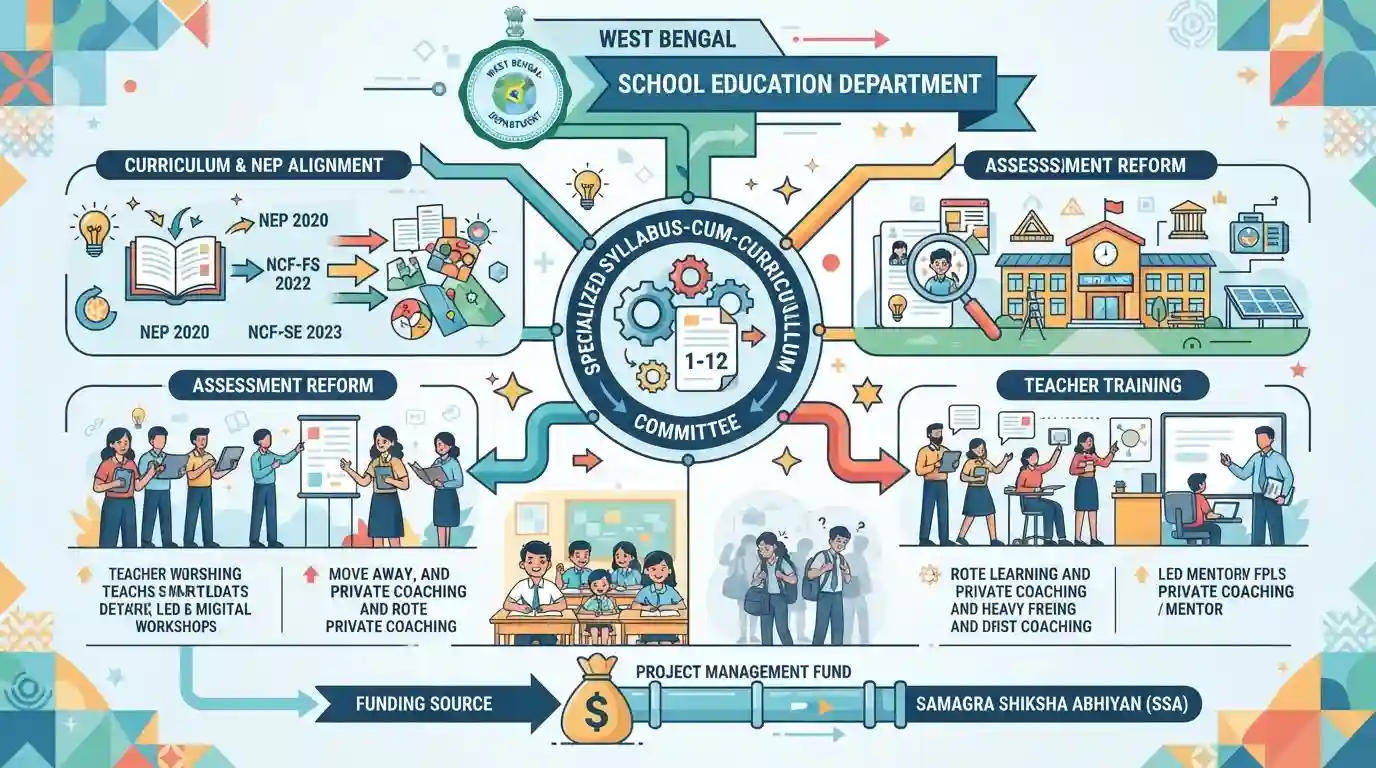
West Bengal's School Education Department has established a specialized syllabus-cum-curriculum committee to overhaul the school curriculum for classes 1 to 12. This initiative seeks to align the state's education system with the National Education Policy (NEP) 2020 and its associated National Curriculum Frameworks (NCF-FS 2022 and NCF-SE 2023). The committee will not only revamp academic content but also review student assessment methods, improve school infrastructure, and modify teacher training. The goal is to move away from rote learning and reduce reliance on private coaching. Funding for this massive restructuring will be sourced from the Project Management Fund of the Samagra Shiksha Abhiyan (SSA).
মূল বিষয়
- The West Bengal School Education Department has formed a committee to completely overhaul the state curriculum for classes 1 to 12 to align it with the National Education Policy (NEP) 2020.
- The syllabus will be integrated with the National Curriculum Framework for School Education (NCF-SE) 2023 and the National Curriculum Framework for Foundational Stage (NCF-FS) 2022.
- The committee is tasked with reviewing the assessment and examination system, enhancing school infrastructure, and overhauling teacher training programs to reduce rote learning and dependence on private tuitions.
- Financial support for the committee's activities will be provided through the Project Management Fund under the centrally-sponsored Samagra Shiksha Abhiyan (SSA).
গুরুত্বপূর্ণ শব্দ
National Education Policy (NEP) 2020

A comprehensive policy replacing the 1986 framework. It shifts India's education to a 5+3+3+4 structure, emphasizing a multidisciplinary approach, foundational literacy, and shifting away from rote memorization toward holistic learning.
UPSC context
Crucial for GS Paper 2 (Education). Tests knowledge of systemic policy reforms and human resource development.
National Curriculum Framework for Foundational Stage (NCF-FS) 2022
India's first integrated curriculum framework for children aged 3 to 8. Developed under NEP 2020, it emphasizes play-based, inquiry-based learning and early childhood care to ensure foundational literacy and numeracy.
UPSC context
Relevant for GS Paper 2 (Education). Highlights pedagogical shifts and interventions targeting early childhood education.
National Curriculum Framework for School Education (NCF-SE) 2023
A comprehensive curriculum framework spanning school education. It operationalizes NEP 2020's vision by promoting multidisciplinary education, vocational integration, multilingualism, and competency-based assessments over rote learning.
UPSC context
GS Paper 2 (Education). Important for analyzing pedagogical innovations and modernization of the school curriculum.
Samagra Shiksha Abhiyan (SSA)
An overarching centrally sponsored scheme for school education spanning pre-school to class 12. It merges earlier programs to ensure inclusive, equitable, and quality education while supporting NEP 2020 implementation.
UPSC context
Relevant for GS Paper 2 (Welfare Schemes). Tests understanding of central-state funding mechanisms and educational equity.
State Council of Educational Research and Training (SCERT)
An apex state-level advisory body responsible for improving school education quality. It designs state-specific curricula, develops textbooks, coordinates teacher training, and implements national educational policies locally.
UPSC context
GS Paper 2 (Governance). Useful for understanding decentralization, state capacity, and localized policy implementation.
প্রিলিমস ফাঁদ
States are legally obligated to implement the National Education Policy (NEP) and the National Curriculum Framework (NCF) under the Right to Education Act.
NEP and NCF are non-binding policy guidelines, not statutory acts. States retain legislative autonomy under the Concurrent List to customize their school curricula.
সংযুক্ত স্থির ধারণা
What is the constitutional framework governing 'Education' in India?
- Concurrent Entry: Education is under Entry 25 of List III, transferred from the State List by the 42nd Amendment in 1976.
- Article 21A: Right to Education (RTE) was enacted via the 86th Constitutional Amendment Act, 2002, guaranteeing free education for ages 6–14.
- Central Precedence: While states customize curricula, Parliamentary laws prevail over state laws in case of conflict under Article 254.
What is the architecture of the Samagra Shiksha Abhiyan (SSA)?
- Subsumed Schemes: Amalgamates three previous Centrally Sponsored Schemes: Sarva Shiksha Abhiyan, Rashtriya Madhyamik Shiksha Abhiyan, and Teacher Education.
- SDG 4 Alignment: Targets Sustainable Development Goal 4, extending support from pre-school to class 12, unlike the earlier primary education focus.
- Funding Formula: Funded via a Centrally Sponsored Scheme cost-sharing mechanism, typically 60:40 between the Centre and States.
আন্তঃবিষয় প্যাটার্ন
CSS leverage vs Fiscal Autonomy
Examines how Centrally Sponsored Schemes use fiscal routing (like SSA project funds) to nudge states into aligning state-level curricula with central policy objectives.
Demographic Dividend & Skill Integration
Connects the pedagogical transition of NCF-SE with demographic goals, restructuring school years to incorporate early vocational training under India's national skill development framework.

The 5+3+3+4 pedagogical shift, 42nd Amendment's Concurrent List transition, and SSA's fiscal leverage will likely be integrated in 2026.
সংযুক্ত PYQ · 1
সংযুক্ত PYQ · 1
- 2021WBCS_PRELIMSGS1
Sabooj-Sathi is a scheme for distribution of Bicycles to students of Government/Government Aided Schools/Madrasahs reading in
