West Bengal Geopolitical Role in India Bangladesh Relations
Source:orfonline ↗
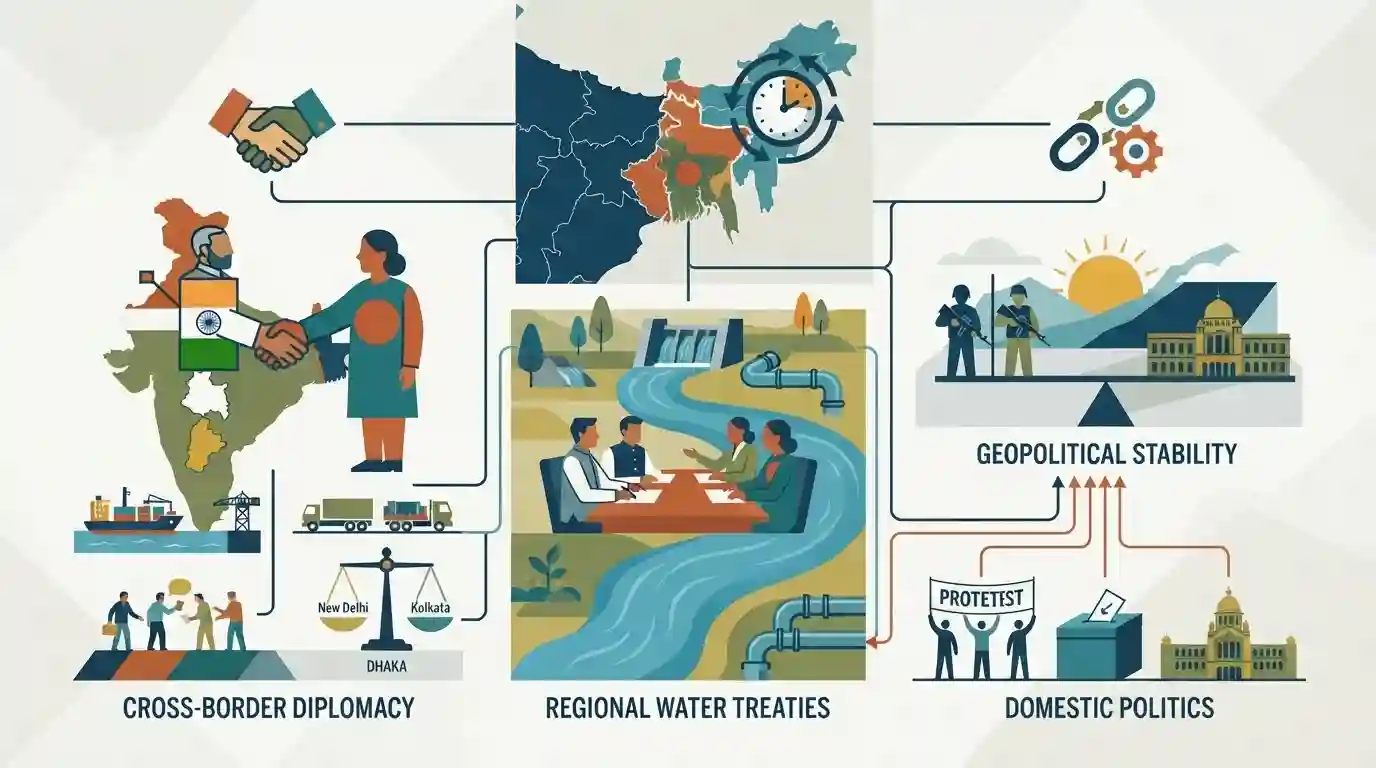
Why It Matters
It highlights how sub-national politics in border states like West Bengal directly influence India's neighborhood-first foreign policy and transboundary diplomacy.
Summary
The article examines the intersection of West Bengal's domestic political dynamics and its consequential impact on India-Bangladesh bilateral relations, focusing on cross-border diplomacy, regional water treaties, and geopolitical stability in eastern India.
Key Points
- West Bengal plays a critical role in shaping India's foreign policy and bilateral relations with Bangladesh due to shared borders, cultural ties, and river water management issues like the Teesta.
- Political shifts and federal dynamics in West Bengal can significantly impact cooperative frameworks between New Delhi and Dhaka, especially concerning cross-border trade, transit, and security.
- Geopolitical security in eastern India remains closely intertwined with stability in Bangladesh and regional cooperation across border districts.
Important Terms
Teesta River Treaty

A transboundary river originating in Sikkim and flowing through West Bengal to Bangladesh, whose proposed water-sharing treaty has stalled due to domestic political opposition from West Bengal.
UPSC context
WBCS Paper IV (International Relations & India's Foreign Policy): Tests understanding of transboundary water diplomacy, federal dynamics, and state-level vetoes in bilateral pacts.
ORF
Observer Research Foundation (ORF) is a premier Indian multidisciplinary public policy think tank that extensively researches and provides strategic analyses on India-Bangladesh relations and regional geopolitics.
UPSC context
WBCS Current Affairs & GS Paper: Tests analytical insight on India's strategic foreign policy posture, think-tank perspectives, and neighborhood diplomacy.
Prelims Trap
Union Government holds exclusive executive power over international treaties, completely bypassing state-level consent for contiguous transboundary river agreements.
Aspirants often assume that foreign treaties regarding international rivers can be signed solely by the Union Government under Entry 14 of the Union List without needing state-level consultation, ignoring the practical federal roadblocks posed by riparian states like West Bengal.
Static Concepts Connected
What are the constitutional provisions governing international treaties and water disputes in India?
- Constitutional Power: Under Article 253, Parliament has power to make laws for implementing international treaties, agreements, or conventions.
- Union List Entry: Entry 56 of the Union List empowers Parliament to regulate and develop inter-state rivers and river valleys.
- State List Conflict: Entry 17 of the State List deals with water, including water supplies, irrigation, canals, and drainage, creating complex federal friction.
Cross-Topic Patterns
Federalism and Treaty-Making Power in India
Article 253 of the Constitution empowers Parliament to make laws for implementing international treaties, yet states like West Bengal exert practical vetoes over transboundary river pacts due to federal sensitivities and regional water dependencies.
Neighborhood First Policy and State-Level Vetoes
India's Act East policy and neighborhood-first approach rely heavily on transit and security cooperation with Bangladesh, making border-state political consensus essential for regional economic integration.

WB state role in transboundary river water sharing (Teesta) + federal treaty powers is a high-probability UPSC/WBCS statement question.
Linked PYQs · 2
Linked PYQs · 2
- 2022WBCS_PRELIMSGS1
The western part of Teesta river in West Bengal is called
- 2021WBCS_PRELIMSGS1
The following river divides West Bengal and Assam :
