State civilian honor revocation over Azad Hind Fauj remarks
Source:theweek ↗
Why It Matters
Questions regarding Netaji Subhas Chandra Bose, the foundation of the Azad Hind Fauj, and related freedom struggle entities regularly appear in WBCS Prelims. Furthermore, understanding the regional demographics of West Bengal, such as the Rajbanshi community and North Bengal socio-political issues, is essential for state-specific GS preparation.
Summary
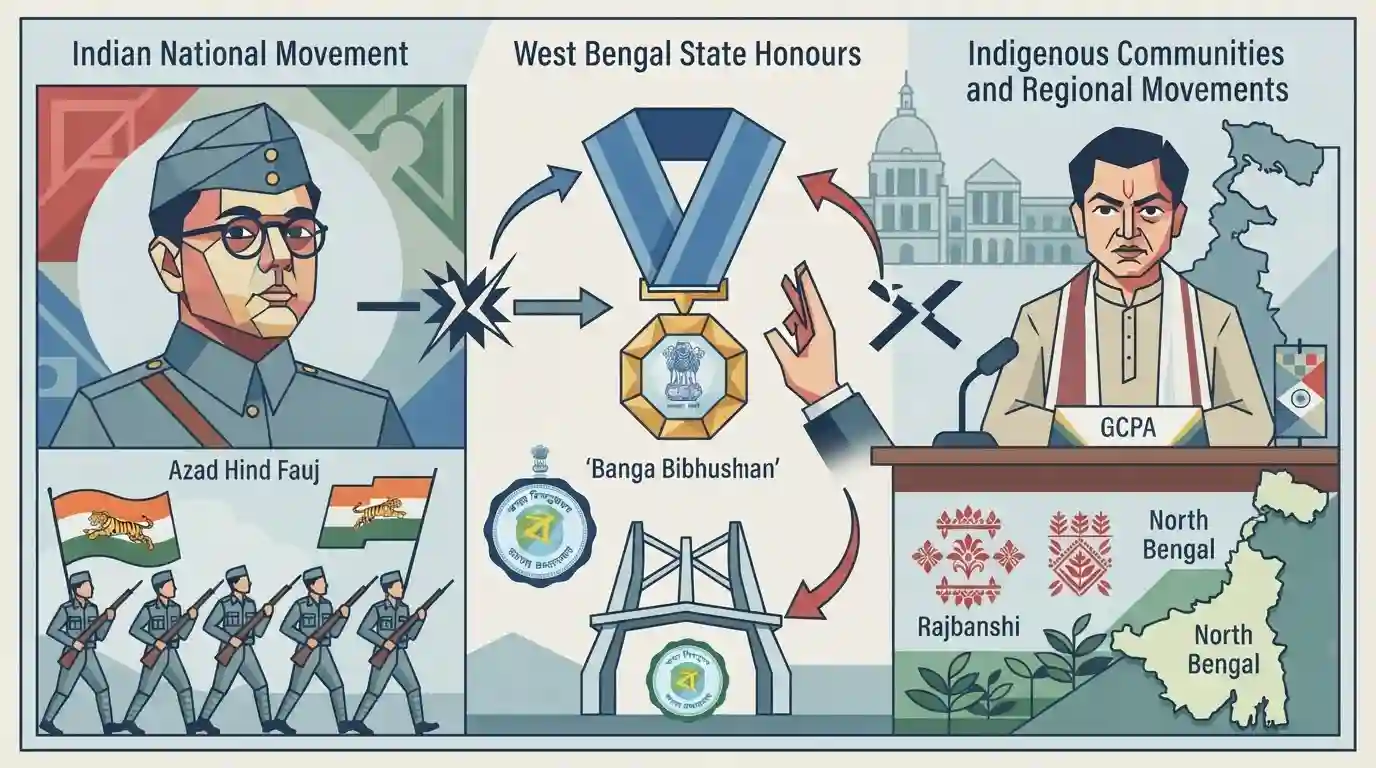
The West Bengal government has formally revoked the 'Banga Bibhushan' state award from BJP MP Nagendra Ray, widely known as Ananta Maharaj, following his derogatory remarks about Netaji Subhas Chandra Bose and the formation of the Azad Hind Fauj. Maharaj, a prominent figure in the Greater Cooch Behar People's Association (GCPA) and a leader of the Rajbanshi community, sparked controversy with statements made at a GCPA meeting in North Bengal. Consequently, the Chief Minister instructed the Chief Secretary to initiate the immediate withdrawal of the state honour.
Key Points
- The West Bengal government revoked the 'Banga Bibhushan' state honour conferred upon BJP Rajya Sabha MP Nagendra Ray (Ananta Maharaj).
- The revocation was prompted by derogatory comments Maharaj made regarding Netaji Subhas Chandra Bose and his ability to form the Azad Hind Fauj.
- Ananta Maharaj is a prominent leader of the indigenous Rajbanshi community and heads a faction of the Greater Cooch Behar People's Association (GCPA).
- The Chief Minister directed the Chief Secretary to immediately withdraw the honour in response to the public statements.
Important Terms
Azad Hind Fauj (INA)

An armed force first established by Mohan Singh in 1942 and later revived by Subhas Chandra Bose in 1943. It allied with Japan during World War II to fight for India's independence from British rule.
UPSC context
Core to Modern Indian History (GS-I), testing knowledge of India's armed freedom struggle and Subhas Chandra Bose's leadership.
Greater Cooch Behar People's Association (GCPA)
A regional political organization in northern West Bengal advocating for a separate 'Greater Cooch Behar' state to protect the cultural, linguistic, and political identity of the indigenous Rajbanshi community.
UPSC context
Crucial for Regionalism (GS-I) and Polity (GS-II). Tests understanding of identity politics, statehood demands, and marginalized ethnic communities.
Banga Bibhushan
West Bengal's highest civilian honour, instituted in 2011 to recognize eminent personalities for their outstanding contributions in fields such as art, culture, literature, and social service.
UPSC context
Relevant to State awards and governance (GS-II). Highlights how political controversies can intersect with the administration of civilian recognitions.
Prelims Trap
Subhas Chandra Bose founded the Azad Hind Fauj (INA) in 1942.
Captain Mohan Singh founded the first INA in 1942. Bose took command in 1943, revitalizing it as the Second INA, making the 1942 founder claim historically inaccurate.
Static Concepts Connected
How did the Cooch Behar princely state integrate into India?
- Independent Status: Retained sovereign status immediately post-August 1947 under Maharaja Jagaddipendra Narayan.
- Merger Agreement: Maharaja signed the Merger Agreement in August 1949, ceding authority to the Government of India.
- Absorption: Transferred to West Bengal as a district on January 1, 1950, resolving its territorial status.
What are the distinct phases of the Azad Hind Fauj's creation?
- First Phase: Founded in 1942 by Captain Mohan Singh using Indian POWs captured by Japan, but disbanded over command disputes.
- Second Phase: Revived in July 1943 under Subhas Chandra Bose, who took charge of the Indian Independence League.
- Provisional Government: Bose declared the Arzi Hukumat-e-Azad Hind in October 1943, launching the offensive against British forces.
Cross-Topic Patterns
Princely integration legacy vs regionalism
The asymmetric integration of historical princely states like Cooch Behar in 1949 leaves structural identity grievances, fueling modern statehood demands.
Constitutional classification asymmetry
The Koch-Rajbongshi's varying status (SC, OBC, ST) across states highlights federal complexities in Scheduled List criteria under Articles 341 and 342.

UPSC may link the integration timeline of 1949 princely states with the INA's transition from Mohan Singh to Bose in a 2026 GS-1 question.
Linked PYQs · 4
Linked PYQs · 4
- 2017WBCS_PRELIMSGS1
Who was the founder of the 'Azad Hind Fauz'?
- 2018WBCS_PRELIMSGS1
Party founded by Subhash Bose was
- 2019WBCS_PRELIMSGS1
Who set up the Indian Independence League?
- 2024WBCS_PRELIMSGS1
Toto, a primitive tribal group, is found in:
