West Bengal Assembly Elections and Indian Federalism Dynamics
Source:Indian Express ↗
Why It Matters
The piece provides an excellent case study on the ongoing tension between centralisation and federal autonomy in Indian politics, which is a core theme in GS Paper 2. It also touches upon critical governance challenges, the role of regional parties in national opposition, and controversies surrounding electoral roll revisions and citizenship.
Summary
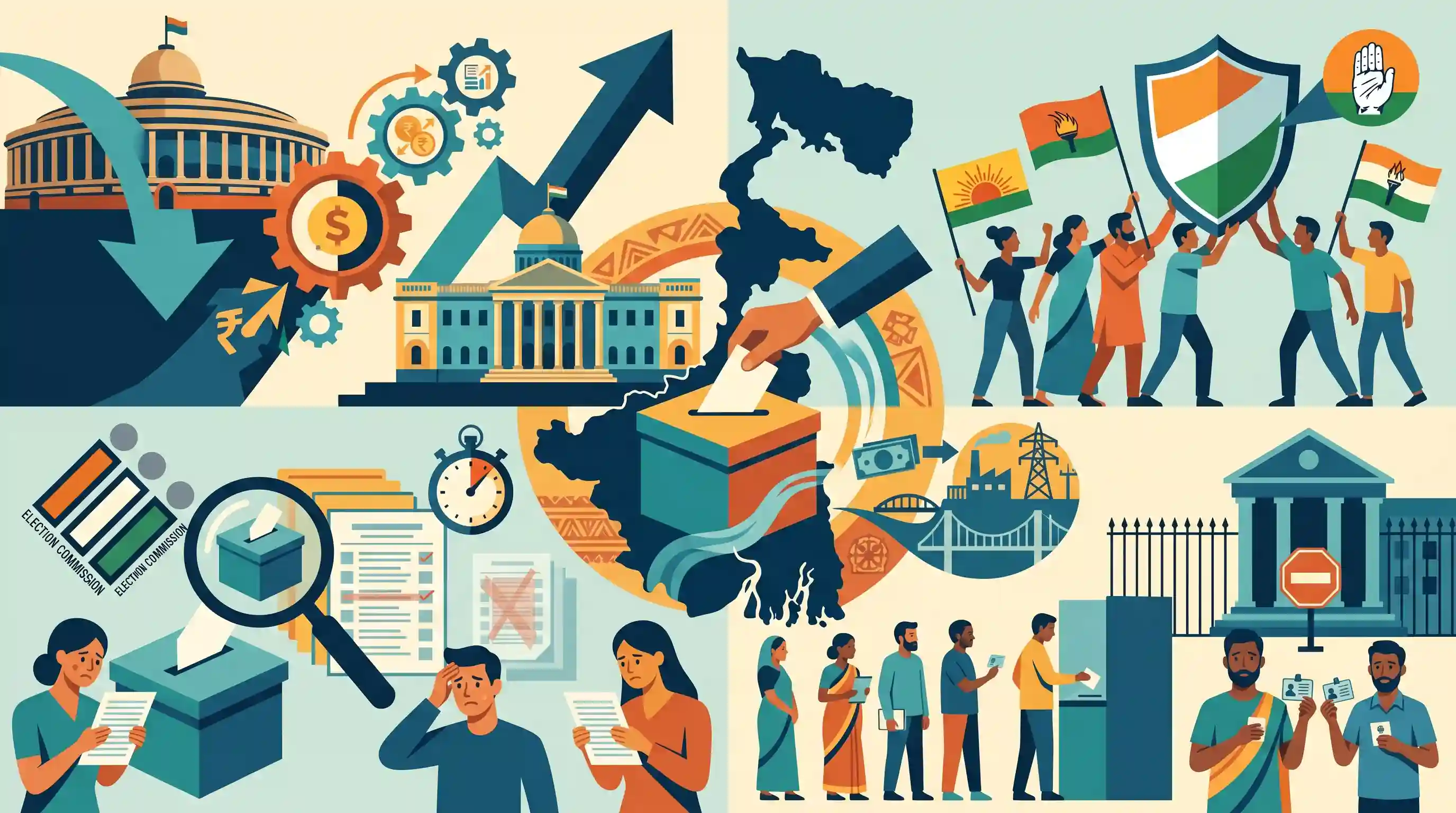
The article analyzes the political and constitutional implications of the West Bengal 2026 assembly elections, highlighting the clash between the centralising tendencies of the national ruling party and the federal assertions of regional parties. It discusses the anxieties surrounding the Special Intensive Revision (SIR) of electoral rolls and potential disenfranchisement tied to citizenship tribunals. Additionally, it explores the broader impact of the election outcome on the national opposition's INDIA bloc and underscores the pressing need for the next state government to move beyond cash-transfer populism to address structural issues like unemployment, infrastructure decay, and Centre-State financial disputes.
Key Points
- The 2026 West Bengal elections are framed as a pivotal battle for India's federal polity, testing the centralising impulse of the national ruling party against regional forces advocating for federal nationhood.
- The election process saw massive mobilisation of central forces and controversies over the Special Intensive Revision (SIR) of electoral rolls, sparking fears of disenfranchisement linked to citizenship tribunals.
- A victory for the TMC could solidify regional parties as the primary opposition to the BJP, potentially challenging the Congress's leadership within the INDIA bloc.
- A BJP win would consolidate a unitary state model but might raise anxieties over citizenship issues given the party's rhetoric on removing infiltrators.
- Regardless of the victor, the state urgently needs to address severe socio-economic challenges, including a lack of jobs, infrastructure decay, and a financial crisis exacerbated by frequent run-ins with the Centre.
- The article notes that cash transfer schemes, while transformative, may yield diminishing returns if core issues like employment and education are not addressed.
Important Terms
Special Intensive Revision (SIR)

A comprehensive house-to-house verification drive by the Election Commission to overhaul electoral rolls. It eliminates errors and duplicates using historical benchmarks to ensure the "purity" of voter lists before major elections.
UPSC context
GS II (Electoral Processes). Tests knowledge of the Representation of the People Act, 1950 and voter list management.
Election Commission (EC)
An independent constitutional body under Article 324 responsible for the superintendence, direction, and control of elections to Parliament, State Legislatures, and the offices of President and Vice-President.
UPSC context
GS II (Constitutional Bodies). Core for understanding institutional mechanisms that safeguard democratic integrity and fair voting.
INDIA bloc
The Indian National Developmental Inclusive Alliance; a coalition of opposition parties formed to challenge the ruling government. It focuses on collective bargaining, federalism, and protecting democratic institutions.
UPSC context
GS II (Coalition Politics). Relevant for studying the role of regional parties and opposition dynamics in a parliamentary democracy.
Trinamool Congress (TMC)
A prominent regional party in West Bengal that champions state autonomy and federalism. It currently leads the state government and plays a key role in national opposition alliances.
UPSC context
GS II (Regional Parties). Tests the impact of state-level parties on federal dynamics and Centre-State relations.
Bharatiya Janata Party (BJP)
A major national party leading the central government. Its governance is often analyzed in the context of centralization, national integration, and its impact on the federal structure.
UPSC context
GS II (Political Dynamics). Key for analyzing shifts in India’s party system and centralizing administrative trends.
Left Front
A coalition of communist and socialist parties (led by CPIM) that historically dominated West Bengal politics. It remains a significant ideological factor in regional electoral contests.
UPSC context
GS II (Political Parties). Important for understanding ideological diversity and the evolution of state politics in India.
Prelims Trap
"Electoral rolls and Special Intensive Revisions are governed by the Representation of the People Act, 1951."
Preparation and revision of electoral rolls are exclusively governed by the RPA 1950. The RPA 1951 deals with the actual conduct of elections and post-election disputes.
Static Concepts Connected
What are the key provisions of RPA 1950 regarding electoral rolls?
- Seat Allocation: Determines the allocation of seats and the delimitation of constituencies for Parliament and State Legislatures.
- Electoral Rolls: Mandates the preparation, regular update, and Special Intensive Revision (SIR) of voter lists.
- Voter Qualifications: Lays down the foundational qualifications for voters, including the condition of ordinary residency.
How do Centre-State fiscal dynamics impact state-level borrowing and welfare spending?
- Article 293 Limits: States cannot raise loans without the Centre's consent if any part of a previous central loan remains outstanding.
- Off-budget borrowing: States often bypass fiscal limits to fund welfare, prompting the Centre to deduct these from borrowing ceilings.
- Fiscal Crowding Out: The RBI consistently warns that over-reliance on non-merit subsidies crowds out critical state capital expenditure.
Cross-Topic Patterns
Welfare populism vs. State borrowing limits
Heavy reliance on direct cash-transfer schemes stretches state fiscal deficits, triggering Central intervention under Article 293(3) and sparking federalism debates over net borrowing ceilings.
Electoral roll revision & Universal Suffrage
Anxieties over Special Intensive Revision (SIR) tie into broader constitutional debates around Article 326 (adult suffrage) and the shifting burden of proof in citizenship determination.

The ECI's powers for Special Intensive Revision under RPA 1950 and constitutional limits on disenfranchisement will be tested in Prelims.
Linked PYQs · 3
Linked PYQs · 3
- 2022MainsGS2
“While the national political parties in India favour centralisation, the regional parties are in favour of State autonomy.” Comment.
- 2024MainsGS2
What changes has the Union Government recently introduced in the domain of Centre-State relations ? Suggest measures to be adopted to build the trust between the Centre and the States and for strengthening federalism.
- 2025MainsGS2
Examine the evolving pattern of Centre-State financial relations in the context of planned development in India. How far have the recent reforms impacted the fiscal federalism in India?
