WB Panchayat Bill bureaucratizes local financial powers
Source:etvbharat ↗
Why It Matters
This issue highlights the tension between elected local representatives and bureaucracy, raising questions about the true devolution of financial and administrative powers to Panchayati Raj Institutions under the 73rd Constitutional Amendment Act, and the extent of State Legislature control over local government subjects.
Summary
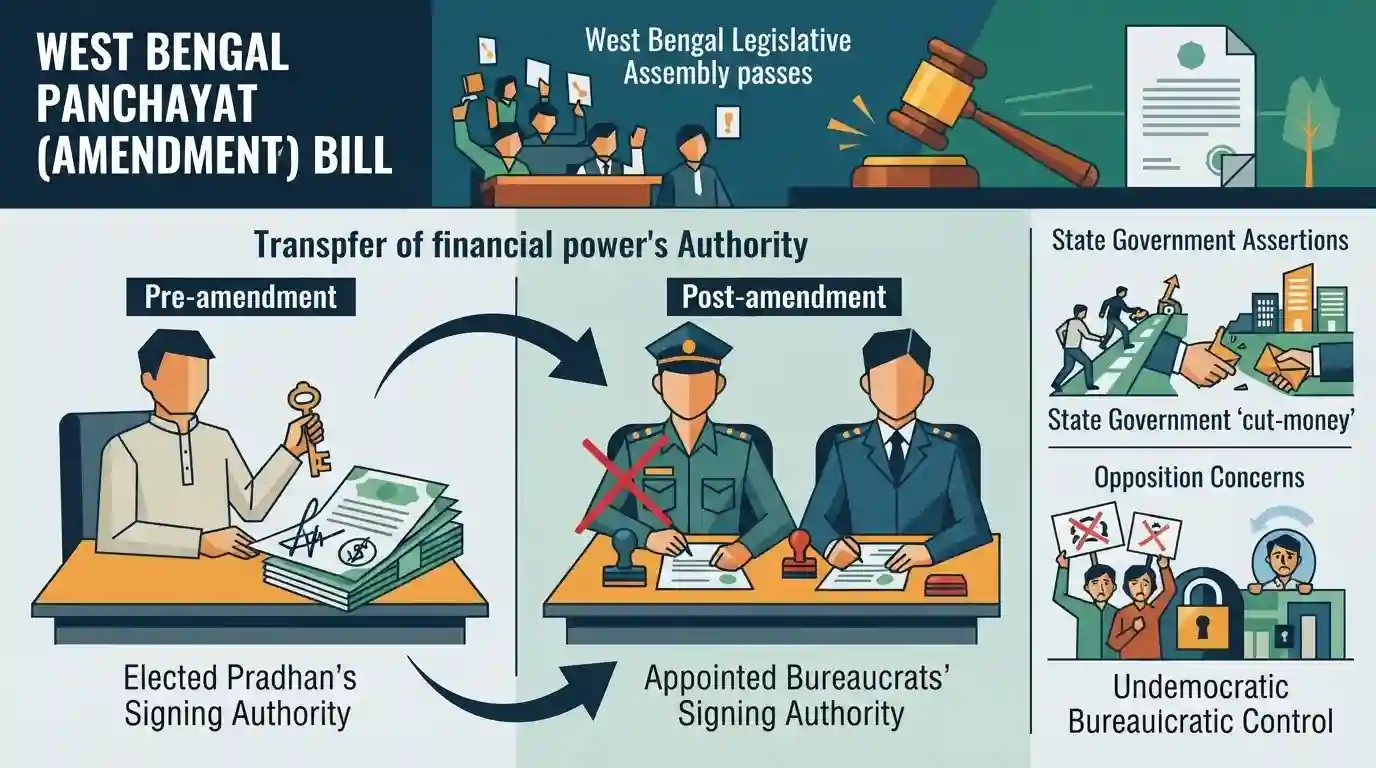
The West Bengal Legislative Assembly has passed the West Bengal Panchayat (Amendment) Bill, introducing a significant shift in the balance of power at the village level. The amendment transfers the financial signing authority from elected village pradhans to appointed bureaucrats, specifically the panchayat secretary and assistant secretary. While the state government asserts this is a temporary administrative measure to prevent development work from stalling and to eliminate the 'cut-money' corruption culture, the opposition has condemned the move as an undemocratic attempt to strip elected local representatives of their powers and increase bureaucratic control over Panchayati Raj Institutions.
Key Points
- The West Bengal Legislative Assembly passed the West Bengal Panchayat (Amendment) Bill, temporarily altering financial powers at the grassroots level.
- The exclusive authority to sign financial documents, previously held by village pradhans, is now transferred to the panchayat secretary and assistant secretary (bureaucrats).
- The government justified the move to ensure uninterrupted development work, such as 100-day work schemes and road building, even if the pradhan is absent or uncooperative.
- State Panchayat Minister Dilip Ghosh stated the amendment aims to curb the 'cut-money' (illegal commissions) culture where pradhans refuse to sign off on projects without bribes.
- The opposition criticized the bill as undemocratic, alleging it curtails the powers of elected representatives in favor of the bureaucracy.
Important Terms
West Bengal Panchayat (Amendment) Bill

A 2026 legislative measure in West Bengal transferring the authority to sign financial documents from elected village pradhans to appointed administrative officers, specifically the panchayat secretary and assistant secretary.
UPSC context
GS Paper 2 (State Legislature; Local Governance). Tests understanding of the balance between democratic decentralisation and bureaucratic oversight in Panchayati Raj.
Gram Panchayat
The lowest tier of India's Panchayati Raj system, operating at the village level. It is an executive body elected to implement development programs and manage local administration.
UPSC context
GS Paper 2 (Panchayati Raj Institutions). Core to questions on the 73rd Amendment and grassroots democratic decentralisation.
Panchayat Samiti
The intermediate block-level tier of India's Panchayati Raj system. It acts as a crucial administrative link coordinating welfare schemes between village-level Gram Panchayats and district-level Zilla Parishads.
UPSC context
GS Paper 2 (Local Self-Government). Tests knowledge of rural development frameworks, intermediate administrative structures, and devolution of powers.
Zilla Parishad
The apex administrative body of the three-tier Panchayati Raj system, functioning at the district level. It oversees development planning, scheme coordination, and links local bodies with the state government.
UPSC context
GS Paper 2 (Local Governance). Crucial for understanding district-level planning and the implementation of state and central welfare schemes.
MGNREGA
A rural labor law and social security measure providing at least 100 days of guaranteed wage employment in a financial year to rural households volunteering for unskilled manual work.
UPSC context
GS Paper 2 (Welfare Schemes). Frequently tested regarding poverty alleviation, employment generation, and the critical execution role played by PRIs.
Prelims Trap
"The 73rd Constitutional Amendment mandates the devolution of financial powers to Panchayats."
The devolution of administrative and financial powers (Articles 243G and 243H) are voluntary provisions, left entirely to the discretion of State Legislatures, not mandatory.
Static Concepts Connected
What are the voluntary provisions of 73rd CAA on financial devolution?
- State discretion: State Legislatures may legally endow Panchayats with the powers necessary to function as institutions of self-government (Article 243G).
- Taxation powers: States may authorize Panchayats to levy, collect, and appropriate taxes, duties, and tolls (Article 243H).
Which committee warned against the bureaucratization of Panchayati Raj Institutions?
- G.V.K. Rao Committee: Appointed in 1985 to review administrative arrangements for rural development and poverty alleviation programs.
- Grass without roots: Concluded that excessive bureaucratization alienated PRIs from the people, famously calling the system 'grass without roots.'
- District focus: Recommended that the Zila Parishad should be the principal body for managing all development programs at the district level.
Cross-Topic Patterns
Democratic Decentralization vs Bureaucratic Control
This rural tension mirrors urban governance debates (e.g., elected Mayors vs. appointed Municipal Commissioners), highlighting a broader systemic reluctance to genuinely devolve power across India.
Probity in Governance vs Subsidiarity
States often cite local corruption to centralize power, creating a GS4 dilemma: balancing financial integrity (preventing 'cut-money') against the democratic principle of subsidiarity.

Expect a 2026 Prelims statement testing if Article 243G/243H financial devolution to PRIs is a mandatory or voluntary Constitutional feature.
Linked PYQs · 4
Linked PYQs · 4
- 2022WBCS_PRELIMSGS1
Which of the following constitutional amendments gives a constitutional status to the Panchayati Raj institutions?
- 2014WBCS_PRELIMSGS1
Panchayat system in India was introduced by the
- 2018WBCS_PRELIMSGS1
Which Amendment of the constitution provided constitutional status to the Panchayats?
- 2011WBCS_PRELIMSGS1
The Parliament has power to legislate with respect to a matter in the State List provided it is in the
