West Bengal industrial policy framework and ease of doing business
Source:indianmasterminds ↗
Why It Matters
State-level industrial policies directly influence regional economic growth, employment generation, and investment inflows. For WBCS Prelims and Mains, understanding the structural shifts, focus areas (like MSMEs and GCCs), and nodal agencies involved in West Bengal's economic governance is highly relevant.
Summary
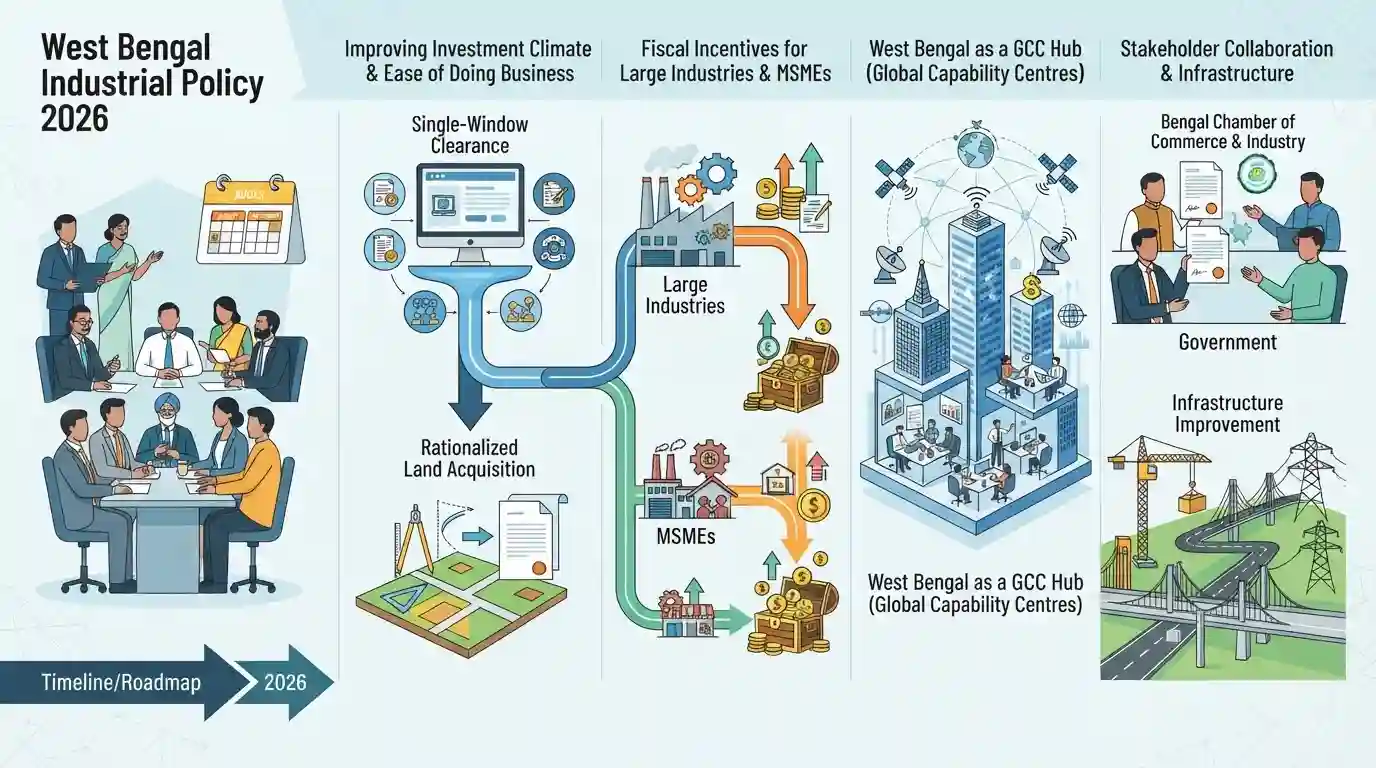
The West Bengal government is preparing to launch a comprehensive Industrial Policy 2026 around August or September. Focusing on improving the state's investment climate, the policy will introduce measures for ease of doing business, single-window clearances, and rationalized land acquisition. The framework is designed to provide fiscal incentives for both large industries and MSMEs, while simultaneously positioning West Bengal as a hub for Global Capability Centres (GCCs). Stakeholders, including the Bengal Chamber of Commerce & Industry (BCC&I), have actively submitted recommendations focusing on regulatory clarity and infrastructure improvement to foster industrial growth.
Key Points
- The West Bengal government is formulating a new, comprehensive Industrial Policy expected to be announced in August-September 2026.
- The policy aims to enhance 'Ease of Doing Business' by streamlining processes, introducing a robust single-window clearance system, and providing clarity on land availability.
- It will balance fiscal incentives and support for both large-scale industries and MSMEs (Micro, Small and Medium Enterprises).
- The state is targeting to become a prominent destination for Global Capability Centres (GCCs) and improving its logistics and transport infrastructure.
- The Bengal Chamber of Commerce & Industry (BCC&I) has submitted recommendations on taxation, regulatory easing, and sectoral incentives to help shape the policy.
Important Terms
West Bengal Industrial Policy 2026

A comprehensive framework drafted by the West Bengal government to revive manufacturing, streamline regulatory approvals, provide fiscal incentives, and reform land acquisition to attract heavy industries and MSMEs.
UPSC context
GS Paper III: Industrial growth and land reforms. Tests state-level economic policies, ease of doing business, and investment-led development models.
Global Capability Centres (GCCs)
Offshore facilities established and owned by multinational corporations to perform strategic, high-value operations like IT, research and development (R&D), engineering, and financial analytics.
UPSC context
GS Paper III: Services Sector. Tests knowledge of foreign investments, service exports, employment generation, and digital innovation.
Bengal Chamber of Commerce & Industry (BCC&I)
Founded in 1853, it is one of India's oldest business associations, acting as an influential representative of regional commerce, lobbying for industrial development and economic infrastructure.
UPSC context
GS Paper III: Industrial Growth. Tests the historical role of trade organizations in shaping corporate policy, investment, and infrastructure.
Micro, Small, and Medium Enterprises (MSMEs)
Enterprises categorized by investment and turnover limits that form the backbone of Indian manufacturing, contributing significantly to GDP, employment generation, and regional development.
UPSC context
GS Paper III: MSME Sector. Tests strategies for inclusive growth, rural industrialization, and domestic manufacturing resilience.
Single-Window Clearance System
A streamlined regulatory facility enabling businesses to obtain all required municipal, environmental, and industrial permits through a single digital platform to minimize bureaucratic delays.
UPSC context
GS Paper III: Ease of Doing Business. Tests administrative reforms, regulatory simplification, and investor facilitation strategies.
Prelims Trap
The Business Reforms Action Plan (BRAP) ranking, which evaluates states on Ease of Doing Business, is compiled and published annually by NITI Aayog.
The BRAP ranking is formulated and released by the Department for Promotion of Industry and Internal Trade (DPIIT), Ministry of Commerce and Industry, not NITI Aayog.
Static Concepts Connected
What is the Business Reforms Action Plan (BRAP) and how does it evaluate states?
- Nodal Authority: Spearheaded by the Department for Promotion of Industry and Internal Trade (DPIIT) under the Ministry of Commerce and Industry.
- Reform Areas: Evaluates states across multiple action areas including single-window clearances, labor regulations, land administration, and taxation.
- Grading System: Categorizes states into groups like 'Top Achievers' and 'Achievers' to promote competitive federalism, avoiding absolute numerical ranks.
What are Global Capability Centres (GCCs) and how do they differ from BPOs?
- In-house Model: GCCs are captive centers owned and operated directly by MNCs to handle core internal strategic operations.
- High-value Focus: They focus on advanced functions like R&D, artificial intelligence, and product engineering, rather than low-end IT maintenance.
- BPO Distinction: Unlike third-party BPOs, GCCs do not serve external clients; they work exclusively for their parent multinational entities.
Cross-Topic Patterns
Competitive Federalism via Sub-National Policies
State-level industrial policies and BRAP assessments drive healthy competition among states to reform land acquisition, labor laws, and digital clearances.
MSME Gender Demographics & Credit Delivery
West Bengal's high concentration of women-led MSMEs highlights the need to link state-level industrial subsidies with central credit schemes like Mudra.

DPIIT’s Business Reforms Action Plan (BRAP) metrics and the rise of Global Capability Centres (GCCs) are highly probable prelims areas for 2026.
Linked PYQs · 1
Linked PYQs · 1
- 2022WBCS_PRELIMSGS1
West Bengal Industrial Development Corporation Ltd. (WBIDC) was established in
