West Bengal Proposes Private Medical College Rural Health Partnership
Source:theprint ↗
Why It Matters
This development reflects a major governance initiative in public health, proposing a mutually beneficial model for private education and public administration. For WBCS aspirants, understanding West Bengal's healthcare hierarchy (BPHCs, medical colleges) and state-specific policy shifts is essential for questions on governance, public schemes, and rural development.
Summary
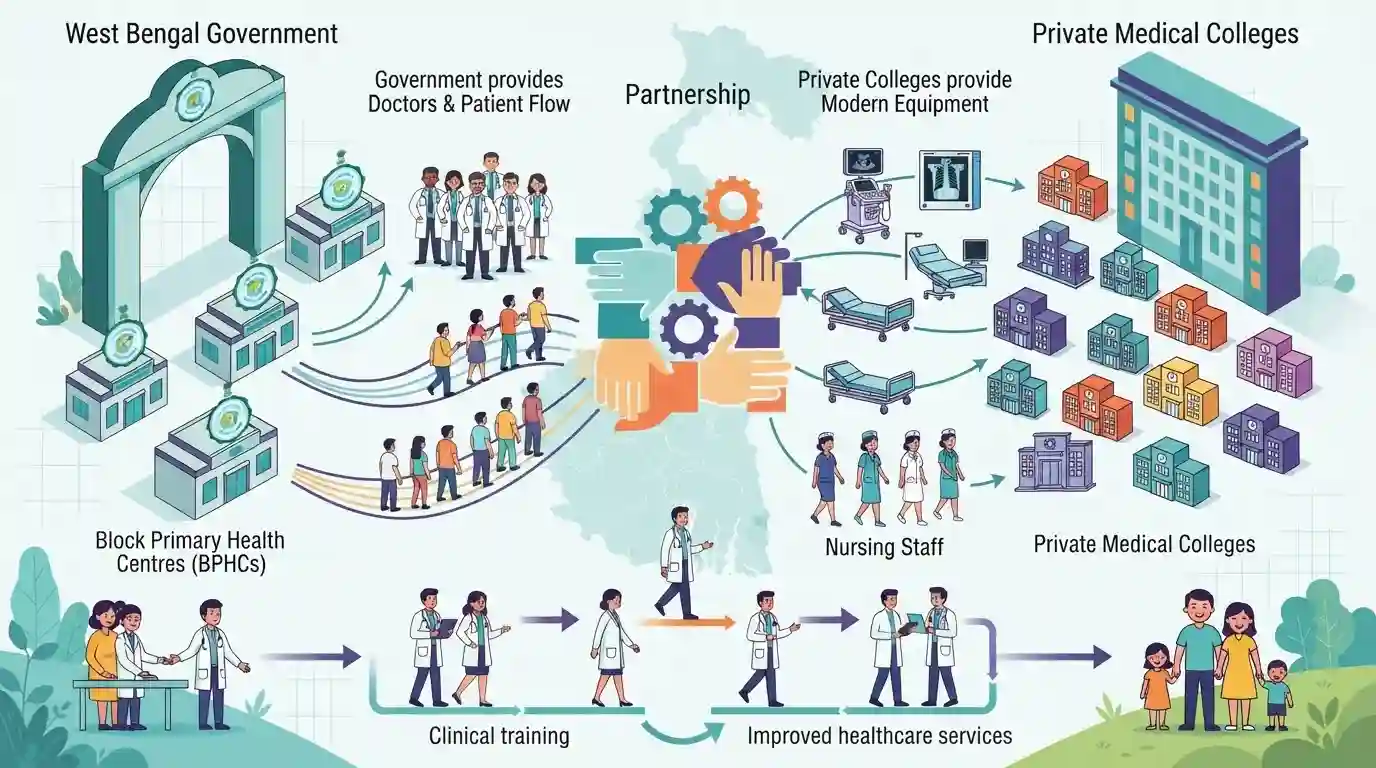
The West Bengal government is planning a strategic operational partnership where the state's 17 private medical colleges would mentor around 10 government-run Block Primary Health Centres (BPHCs) each. The partnership aims to boost rural healthcare infrastructure by allowing private colleges to provide modern equipment and nursing staff, while the government provides doctors and patient flow, ensuring sufficient clinical exposure for medical students and improved grassroots healthcare services.
Key Points
- The West Bengal government is exploring a novel public-private partnership (PPP) model to link private medical colleges with state-run Block Primary Health Centres (BPHCs) to bolster rural healthcare.
- Under the preliminary proposal, each of the state's 17 operational private medical colleges could mentor approximately 10 BPHCs.
- Private medical colleges would supply equipment (such as ultrasonography machines and semi-auto analysers) and trained nursing personnel, while the government would supply doctors, staff, and direct patient flow.
- The model aims to solve two major issues: improving clinical exposure for private medical students (as clinical learning depends on active patient interaction) and addressing the infrastructure and manpower deficit in grassroots healthcare.
- BPHCs typically operate with around 20 beds and cater to 30 or more patients.
- In addition to this proposal, West Bengal is working towards establishing six new government medical colleges, an AIIMS-like institution in North Bengal, and a dedicated trauma centre in South Bengal.
Important Terms
Swasthya Sathi Scheme

Launched in 2016 by the West Bengal government, it is a flagship cashless health insurance scheme providing universal coverage of up to ₹5 lakh per family annually for secondary and tertiary healthcare.
UPSC context
WBCS GS Paper-IV (Government Schemes). Tests knowledge of state-level social security and public health initiatives.
Block Primary Health Centre (BPHC)
A critical block-level public health facility in West Bengal's rural health system, usually holding about 20 beds, offering primary treatment and serving as the first referral point.
UPSC context
WBCS GS Paper-IV (Social Sector & Health). Tests understanding of rural public healthcare architecture and decentralization.
West Bengal Health Department
The state department responsible for maintaining and developing healthcare systems, promoting public health, and managing medical education and administration throughout West Bengal.
UPSC context
WBCS GS Paper-V (Polity & Governance). Tests knowledge of state executive organs and public welfare administration machinery.
Forum for Business, Social and Cultural Initiatives (FBSC)
A Kolkata-based business networking and social forum that fosters collaboration among industries, professionals, and the government to promote regional development and economic growth.
UPSC context
WBCS GS Paper-IV (Economy). Tests awareness of regional industrial forums and corporate-government engagement.
Prelims Trap
Private medical colleges will assume administrative control and recruit doctors for the mentored Block Primary Health Centres (BPHCs).
The government retains administrative control and continues to provide doctors; private colleges only supply equipment and nursing staff to gain clinical exposure.
Static Concepts Connected
What is the structure of the primary healthcare delivery system in rural West Bengal?
- Sub-Centres (SCs): The lowest tier serving 3,000–5,000 population, currently being upgraded to Su-Swasthya Kendras.
- Primary Health Centres (PHCs): The referral unit for 6 Sub-Centres, managing basic preventive, promotive, and curative services.
- BPHCs / Rural Hospitals: Block-level 20-bed hospitals (synonymous with CHCs) headed administratively by the Block Medical Officer of Health (BMOH).
What are the primary PPP models used in India's social infrastructure?
- Service/Outsourcing Model: Private partners provide specific operational services like diagnostics or laundry for a fixed fee.
- Management Contract: Private partners operate and manage state-owned facilities without major capital investment.
- Co-location Model: Private niche facilities (like dialysis units) are set up within the physical premises of government hospitals.
Cross-Topic Patterns
State Health Autonomy vs Central Schemes
Contrasting West Bengal's reliance on Swasthya Sathi over PM-JAY highlights fiscal federalism and state-specific healthcare innovations in social sector planning.
Medical Education vs Rural Brain-Drain
Linking the lack of clinical exposure in private medical colleges with understaffed rural BPHCs addresses both medical education quality and the rural healthcare deficit.

Expect questions on West Bengal's rural health hierarchy (BMOH role) and the structural divisions of state-led healthcare PPPs.
Linked PYQs · 2
Linked PYQs · 2
- 2021WBCS_PRELIMSGS1
How many new Government Medical Colleges have become functional in West Bengal during the last ten years?
- 2021WBCS_PRELIMSGS1
What proportion of the Insurance Premium payable for Swasthya-Sathi Scheme is borne by the State Government?
