Sundarbans mangrove encroachment eviction and ecosystem revival
Source:The Hindu ↗
Why It Matters
Important for understanding regional environmental policies, climate change mitigation, and biodiversity preservation in the fragile delta ecosystem of West Bengal, making it highly relevant for WBCS Prelims.
Summary
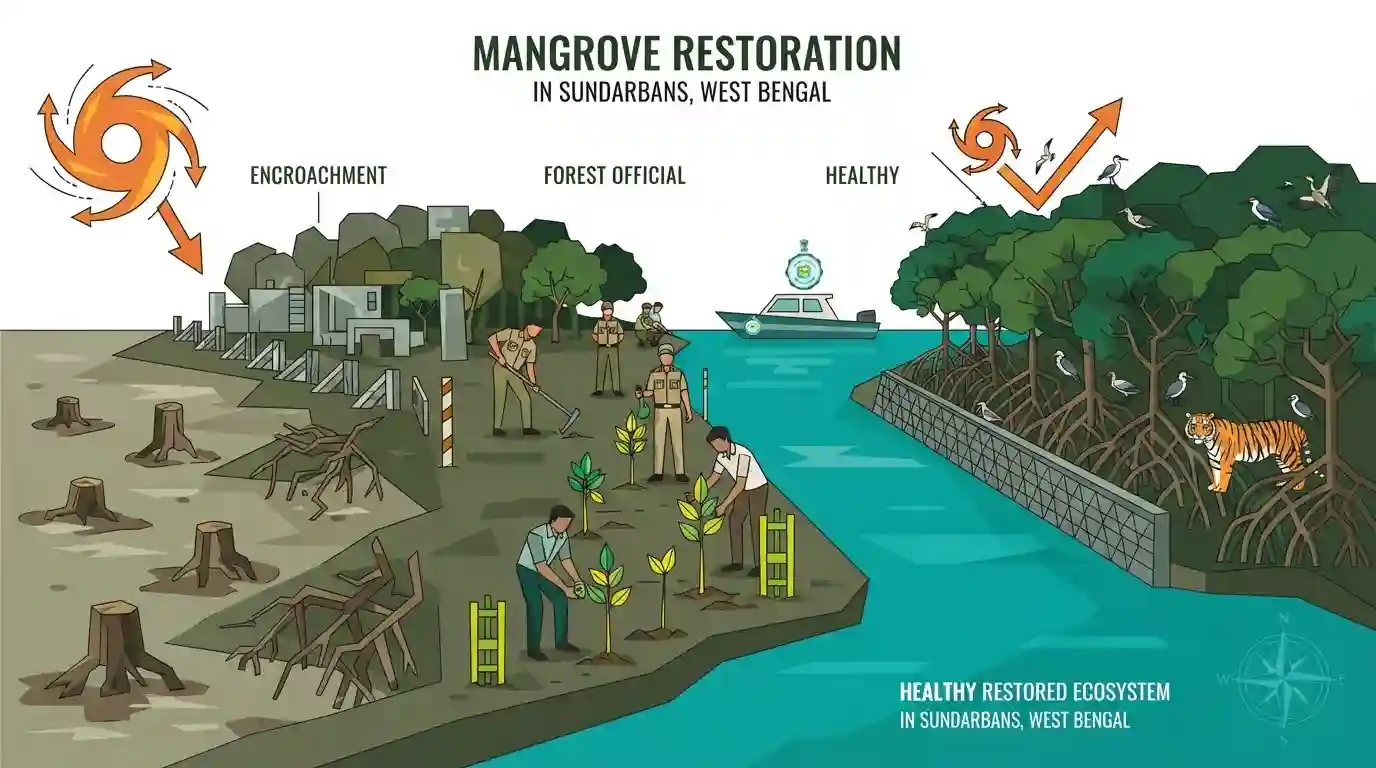
The West Bengal government announced a major initiative to restore mangrove forests in the Sundarbans region that have been degraded or lost due to illegal encroachments. Emphasizing the ecological significance of mangroves as a natural barrier against cyclones, state authorities are planning systematic anti-encroachment drives and large-scale afforestation programs.
Key Points
- The West Bengal government has pledged to restore mangrove forests in the Sundarbans that have been lost due to illegal encroachments.
- State Minister for Sundarbans Affairs Bankim Chandra Hazra highlighted the critical need to protect coastal ecosystems from climate vulnerability and cyclones.
- Mangroves serve as a natural bio-shield against severe cyclonic storms and erosion in the fragile deltaic region.
- Efforts will target clearing illegal structures and reclaiming land for massive mangrove afforestation drives.
Important Terms
Sundarbans

The world's largest contiguous deltaic mangrove forest, located across India and Bangladesh. It acts as a vital natural green shield against severe cyclonic storms and tidal surges.
UPSC context
WBCS Paper V (Geography & Environment of West Bengal) — tests knowledge of deltaic ecology, climate vulnerabilities, and coastal bio-shields.
Mangroves
Salt-tolerant evergreen halophytic trees and shrubs that grow in coastal intertidal zones, protecting shorelines from erosion and acting as carbon sinks.
UPSC context
WBCS Paper III & V (Environment, Biodiversity & West Bengal Geography) — tests ecosystem restoration and climate resilience.
Department of Sundarban Affairs
A specialized administrative department of the Government of West Bengal exclusively tasked with the socio-economic development and infrastructure planning of the backward Sundarban delta region.
UPSC context
WBCS Paper I & V (West Bengal Administration & Polity) — tests institutional mechanisms and governance bodies specific to the state.
Static Concepts Connected
What are the key geographical and ecological features of the Sundarbans Biosphere Reserve in West Bengal?
- Global Status: World's largest contiguous mangrove forest spanning India and Bangladesh, with the Indian portion designated a UNESCO World Heritage Site.
- Ecological Role: Acts as a natural bio-shield against severe cyclonic storms, storm surges, and coastal erosion along the Bay of Bengal.
- Biodiversity: Home to the endangered Royal Bengal Tiger and unique estuarine ecosystems adapted to tidal inundation and saline water.
Cross-Topic Patterns
Mangrove Restoration and WB Administrative Geography
The Sundarbans delta illustrates the intersection of climate resilience (mangrove bio-shields), human displacement, and administrative governance under the Sundarban Affairs Department.

Sundarbans ecology, UNESCO status, and blue carbon role frequently appear in WB Civil Service geography and environment multiple-choice questions.
Linked PYQs · 3
Linked PYQs · 3
- 2024WBCS_PRELIMSGS1
On a per hectare basis which of the following forests will hold maximum amount of carbon?
- 2019WBCS_PRELIMSGS1
Sundarban is declared as 'World Heritage Site' for
- 2021WBCS_PRELIMSGS1
The boundary line of Sundarban was demarcated by
