Sundarbans delta environmental security and afforestation policy
Source:The Hindu ↗
Why It Matters
Important for West Bengal civil services aspirants tracking state-specific environmental policies, coastal conservation efforts, and the ecological management of the Sundarbans.
Summary
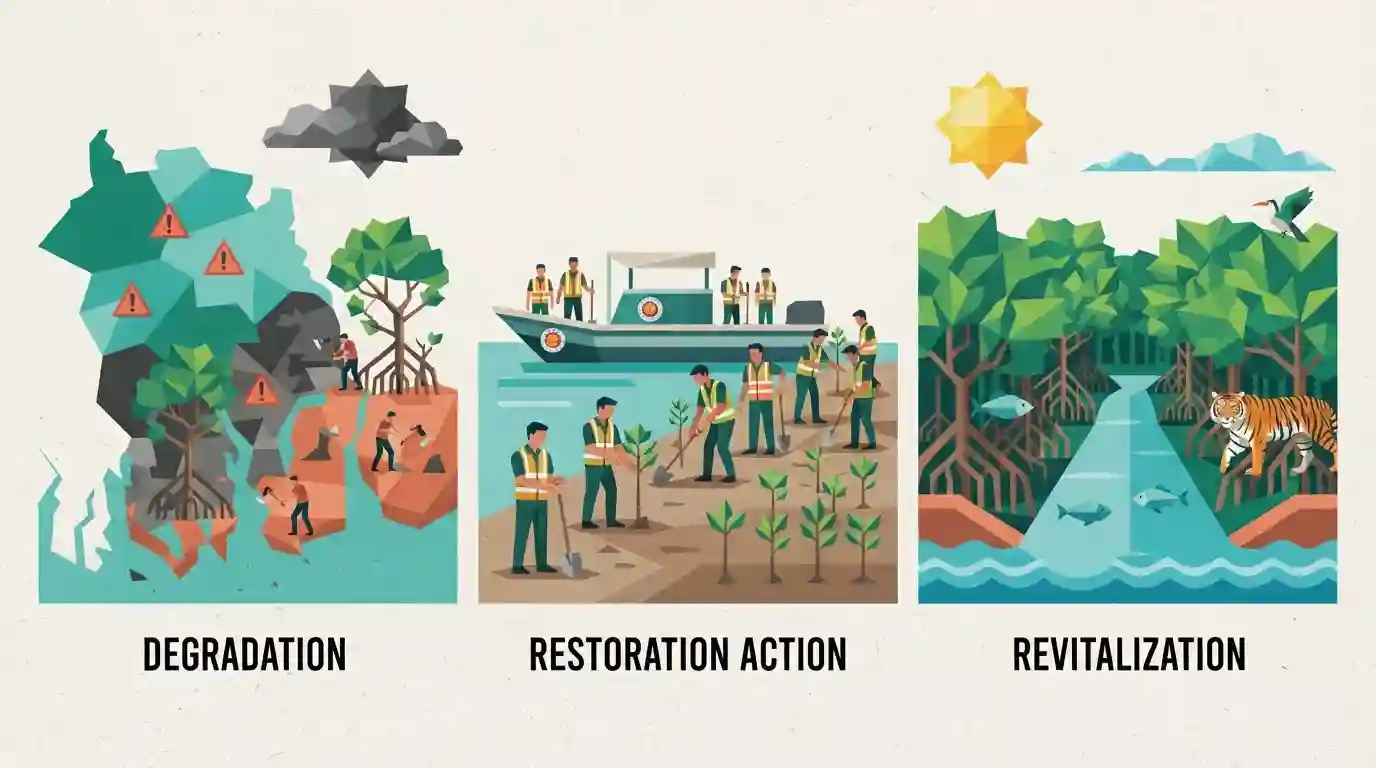
The West Bengal government has pledged to restore mangrove forests in the Sundarbans that have been lost due to illegal encroachments, highlighting the ecological vulnerability and environmental significance of the delta region.
Key Points
- A West Bengal Minister has announced initiatives to restore mangroves lost to encroachments in the Sundarbans.
- The Sundarbans region is ecologically sensitive, facing severe threats from coastal erosion, climate change, and human encroachment.
- Mangroves play a crucial role as a natural barrier against tropical cyclones and storm surges in the deltaic region.
Important Terms
Sundarbans

The dense, halophytic tidal forests situated in the delta of the Ganges, Brahmaputra, and Meghna rivers, renowned as the largest mangrove ecosystem in the world and a critical biosphere reserve.
UPSC context
WBCS Paper III (Environment & Geography) — tests knowledge of West Bengal's biosphere reserves, delta ecology, coastal vulnerability, and biodiversity conservation.
Bheries
Shallow, earthen enclosures or fish ponds constructed illegally within deltaic forest zones by clearing interior mangrove trees, primarily for commercial pisciculture and shrimp farming.
UPSC context
WBCS Environment & Geography — tests understanding of anthropogenic pressures, wetland conversion, and illegal encroachment on protected mangrove land in West Bengal.
Mangrove Forests
Salt-tolerant evergreen trees and shrubs that grow in shallow coastal intertidal zones, acting as natural bio-shields against cyclones, coastal erosion, and storm surges.
UPSC context
WBCS Paper III (Environment & Ecology) — fundamental for questions on coastal ecosystem services, disaster mitigation, and climate change adaptation in West Bengal.
Static Concepts Connected
What are the key geographical and ecological features of the Sundarbans mangrove forest?
- Global Status: Largest deltaic mangrove forest in the world, spread across India and Bangladesh, recognized as a UNESCO World Heritage Site.
- National Share: West Bengal holds about 42.45% of India's total mangrove cover, making it the highest contributor nationally.
- Ecological Role: Acts as a natural bio-shield against tropical cyclones, storm surges, and coastal erosion in the northern Bay of Bengal.
Cross-Topic Patterns
Mangroves + Disaster Management + Species Conservation
Sundarbans mangrove degradation directly impacts coastal communities, intensifying climate-induced displacement and threatening the habitat of the endangered Royal Bengal Tiger.

Expect assertion-reason on Sundarbans mangrove percentage and role as bio-shields against cyclones in WB civil services prelims.
Linked PYQs · 2
Linked PYQs · 2
- 2019WBCS_PRELIMSGS1
Sundarban is declared as 'World Heritage Site' for
- 2012WBCS_PRELIMSGS1
'Sundarban' has been sited as a world heritage site due to its :
